
Quant QNT and The Clearing House: What the Bank Deal Means
The Clearing House picked Quant to link tokenized deposits between US banks. What was announced, which bank networks involve Quant, and what is unclear for QNT.
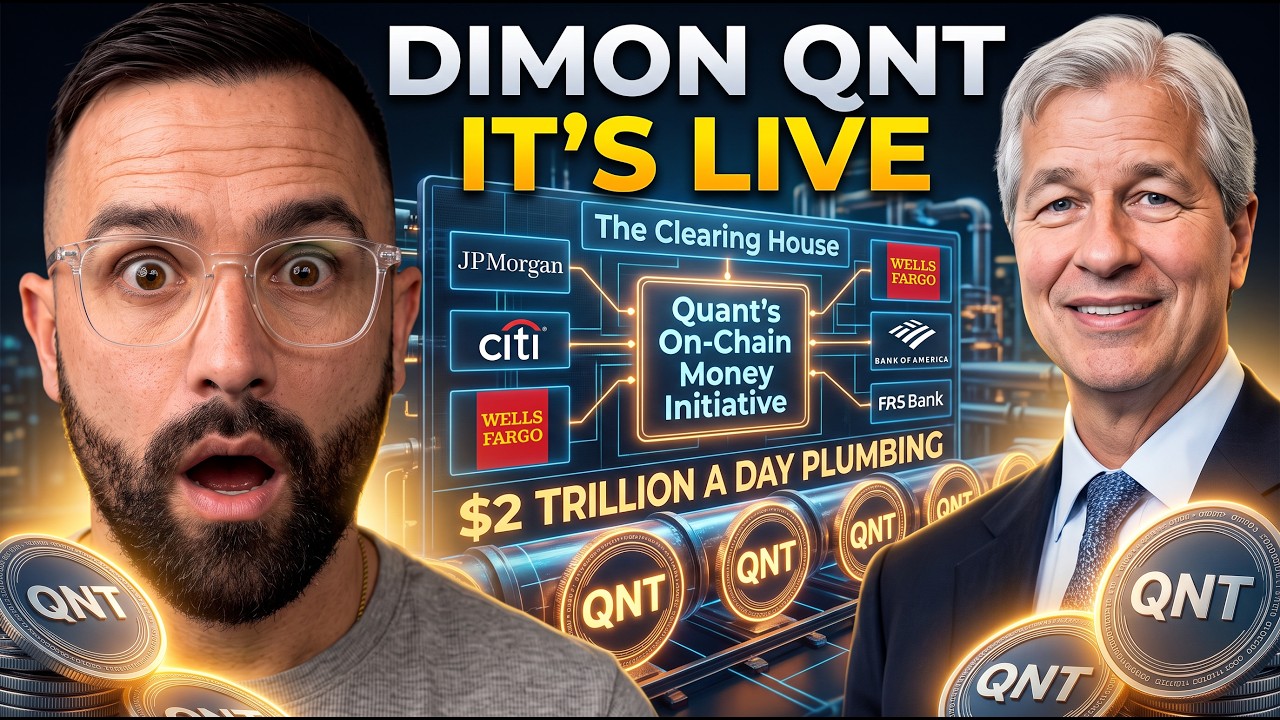
Key takeaways
- The Clearing House, owned by 25 of the largest US banks, picked Quant on September 24, 2026 to provide the interoperability layer for its on-chain money initiative.
- The Clearing House network won't be available to participating banks until the first half of 2027, so nothing is live in the US yet.
- The video describes four tokenized deposit networks as Quant's, but Quant's own paper ties only the UK and US efforts to Quant. Germany's pilot and Canada's plan are not linked to Quant in public sources.
- Bank use of Quant's software is not the same as bank demand for the QNT token, and the video does not explain how one leads to the other.
- QNT rose from about $71 to $287 between September 24 and 28, according to market reports. The video's view that the token is still undervalued is speculation, not a forecast.
The Clearing House, the private payments company owned by 25 of the largest US banks, picked Quant Network on September 24, 2026 to provide the interoperability layer for its on-chain money initiative. The network would let banks clear and settle tokenized deposits with each other. It is not expected to open to banks until the first half of 2027.
For anyone holding Quant’s QNT token, the video presents this as the moment banks standardized on Quant’s technology across four continents. The record is narrower than that, and the open question for holders is not whether banks use Quant’s software. It is whether that use reaches the token.
What did The Clearing House announce?
The Clearing House announced its on-chain money initiative in June. In September, following a competitive process, it chose Quant to supply the technology that lets tokenized deposits move between banks. Quant described its role as providing “the interoperability layer that lets tokenized deposits move freely within the regulated banking system.” It said this builds on its work “in the UK, Europe and beyond.”
The Clearing House is a core part of US bank plumbing. It runs CHIPS, a large-value payments system, and RTP, the real-time payments network. The video says CHIPS alone clears more than $2 trillion a day, but The Clearing House gives that figure for its systems as a whole. The video also says The Clearing House processes over 630,000 transactions on a normal business day.
Banks reported as owners include Bank of America, BNY, Citi, Fifth Third, HSBC, JPMorgan, PNC, US Bank and Wells Fargo. The video also names KeyBank and TD Bank.
What are tokenized deposits and why do banks need a middle layer?
A tokenized deposit is ordinary money held at a regulated bank, represented as a token on a blockchain. The video points to JPMorgan’s JPM Coin as an existing example and says other large banks are building their own. Bullrunners has covered one of those efforts in Wells Fargo’s tokenized deposit plans.
The hard part is moving money between banks. Sal Karakaplan, The Clearing House’s chief strategy officer, explained in a clip shown in the video that banks want to use their tokens for interbank payments. They also want “an entity in the middle” to clear and settle those transactions. If a JPMorgan customer pays a Wells Fargo customer, the two banks’ tokens still need to settle with each other.
According to the video, Quant’s pitch is to connect different bank blockchains to each other and to existing fiat payment systems. In a clip the video places at the Sibos conference, The Clearing House’s president and CEO, David Watson, said banks founded the organization about 170 years ago to exchange paper checks. He said they are now asking it to do the same for tokenized deposits and the underlying fiat money.
Who is behind Quant Network?
Quant Network is a London-based company founded by Gilbert Verdian. The video says it was founded in 2015. Verdian has more than 20 years of experience in cybersecurity. His Quant biography says he worked at HM Treasury and HSBC and held senior security and technology roles. It also says he established the initiative behind ISO TC 307, the International Organization for Standardization’s technical committee for blockchain and distributed ledger technology.
In an older interview played in the video, Verdian described the goal as a layer that sits on top of blockchains. That layer would let blockchains connect to each other and to existing systems without anyone changing what they already run. He compared it to how internet routing works.
Is Quant behind all four bank networks?
No, not on the public record. The video presents four national tokenized deposit efforts as Quant networks and cites Quant’s paper “Above the Ledger.” That paper says four such networks are being built, but it links only two of them to Quant: the UK network, which Quant built, and the US network, which selected Quant.
| Country | Banks | Quant’s role | Stage |
|---|---|---|---|
| United Kingdom | Barclays, HSBC, Lloyds, Monzo, Nationwide, NatWest, Santander | Built the shared platform | Completed live customer transactions with tokenized sterling deposits |
| Germany (CBMT) | Commerzbank, Deutsche Bank, DZ Bank and UniCredit, per reporting; the video also names Helaba and BNP Paribas | Not named; reported tech providers are G+D, GFT and UDPN | In pilot, with pre-production trials |
| Canada | BMO, CIBC, National Bank of Canada, RBC, Scotiabank, TD | Not named in public sources | Banks said on September 22, 2026 that they are jointly exploring a Canadian dollar tokenized deposit solution |
| United States | Members of The Clearing House | Selected in September 2026 | Not available until the first half of 2027 |
The video calls the UK trial the world’s first live customer transaction using tokenized deposits. Industry reporting describes it as a UK first. The video also says German corporates including Siemens, Mercedes-Benz, Bosch and BASF are already executing live transfers. Siemens has been reported as taking part in the German effort, but Quant’s paper describes that effort as still in pilot.
The video also links the deal to four papers it says were released within roughly two weeks of each other. They are Quant’s “Above the Ledger,” a joint Quant and Murex paper on tokenized settlement, a Capgemini paper with Quant on agentic AI for banks, and a tokenization analysis the video attributes to Citi. The captions are unclear on that last source. The video calls the timing “coordinated positioning.” That is the host’s interpretation, not something the institutions said.
What happened at Sibos 2026?
Quant ran two demos at Sibos 2026, the annual banking conference hosted by Swift at the Miami Beach Convention Center from September 28 to October 1.
- Murex repo demo. Quant and Murex ran a live repo settlement demo on the conference’s Discover Stage. Murex’s MX.3 platform is used for trading and settlement at many banks. According to the video, the trade was a US dollar repo against a tokenized US Treasury, with tokenized deposits as the cash. The video says the teams deliberately stopped the trade midway to show the system can handle a failure without leaving a half-finished settlement.
- Capgemini AI demo. Quant and Capgemini showed Capgemini’s AI agents working with tokenized deposits to handle corporate treasury liquidity shortfalls. The video calls it an “agentic treasury control tower.”
The video also played a clip of Wells Fargo’s global head of payments, who said the bank is expanding from instant payments into blockchain and tokenization.
What does this mean for the QNT token?
QNT rose from about $71 on September 24 to $287 by September 28, according to market reports. The video says this took the token to levels not seen in roughly four years. It argues the token is still undervalued relative to the bank activity. That is the video’s speculation, and Bullrunners makes no price prediction.
The video also cites bank research. It names analysts forecasting more than $5 trillion in tokenized assets by 2030, and JPMorgan research identifying up to $120 billion in value from fixing cross-border payments. Bullrunners has not confirmed these figures. They are estimates about the whole market, not about Quant or QNT. For background on that wider market, see how real-world asset tokenization works.
What the video does not explain is the link between bank use and token demand. Banks paying Quant for software and banks needing to hold or spend QNT are two different things. Bullrunners has looked at that gap in whether banks need the QNT coin after the Clearing House deal.
What to watch next
The US network has not opened yet, so the useful checks are on documents, not price charts.
- The Clearing House launch timeline. Watch for confirmation that the network opens to banks in the first half of 2027, or for any delay.
- Which banks actually join. Owning part of The Clearing House is not the same as issuing and settling tokenized deposits on the new network.
- The token’s role. Look for anything from Quant that says whether banks on these networks pay fees in QNT, hold it, or never touch it.
- Germany and Canada. Check whether either project names Quant as a provider. Today, public sources do not.
- Read the papers yourself. The video leans on four white papers. Checking what they say about Quant specifically, rather than about tokenization in general, is the best test of the “one rail” claim.
Frequently asked questions
What did The Clearing House announce with Quant?
The Clearing House picked Quant Network on September 24, 2026, after a competitive process, to provide the interoperability layer for its on-chain money initiative. The goal is to let banks clear and settle tokenized deposits with each other inside the regulated banking system.
When will The Clearing House's tokenized deposit network go live?
The Clearing House has said the network won't be available to participating institutions until the first half of 2027.
What is a tokenized deposit?
A tokenized deposit is ordinary bank money represented on a blockchain and issued by a regulated bank. The video gives JPMorgan's JPM Coin as an example and says other large banks are building their own versions.
Is Quant behind the UK, German and Canadian bank networks?
Quant built the platform used in the UK trials, and The Clearing House selected Quant in the US. Public reporting does not link Quant to Germany's pilot or Canada's planned project, even though the video presents all four as Quant networks.
Does the Clearing House deal mean banks will buy QNT?
The video does not show that. It describes banks using Quant's technology, but it does not explain whether or how that use requires the QNT token.
Full video transcript
From the video's captions, lightly formatted. Captions can mishear names and numbers, so check figures against the article above.
Jamie Dimon just quietly handed the two trillion dollar a day plumbing of the entire US banking system over to one small British company most Americans have never even heard of. And guys, the company is Quant Network and the ticker is QNT. On September 24th, the Clearing House, which is the private payments network that Dimon's JP Morgan, Society, Wells Fargo, and Bank of America all sit on the board of, officially picked Quant to run their new on-chain money initiative. And that's the same rail moving over two trillion dollars a day between the 25 biggest banks in the country. But here's where it gets absolutely wild because in the same two-week window, four separate institutional white papers dropped from Quant, Murex, Capgemini, and Society.
And every single one of them points to the exact same infrastructure powering tokenized deposits across four continents at once. And then Cboe itself put the whole thing on live TV from the Miami Beach Convention Center. Just watch how the anchor framed what these banks are actually building.
A major initiative's underway in the US that's modernizing money movements by connecting on-chain activity with traditional payment rails and enabling clearing and settlement of tokenized commercial bank money at scale.
It will enable participating banks' corporate and commercial clients to move, program, and settle funds 24/7, 365 days a year without leaving the regulated, insured banking system.
Now come on, guys. These banks are literally on Cboe TV announcing their end game. And the company they picked to actually build it is a British firm most Americans probably have never heard of. And here's the part that changes everything for your bag. The token sitting underneath the rail these banks just standardized on is trading at a valuation that hasn't even begun to reflect what a two trillion a day banking route is actually worth.
And by the end of this video, you're going to see exactly why this is the biggest institutional handover of the decade and why QNT sits inside the four continent rollout happening right now. So, if you're feeling bullish, like this video, and if you're going to become the first millionaire in your family tree, confirm it right now by subscribing to the channel and commenting 777 down below. But, let's jump straight into it.
[music]
All right, Bull Runners, welcome back to the channel. So, let me lay this out for you piece by piece because when you see the timeline all in one place, you literally cannot make this up. We start with the company. Quant Network is a London-based company that was founded in 2015 by a guy named Gilbert Verdian. And Verdian isn't some crypto influencer who showed up during the last bull cycle.
This guy spent over 20 years in cybersecurity at the highest levels of government and enterprises, including CISO and HSBC and CTO at the UK Treasury. And most importantly, he's the guy who founded ISO Technical Committee 307, which is the international standards body for blockchain. Basically, the group that writes the global rules for how blockchains talk to each other. So, this is not some retail project. This is a guy who sat inside the machine for two decades, then walked out and built the exact interoperability layer that some machines now wants to use.
Now, listen to how he described the original vision from an interview he gave years ago before any of this was in the headlines.
So, so we wanted to create um the the layer and the abstraction that sat on top of blockchain, which didn't make anyone change anything. It just carried on as is, but it provided that overlay on top and and it gave you uh the way to do interoperability. Really similar to the way the internet does routing and and TCP/IP. So we So we took a lot of the learning from our experience working with, you know, the internet from the early days and applied that to blockchain technology to provide a very open, flexible way for people to to connect blockchains, but also have all the blockchains connect to existing systems.
That interview is from years before any of this hit the headlines, and he was already describing exactly the invisible plumbing every major bank in the world is now scrambling to build. And back then, everybody honestly thought it was too easy. But fast forward to right now, and the entire industry is racing to tokenize their deposits, and they all need the exact rail Verdian sketched almost a decade ago. But here's where the timeline gets absolutely insane, because in that same two-week window, four separate white papers landed from four different institutions, and every single one of them points at Quant. Paper one is Quant's own above the ledger, which maps the four live tokenized deposit networks already running around the world.
Paper two is a joint paper from Quant and Murex on how tokenized scales inside existing settlement workflows. Paper three is from Capgemini, the 200,000 employee consulting giant, partnering with Quant on Aigenic AI for banks. And paper four is from Citi, which released its own tokenization analysis pointing at exactly this shift. So that's four papers, four institutions, one rail, and two weeks between all of them. And behind those papers is the real receipt, because Quant isn't just writing about this stuff, they're running it live on four networks right now.
Network one is the United Kingdom, where seven of the biggest banks in Britain, Barclays, HSBC, Lloyds, Monzo, Nationwide, NatWest, and Santander completed the world's first live customer transaction using tokenized sterling deposits on a shared platform built by Quant. So, you have real customers, real money moving between actual banks on Quant's rails. Network two is Germany, called the CBMT initiative. Commerzbank, DC Bank, Helaba, UniCredit, and BNP Paribas, the biggest bank in the entire Eurozone, are all running it with corporates like Siemens, Mercedes-Benz, Bosch, and BASF already executing live transfers. Network three is Canada, where just before the UK and US news dropped, Canada's six largest banks, CIBC, National Bank of Canada, RBC, Scotiabank, and TD jointly announced they're building a Canadian dollar tokenized deposit solution.
Now, that's the entire Canadian banking backbone on one rail. And network four is where it gets truly insane because network four is the United States, and it just landed on Quant's plate. So, here's what actually happened on that Wednesday in September. The Clearing House is not a small company. It's the private clearing and settlement engine that sits at the heart of the American banking system, owned by 25 of the largest banks in the country.
It runs CHIPS, the network that clears more than two trillion dollars every single day. Plus, RTP, the real-time payments network, and it processes over 630,000 transactions on just a normal business day. So, when they announced the on-chain money initiative back in June, they were basically saying, "We're moving the two trillion dollar a day plumbing of America banking onto a blockchain." And the question every institution had was, "Who's chain? Who's rail?" Well, just watch this. Big news, Quant has partnered with The Clearing House to bring on-chain programmable money to the United States.
We will provide the interoperability layer that lets tokenized deposits move freely within the regulated banking system. This builds on our work in the UK, Europe, and beyond.
Now, you can't make this up. The Clearing House ran a competitive process, evaluated every major provider on the planet, and picked one company. And that one company is Quant. And the list of banks that will move money through Quant's rows includes Bank of America, BNY Mellon, Societe, Fifth Third, HSBC, JP Morgan, KeyBank, PNC, TD Bank, US Bank, Wells Fargo, you name it, they're on the list. And these are not fringe institutions.
This is the actual American banking system. Now, just listen to how Saule Karacaplan, the Chief Strategy Officer of The Clearing House, laid it out on the record.
The The Clearing House is proposing to stand up a clearing and settlement of tokenized deposits from each bank. So, we are assuming, I know from the market demand, that the banks are planning to stand up their own tokenized deposits. And what we're hearing is, even though there are many use cases for them intra-bank, they also want to have interbank transactions. And they would like, you know, an entity in the middle to be able to clear and settle those tokenized deposit transactions.
Just think about the mechanics for a second. JP Morgan already issues a tokenized deposit. They call it JPM Coin. Wells Fargo, Societe, and Bank of America are each building their own version. And when a customer at JP Morgan wants to pay a customer at Wells Fargo, that transaction has to clear and settle between banks.
And that is the actual plumbing. And Quant is the layer that makes that plumbing work between chains, between banks, and between the tokenized world and the fiat rails moving trillions. And here's where it all ties together. Sibos is the biggest annual banking conference on Earth, hosted by Swift and Sibos 2026. It's run at the Miami Beach Convention Center from September 28th through to the October 1st.
And on the discovery stage, Quant ran a live demo with Murex, whose MX.3 platform is used for trading and settlement at hundreds of banks globally. The demo was a US dollar repo transaction against a tokenized US Treasury. We have tokenized deposits used for the cash leg. And then mid execution, they deliberately killed it. Just to prove the system handles failure without breaking.
Because for banks, a half-executed settlement is honestly the absolute worst case in payments. And right next door, Quant partnered with Capgemini to demo something they called the Agentiq Treasury Control Tower, which uses Capgemini's AI agents on top of Quant's tokenized deposits to solve corporate treasury liquidity shortfalls in real time. Agentiq AI plus tokenized bank money running live for banking executives from every continent on the floor. And Wells Fargo was there, too. And listen to what their global head of payments said about why this moment is happening right now.
So, we're we're basically starting to expand or continuing to expand the capabilities our clients have to send money around the world. And so, we started with, you know, years ago instant payments and sort of that journey. Now we're leveraging blockchain tokenization.
So, that's the global head of payments at one of the four biggest banks in America confirming on live TV that this transition is already underway in production flows. And then listen to how Dave Watson, the CEO of The Clearing House, framed the whole thing from the Sibos stage.
It's a great question cuz industry collaboration is key. I mean, Wells Fargo and many of the other banks who founded us 170 years ago did it to create a safe place to exchange checks and and bits of paper. In essence, 170 years later, they're asking us to do the same thing again. Actually create a safe place to be able to exchange both tokenized deposits, but also the underlying fiat currency as needed.
Just think about what he's actually saying. The institution that was literally created to make paper checks between banks work in the 1850s is now being asked by those exact same banks to make tokenized digital money between banks work in 2027. And the technology partner they picked to make that happen is just one small British company that most of the crypto world has barely heard of. So, let me just pull back for a second and show you what's really going on here. Because when you zoom out, this isn't incremental upgrade.
This is a total plumbing swap for the entire global financial system. Bank of America and Societe analysts have called this shift over $5 trillion in tokenized assets by 2030. And JP Morgan own research identified up to $120 billion in unlockable value just from fixing cross-border payments alone. And every one of those numbers requires an interoperability layer between the chains the banks are building and the fiat rails that they already run. And that is Quant.
And that's the whole thesis. Now, here's what CNBC reported earlier about how the biggest banks were thinking about this shift.
Digital first in economy that we're moving towards is really important. As our clients embark on this digital journey, being able to move money 24/7, 365, in a programmable fashion with always on is what we really want to enable our clients.
Now, come on. Every one of those capabilities needs a rail underneath it. And the rail every major American bank is now building towards is the one Quant has been shipping since 2015. Now, here's what this actually means for your portfolio. Because the market noticed when the news hit, QNT ripped from double-digit territory into triple-digit territory inside a single week.
And the chart printed levels it hasn't seen in roughly 4 years. And look, it's not because retail suddenly discovered it, it's because institutional capital started repricing what this rail is actually worth once you can see the four networks lined up next to each other. But here's what most people are honestly missing. The clearinghouse itself said the network won't be available to participating institutions until the first half of 2027. So we're nowhere near the peak of this adoption yet.
We're actually at the moment right before the switch flips. And this is the setup window, guys. And retail almost always misses it because it looks quiet from the outside. So there's a pattern that plays out every single cycle. One big institution picks the rail, then two or three more pick the same rail because they don't want to be left out.
Then trade publications catch on, then mainstream press. And by the time your uncle at Thanksgiving asks about it, retail has already been dumped on. And right in the middle of that pattern is a quiet window where the receipts are undeniable, but the price hasn't fully caught up yet. And that's exactly where we are with Quant right now. And honestly, I'm not the only one saying this.
Bank of America, SocGen, JP Morgan, Capgemini, and Murex are all pointing at the same rail with white papers, joint demos, and integration announcements. And when five institutions of that size publish converging analysis in a two-week window, that's not a coincidence. That's coordinated positioning. The infrastructure is being built in plain sight, and the people who actually read those white papers before they hit mainstream Twitter are the ones who get positioned before everyone else does. Now look, you've been watching the global financial plumbing get rebuilt in front of your own eyes, and most people in your life still think crypto is a scam.
The entire monetary system is getting swapped under the hood, and if you don't understand what's being built right now and what rails it runs on, you're going to wake up on the other side of this reset holding the wrong bag. Now I get it. I have been there myself. Watching the same institutions that spent a decade calling this stuff worthless, now building out their own replacement for the dollar system. And realizing you have a very short window to position before the switch actually flips.
So, let me show you what happens when somebody stops watching from the sidelines and actually walks through the door before it closes on them. One of our members named Herschel Bentley walked into our world and instead of chasing whatever coin Twitter was screaming about that week, he actually listened when we started laying out the infrastructure thesis on layer one networks. Specifically, he built into SUI at around 75 cents. And then he did the thing most people never do. He added on the dip.
He bought again and he averaged in at dollar 45. He sat through the chop while everybody on his timeline was flipping to the next shiny thing. And when the market finally caught up to the infrastructure story, his position was already sitting at $4.33. And that's a 98% unrealized move on his average entry. On a layer one infrastructure play using the exact same mechanism we're breaking down right now on Quant.
He positioned early into the infrastructure thesis and he let the market come to him. Now, I have to be real with you about why I keep pushing this point. Because years ago, I turned about 20 grand into over $150,000 and then I watched it bleed all the way back to zero. Because I didn't understand what I'm showing you right now. I was the guy holding through the announcement instead of positioning before it.
So, when I say it's about being positioned before the switch flips, not chasing a pump after it, that's the mistake I already made once. Now, results aren't typical, so don't be typical, but inside the accelerator right now, you've got operators from the fintech world, retired bankers, family office portfolio managers, retail investors trying to do this right the first time, you name it. And what we're actually building with this is the framework to become your own bank, positioned on the exact same rails the institutions are moving on to right now. So, the private intelligence network link in the description takes you to a 15-minute call with our team, where we'll walk you through your portfolio and tell you whether the accelerator is the right move for you. Now, most of the investors we work with are ready to deploy at least $50,000 or more in crypto.
So, if that's you and you want to stop being the last one to hear about the biggest institutional handover of the decade, click the link and book the call. Now, crypto carries risk and past performance doesn't guarantee future results. This is education, not financial advice. So, click the link, book the call, and I will see you at the top. As always, you know what to do.
Stay bullish.
[music]
Education and commentary only, not financial advice. Crypto is volatile and you can lose money. Do your own research and speak to a qualified advisor before making investment decisions. Figures and quotes are as reported in the video on October 23, 2026 and may have changed since.


