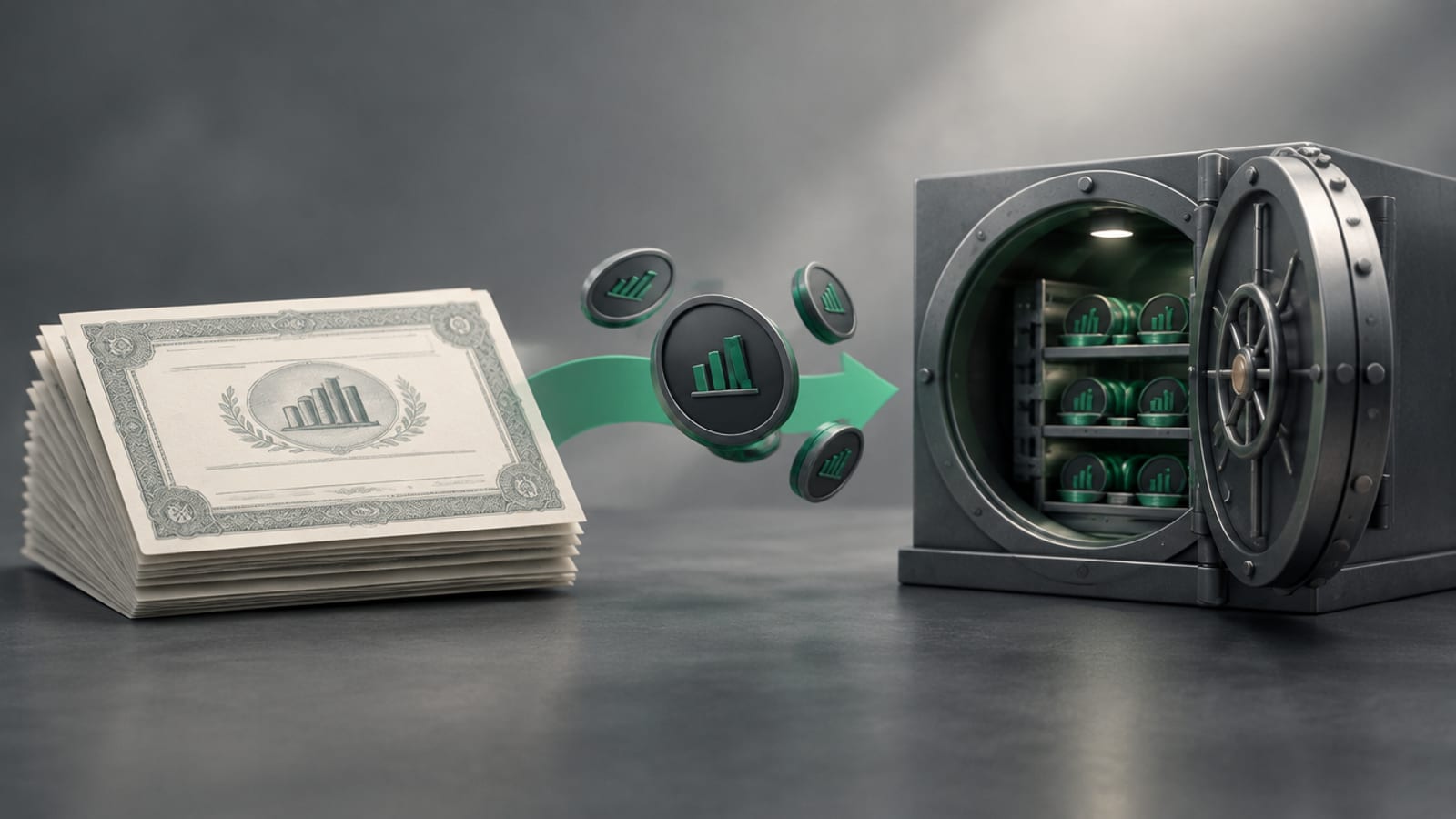
XRP and Ice-Nine: Jim Rickards' Warning and Grayscale's Pause Line
Jim Rickards' Ice-Nine warning, the SEC's money market fund gates, and the suspension language in Grayscale's XRP fund filings, explained for XRP holders.
Key takeaways
- Jim Rickards' 'Ice-Nine' idea is that in a crisis, institutions pause withdrawals rather than pay everyone out, and he says the rules for this are published, not secret.
- The SEC added withdrawal gates to money market funds in 2014 and removed them in 2023. Institutional prime and tax-exempt funds now must charge a fee on days when net withdrawals pass 5% of assets.
- According to the video, Grayscale's XRP fund filings say its redemption program could be suspended. The filing confirms custodian Anchorage Digital may pause services during a ledger hard fork.
- XRP on the XRP Ledger itself cannot be frozen. Pause rights sit with the exchanges, funds and custodians that hold XRP for customers.
- The video suggests searching your exchange's user agreement for the word 'suspend' to see whether it appears near withdrawals.
Jim Rickards’ “Ice-Nine” warning says that in a severe crisis, financial institutions will stop handing people their money back. A Bullrunners video traces that idea through real rules. It starts with the SEC’s 2014 money market fund gates and ends with a line in Grayscale’s XRP fund filings that, according to the video, says redemptions could be suspended.
For XRP holders, the point isn’t whether a global freeze is coming. Pause buttons are written into the agreements of the companies that hold coins for people, and most holders have never read them. The video argues that knowing whose rules your XRP sits under matters more than any forecast.
What is Jim Rickards’ Ice-Nine warning?
Jim Rickards’ Ice-Nine warning is his claim that authorities will “lock down the system” in the next big panic. The video plays a clip recorded around the release of his 2016 book The Road to Ruin. In it, Rickards lists what he expects:
- banks closed and accounts frozen
- money market funds suspending redemptions
- stock exchanges closed
- ATMs limited to perhaps $300 a day, or nothing at all
The name comes from Kurt Vonnegut’s novel Cat’s Cradle. In it, a single crystal of an unusual ice touches water and freezes everything: rivers, oceans, all of it. Rickards’ point is that you can’t freeze just one part of the system. Lock up the funds and people run to the banks, so the banks get shut, and the freeze spreads.
Rickards also says this isn’t the work of a secret meeting. He calls the plans “transparently non-transparent”: published, but buried “20 layers deep” on “the IMF website or the Fed website.” The video takes that literally. Its argument is that the risk lives in small print most people never open.
What happened to money market funds in 2008?
On September 16, 2008, the day after Lehman Brothers collapsed, the Reserve Primary Fund told investors each share was worth 97 cents. People had treated those shares as cash, worth $1 each. According to a clip in the video, that set off a two-day, $200 billion run on money market funds starting September 17, 2008.
The video focuses on the investors who didn’t get out. On September 22, 2008, the SEC signed an order allowing the fund to stop paying out. The last large payout didn’t arrive until January 2010. Investors eventually got back more than 98 cents per share, but some of that money was out of reach for roughly 16 months.
The video also goes back to 1933, when every bank in America closed two days after a new president took office. The “bank holiday” began on March 6, 1933, and lasted about a week. When banks reopened from March 13, people deposited more than they withdrew. For that week, though, no one could touch their money.
What are money market fund gates?
A gate is a rule that lets a fund block withdrawals for a set period. In July 2014, the SEC adopted rules letting a money market fund’s board put up a gate if the fund ran short of cash it could sell quickly. Technically, that meant weekly liquid assets falling below 30%. A gate could lock withdrawals for up to 10 business days in any 90-day period.
The video’s criticism is that a gate only traps the people who didn’t leave fast enough. The gate rules were in place when markets came under stress in March 2020. On March 15, 2020, Fed Chair Jerome Powell told reporters, “We’ve built a very resilient financial system.” On March 18, the Fed announced an emergency program to help money market funds pay out investors who wanted to leave.
The Government Accountability Office (GAO), Congress’s auditors, later found that institutional funds lost about 30% of their assets in two weeks. It also found that some investors may have pulled out early to get ahead of possible fees or gates. Gary Gensler, then the SEC’s chair, later explained that behavior with a saying: in the woods, you don’t have to outrun the bear, just one of your fellow campers.
In July 2023, the SEC voted to remove gates from money market funds. According to the video, the SEC said the change was designed to reduce the risk of investor runs. The SEC also changed the fee rules:
- Institutional prime and institutional tax-exempt funds must now charge a liquidity fee on any day when net withdrawals exceed 5% of the fund’s assets.
- The fee is sized to the estimated cost of selling assets to meet those withdrawals. A 1% fee applies only if the fund can’t estimate those costs.
- Government money market funds don’t have to charge it.
The video’s view is that the idea didn’t disappear. It just moved.
Rickards connects the rule to a story of his own. In a clip about a dinner with someone from BlackRock, he says the government wants the power to order BlackRock not to sell in a panic. He names “the SEC rules on money market funds suspending redemptions” among the tools already in place.
What did Grayscale’s XRP fund filing say?
Grayscale made two operational changes to its Grayscale XRP Trust ETF (GXRP) around the start of October 2026. The filings include a prospectus supplement dated October 5, 2026, posted on the SEC’s website. The changes were:
- Anchorage Digital can now hold some of the fund’s XRP. Coinbase remains the main custodian.
- Two large trading firms, Macquarie Capital (USA) and Virtu Americas, can now move XRP directly in and out of the fund.
The video calls this good news for XRP, since it adds more Wall Street infrastructure around the coin. The video then reads out a line it says appears further down the filing. In effect, the line says there is no guarantee the trust’s redemption program won’t be suspended. Bullrunners could not confirm that exact wording in the filing, so it is reported here as the video’s reading.
The filing also covers a hard fork, where the ledger splits into two versions. In that case, the video says, the trust may suspend creations and redemptions, and both custodians can pause withdrawals too. The filing does say Anchorage may temporarily suspend services during a fork. The video counts this as several separate pause points on one XRP fund: the fund’s own, plus one for each company holding the coins. Grayscale’s filing says it has not determined how much of the fund’s XRP will move to Anchorage.
For more on how these funds hold coins, see Bullrunners’ explainer on XRP ETF custody and insurance.
Can XRP itself be frozen?
No. XRP on the XRP Ledger cannot be frozen, and the ledger’s documentation says so. Any pause button sits with whatever company is holding the XRP for you. Bullrunners covered this distinction in why XRP can’t be frozen but stablecoins can.
Rickards makes a parallel point about gold funds. When things get worse and people want physical gold, he says, an authorized dealer can convert ETF shares into metal, but a retail investor cannot. The video applies the same logic to XRP funds. Shareholders own shares, a custodian holds the coins, and only a few large trading firms can swap shares for actual XRP.
Exchanges hold coins for customers in a similar way. The video points to FTX, which halted crypto withdrawals on November 8, 2022, leaving customers’ coins stuck. Bullrunners’ guide to what happens when an exchange freezes your account explains the usual process. The video also notes that coins in your own wallet still have to be reported and taxed like anywhere else.
Why does the video say waiting to move coins may not work?
The video argues that a plan to leave coins on an exchange and move them the moment trouble appears may not work. Its reasoning draws on 2008 and 2020. In the host’s view, by the time you see trouble, so does everyone else, and that is the moment a pause button is designed for. The host says March 2020 showed the threat of fees made people run sooner. The GAO was more cautious, saying only that the rules may have contributed to the runs.
The one-word search and three decisions
The video offers a simple check:
- Open the app or exchange where your XRP sits.
- Find the user agreement or terms of service.
- Search for the word “suspend.”
- If it appears anywhere near withdrawals, that is the company’s written right to pause them.
The host then sets out three questions he says this history raises for anyone holding a large amount of XRP:
| Decision | The video’s question |
|---|---|
| Custody | Is the XRP behind the holder’s own keys or a company’s pause button? |
| Yield | If it’s earning while the holder waits, is it inside someone else’s product with its own lock? |
| Timing | If the holder plans to move it, will that happen before a withdrawal banner appears or after? |
The video’s point is that if these questions aren’t settled in advance, they get settled for you on the day. For a wider look at custody, see Bullrunners’ piece on who owns your XRP under the SEC’s custody proposal.
What to watch next
The video suggests keeping an eye on the SEC’s website. Grayscale’s change appeared there as a filing, so if another XRP fund changes custodians or adds suspension language, that is where it will show up first. It is also worth watching whether Grayscale discloses how much of its XRP moves to Anchorage Digital.
Whether Ice-Nine is a real threat or a scare story, the money market fund gates and the 2020 runs are on the record. Grayscale’s filings also include pause language for a hard fork. Checking your own provider’s terms takes a few minutes.
Frequently asked questions
What is Jim Rickards' Ice-Nine theory?
In an interview clip recorded around the release of his 2016 book The Road to Ruin, Rickards says authorities will 'lock down the system' in the next big crisis by freezing accounts, closing banks and letting money market funds suspend redemptions. He named the idea after a Kurt Vonnegut novel in which one crystal of a special ice freezes all the water it touches.
Can Grayscale's XRP fund suspend redemptions?
According to the video, Grayscale's XRP Trust ETF filings say there is no guarantee the trust's redemption program won't be suspended, and that creations and redemptions may be suspended during a hard fork of the XRP Ledger. The filing does confirm that custodian Anchorage Digital may temporarily suspend services during a fork.
Can XRP itself be frozen?
No. XRP on the XRP Ledger cannot be frozen, and the ledger's own documentation says so. The pause risk comes from exchanges, funds and custodians that hold XRP for customers.
Do money market funds still have withdrawal gates?
No. The SEC voted in July 2023 to remove gates from money market funds. Institutional prime and institutional tax-exempt funds must now charge a liquidity fee when a day's net withdrawals exceed 5% of assets. The fee is sized to estimated selling costs, with 1% used only if those costs can't be estimated.
How do I check if my exchange can pause withdrawals?
The video suggests opening your exchange's user agreement and searching for the word 'suspend.' If it appears near withdrawals, that is the exchange's written right to pause them.
Full video transcript
From the video's captions, lightly formatted. Captions can mishear names and numbers, so check figures against the article above.
If enough people do that, they will just suspend delivery. So, then they can do that. I've I've actually enough of a geek I've read all the rule books of all the exchanges. Every one of them has a rule saying that they can change the rules.
Jim Rickards has been warning for about 10 years that in the next big crisis they won't give people their money back. In his own words, they're going to lock down the system. So, you go to take your money out and nothing happens. Which is mad, right? Until you find out that back in 2014, America's markets regulator wrote that button into the rules for the fund sold as the safest place your cash could sit.
And that's not even the best bit. Rickards named that rule himself on camera in a story about a dinner with someone from BlackRock. And at the start of October, a fund that holds XRP for people put a line in its own filings about its redemptions maybe being suspended. I'll get you to look that one up on your phone before we're done. If you've got XRP on an exchange and you've been holding it for years, I'm right there with you because we've all had that moment of waiting on our own money.
And there's a link in the description. The first one, it's changed how a lot of people handle the big calls on coins like this. And I'll tell you why before we're 5 minutes in. Because if you're holding a proper bag of XRP, the fear is simple. You go to get your money out and you can't.
So, it comes down to one question. If that button ever stops working, whose button is your XRP behind? And by the end of this, I'll show you the one word to search for in your own exchange's small print and the three decisions it forces anyone holding a proper bag. So, stay with me. Let's go back.
It's the 16th of September 2008. Lehman Brothers went bust the day before and a fund sold as basically as good as cash, the Reserve Primary Fund, tells investors each share is now worth 97 cents. Watch what that did.
Let's take a look back in history to 16 years ago when a two-day $200 billion run on money market funds began on September 17th, 2008. It started when the Reserve Primary Fund, the OG money market product created in 1970, broke the buck.
That's 200 billion gone in two days from the funds everyone thought were the safe bet. But what nobody talks about is the people still stuck inside. A few days later, the SEC signed an order letting that fund stop paying out. And the last big payout didn't land until January 2010. They got more than 98 cents back in the end, but some of it was out of reach for the best part of 16 months.
So in July 2014, the SEC voted through new rules for these funds, and one of them was basically a button. If a fund ran short of cash it could sell quickly, its board could put up what the rules call a gate. Think of it as a locked door on your withdrawals for up to 10 working days at a time. So their answer to people running for the door was a lock on the door, which is crazy because it only locks in the people who didn't run fast enough. For me, that's Ice 9 in a rule book two years before Rickard's book came out.
But what matters for us is whose rule book our own coins are under, and most of us have never checked.
[music]
Right, welcome back to Bull Runners. It's me, a coffee, and an SEC rule book. So it's my opinion, and tell me yours in the comments. I'll give you the good and the bad because it's your money, and you can't make a proper call on half the story. Okay, picture it.
You open the app the one morning you need the money, and there's a little gray banner across the top saying withdrawals are temporarily paused. Your balance is still there and you can't move a single coin. That's the horrible bit about doing it on your own. Nobody reads the user agreement and the people writing these rules aren't waiting for us. I've had a version of that.
I passed a funded challenge with a trading firm once where they backed you with their money after you pass their test and they refused to pay out about 30 grand. It took a long time and a lot of emails and I genuinely thought I'd never see it. Got paid in the end, but we've all had money we couldn't get haven't we? And that's exactly why that first link is there. Instead of finding out on the day, you've got a team reading into this stuff every week and it starts with a short free video and a free chat about your own coins.
I'll tell you properly at the end, but if this is already hitting home, have a look. Now, none of this is new. Let's pull the thread back even further. It's 1933. America's banks are failing by the thousands and a new president has just been sworn in.
Listen to what his first big move was.
Essentially, his first act as president of the United States is to close every bank in America.
The banks were going to close for a week.
Every bank in America's got shut two days after he was sworn in. They called it a bank holiday and when they were reopened from the 13th, people actually put more back in than they took out. But for a whole week, your money was in the bank and you couldn't have a penny of it. Fast forward to 2016 and that's the pattern Jim Rickards builds a whole book on, The Road to Ruin. Let's hear it from him in his own words just before it came out.
The plan is to stop giving people their money back. They're going to lock down the system. They're not going to let you get your money back. They're going to freeze bank accounts, close banks if necessary. Money market funds will suspend redemptions, stock exchanges will be closed, ATMs will be reprogrammed so that they'll give you perhaps $300 a day in gas and groceries or perhaps nothing at all.
Hang on. Did you hear what he put on that list? Money market funds will suspend redemptions. That's a gate from 2014, the exact button we just read. And he calls the whole thing Ice Nine after a Kurt Vonnegut novel where one crystal of a strange kind of ice touches water and the whole lot freezes, rivers, oceans, everything.
His point is you can't freeze just one bit. Lock up the funds and people run to the bank. So, you shut the banks and it spreads. And look, he's not talking about a bloke in a room with his hands on a switch. Listen to how he actually describes where the plan is kept.
They what I call transparently non-transparent. What I mean by that is they actually put this stuff out there, so it's not It's not like I had to break into a vault or, you know, wiretap the boardroom or something at the Fed. It's out there, but it's buried, you know, 20 layers deep on the IMF website or the Fed website. So, so it's out there, but it's hard to access. So, that's what I mean by secret.
Buried 20 layers deep. That's what we're up against and it isn't a secret meeting. It's a small print. It's a rule about our money written by people who've never met us, sat on a website none of us ever open. That's the sort of thing the research team digs out for members, by the way.
And that's where most of us get caught out. We buy the same coins as the big money, but the big funds pay people whose whole job is reading that small print. And most of us clicked, I agree, and never scrolled. Then the button got its first proper test. March 2020, COVID hits and on the 15th the Fed's chairman gets on a call with reporters.
Listen to how calm he sounds.
We've built a very resilient financial system. The banks are highly capitalized, lots of liquidity, much better at at understanding and managing their risks.
A very resilient financial system. Three days later, the Fed had to set up a brand new emergency scheme just to help money market funds pay out the people trying to leave. And what made it worse was the lock itself. The government's own auditors found the funds built for big companies had about 30% of their money pulled out in 2 weeks. And some people may have pulled out early just to get ahead of a fee.
Here's how the man running the SEC explained it a few years later.
There is a saying when you're in the woods, you don't have to outrun the bear, you just have to outrun one of your fellow campers. All right, this saying may be a bit gruesome for sure, but it helps to explain why investors might try to cash out of investments before the proverbial bear catches them.
Outrun your fellow campers. That's his own picture and he's spot-on because once you know there's a lock on the door, you run before it shuts. And now the bit that stinks. In July 2023, the SEC voted to take the gates out of those funds altogether. And in its own words, the change is designed to reduce the risk of investor runs.
So, you could say the Ice 9 button's gone and the theory's the idea didn't disappear, it just moved. The funds built for big companies now have to change people to a fee to leave on a bad day, 1% by default. And the pause language lives on in other filings including, it turns out, one about XRP. Here's where Recalls names the rule himself, and stick around because at the end, I'll give you one search to keep running after this video. Remember that dinner I mentioned?
Here's Rickards telling it, and listen right to the end because he lands on the very rule we've been reading.
And the reason was that in the next panic, they want to be able to order BlackRock not to sell. There won't be a run on BlackRock cuz BlackRock doesn't have those kind of liabilities, but uh their clients will be calling them up saying, "Either give me my money back or sell everything." Um and BlackRock is uh obliged as a fiduciary, as a wealth manager, to go ahead and do that. And the government wants to say, "No, you can't." Or their newly enacted, whether it's the Patriot Act or Dodd-Frank or the SEC rules on uh money market funds suspending redemptions, etc., they've been put in place in the meantime.
Now, were you listening? Did you catch the last thing he named? The SEC rules on money market funds suspending redemptions. That's the rule itself, and the BlackRock part is his story from a dinner in his own words, and he didn't need anyone to leak it to him because he just read the rules. And now, look at what turns up at the start of October.
Grayscale, one of the big fund companies, updated the paperwork for its XRP fund, the one that trades on the stock market. And there are two changes. A second company, Anchorage Digital, can now hold some of the fund's XRP alongside Coinbase, and two big trading firms can now move XRP straight in and out of the fund. That's genuinely good news for XRP because it's more of Wall Street's plumbing being built around the coin. But read a bit further down, and there's this line.
"There can be no assurance that the trust redemption program will not be suspended or become available in the future." And you can check that one yourself. Search Grayscale XRP Trust Prospectus Supplement. The 5th of October and it sat on the SEC's website. That's what Rickards was getting at the same week talking about gold funds. Let's hear his case together.
And when you most want your gold, when the situation is deteriorating rapidly and stock market's crashing and other things are are collapsing and you say, "Well, now now's when I really want my gold." And you go to convert any of those contracts to physical gold. Some of them physically you can't you cannot convert an ETF into physical gold. An authorized dealer can but a retail investor cannot.
An authorized dealer can but a retail investor cannot. Swap gold for XRP and it's the same picture. If you own shares in a fund, the coins are with a custodian. Basically, the company that looks after them and only a couple of big trading firms can swap those shares for actual XRP. But the XRP itself hasn't got a pause button and I won't pretend it has.
XRP on the ledger can't be frozen by anybody and the ledger's own docs say so. So, the pause buttons are on whatever company is holding it for you. And just so it's said, coins in your own wallet are still yours to report and pay tax on same as anywhere else. So, here's one for free. Open whatever app your XRP sits on.
Find the user agreement and search one word, suspend. Go on, have a look. If that word turns up anywhere near withdrawals, that's their pause button written down long before the day you need it. And if you found it, stick holding in the comments. That's how FTX customers held theirs right up until the 8th of November 2022, when it held crypto withdrawals and their coins were stuck.
And there's one more line in that Grayscale's filing about what happens if the ledger ever splits in two. That I'll come back to in a minute. Right, that split. If the ledger ever went through what's called a hard fork, where it splits in two versions, Grayscale says the trust may suspend creations and redemptions during any such period. And both the companies holding the coins can pause withdrawals, too.
It's rare and it's dull lawyer language, but count them up. That's the funds own pause, plus one for each company holding all the coins, all on one XRP fund. And as I'm recording this, Grayscale hasn't said how much of the XRP is moving over to Anchorage. And don't go anywhere because I've still got that search for you at the end. Now, some of you are going, "Fine.
I'll leave it where it is and just move it the second I see trouble coming." But that's the whole lesson of 2008 and 2020. By the time you see trouble, everybody's seen it, and that's the exact moment a pause button is built for. Listen to what FTX customers said nearly a year after the withdrawal stopped.
Biggest advice to him is figure out what you can do [music] to help all those people who lost their life savings on FTX.
Life savings. And all of it sat behind a button somebody else pressed. Waiting's fine, but sort out where your coins are while you wait. That's what the team helps members with. My honest take, the [snorts] gates were real, the runs were real, and that pause line in an XRP fund's filing is real.
And I reckon there's a lot more of Wall Street building round XRP still to come. But for me, the only XRP nobody else can pause is the XRP you've got on your own keys. So, quick recap. Recard's called it Ice 9 and named the rule himself. The SEC wrote a 10-day lock in the fund sold as safest.
And March 2020 showed the lock made people run sooner. Then an XRP fund wrote down its redemptions could be suspended. And a lot of us keep our coins on an exchange with its own pause clause. So, that leaves you and me with three decisions. Whose button is our XRP behind?
Ours or a company's? If it's earning while we wait, is that inside somebody else's product with its own lock? And when we do move it, before the banner goes up or after? Because if we haven't decided, it gets decided for us on the day. So, for me, the time to sort out where your XRP sits is before anybody reaches for a pause button.
Most of us leave our coins wherever we bought them. And that's not on us because nobody ever sits you down and says, "Read the small print first." Do they? And I know that feeling because that's me. I send my money back and forth through America and Asia all the time, and it still takes 3 days. 3 days staring at pending on my own money with somebody else deciding when I get it.
If you've ever sent money abroad, you'll know that feeling. But honestly, this one's very fixable. That's what our private intelligence network is for, guys. Most of what I bring you on this channel comes from inside it. And in there, it goes a lot deeper than I can in one video.
Basically, the research team digs into where this is heading, and members hear it first. They'll help you get it on your own keys, so no bank or exchange can freeze it like FTX did. They'll show you how to get what you're already holding earning instead of just sat there. And every week, there's a call where the team walks you through how they're reading it and when they're buying and taking profit themselves, so you're not guessing. And everyone in there is holding a decent bag and in it for the long haul, same as you and me.
Honestly, I'd be a lot further along myself if we had started Go Coin Pro sooner. And if you searched your app earlier and found that word right next to withdrawals, that's exactly what the 15 minutes is for. And that's the same for anyone who's had coins somewhere that wasn't safe. One of our members, Julio, mostly self-taught since 2018, had major losses from the way his coins were stored. This is a real message he sent in and it's on Trustpilot.
So, you can look it up. Now, his coach explains things until he gets it evenings and weekends, too, while he runs his business. That's what it looks like when you stop leaving it to chance. Now, results like Julio's are exceptional and they didn't happen by sitting still. So, be exceptional.
Look, you could leave it and hope the timing works out or try and piece it together yourself at midnight reading user agreements like we all have. I'd rather you just spend 15 minutes with the team and came away with a plan for your bag. It's free and worst case, you come away clearer. So, here's what I'd do. Tap more under this video and hit the very first link.
Watch the short free briefing, then book your free 15-minute call with someone on the team right underneath it. They'll go through where you're at with your crypto and tell you straight whether it's a fit for you. That's the first link. So, pause this, do it now, and come straight back. I'll be right here.
It's built for people holding $50,000 or more in crypto. And if that's not you yet, that's absolutely fine. Keep watching these videos with me. They're up every day. They're free and we'll keep learning this together.
And look, none of this is financial advice, guys. It's just my take after a lot of digging. Crypto carries risk. What's happened before is no guarantee of what comes next and a member's results isn't a promise of yours. The keys stay with you the whole time.
The team never needs them, and that's kind of the whole point. So, stick with me, subscribe, and there's a new one every day. Tell me in the comments, is Ice 9 coming, or is it a scare story? And keep an eye on the SEC's own website. Grayscale's change went up there as a filing.
So, if another XRP fund changes who holds its coins, that's where to look first. Thanks for watching, guys. Keep your head, stack with purpose, and I'll keep you posted.
[music]
Education and commentary only, not financial advice. Crypto is volatile and you can lose money. Do your own research and speak to a qualified advisor before making investment decisions. Figures and quotes are as reported in the video on October 23, 2026 and may have changed since.