XRP Inheritance: Why Your Seed Phrase Doesn't Belong in Your Will
How families lose crypto when a holder dies, what Quadriga taught, why a seed phrase in a will is risky, and the four ideas careful XRP holders use instead.
Key takeaways
- If nobody knows your crypto exists or how to reach it, your family can lose access even though the coins never disappear.
- Never write a seed phrase into a will: in England and Wales and in the US, wills generally become public records through probate.
- Keep a written inventory (the map) separate from the keys, and tell your executor where the inventory is.
- Exchange-held XRP passes to heirs through a paperwork process with the company; self-custodied XRP can only be reached by whoever has the secret key.
- Crypto can count toward an estate for tax purposes, so the plan belongs with a qualified solicitor or estate planner.
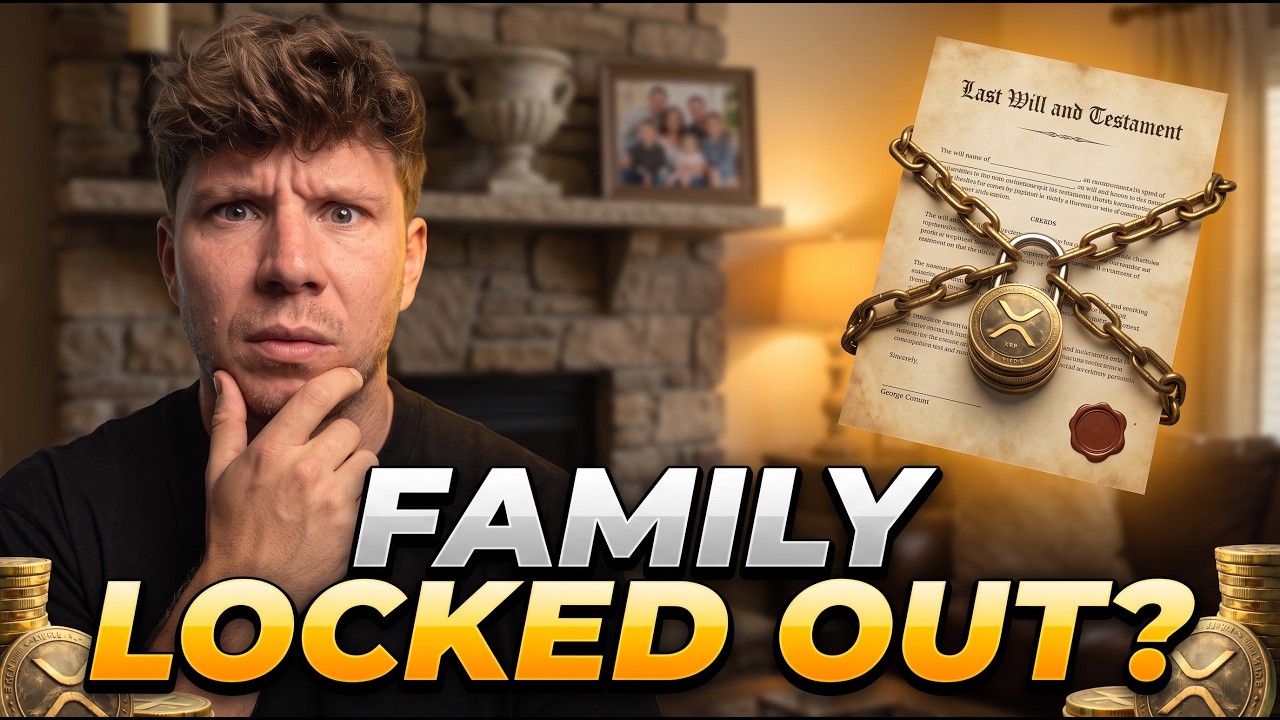
XRP can be lost to a family when its owner dies. The coins don’t vanish. The problem is that nobody else knows they exist or how to reach them. A Bullrunners video walks through real cases, explains why a seed phrase should never go in a will, and outlines what careful holders do instead.
Many XRP holders bought quietly. A partner may know there is “some crypto” but not how much, where it sits or how to get in. The passwords often live in one person’s head or on a slip of paper in a drawer. The video’s point is simple: that arrangement works every year until the one day it matters, and then it fails completely. The host says he is not a lawyer, that inheritance rules differ by country, and that your own plan needs a qualified solicitor or estate planner.
What happened at QuadrigaCX?
QuadrigaCX, described by CBC as Canada’s largest crypto exchange, said it could not reach most of its customers’ funds after its co-founder and CEO, Gerald Cotten, died. Cotten died in India on December 9, 2018, at age 30. Customers were not told until January 2019. At the end of that month, Quadriga sought protection from creditors in a Nova Scotia court. A court filing said the exchange owed customers about 250 million Canadian dollars, roughly 190 million US dollars.
The company’s public explanation was that its reserves sat in a cold wallet on Cotten’s laptop and that efforts to reach them had failed. The story the world heard was that one man held the keys and took the passwords with him.
That turned out to be only half the story. On June 11, 2020, the Ontario Securities Commission (OSC) published its investigation report. It did not find money sitting safely behind a lost password. It found that most of the losses came from Cotten himself. It called Quadriga a Ponzi scheme that cost tens of thousands of people at least 169 million Canadian dollars.
The video draws two lessons:
- When one person holds every key, everything depends on that one person. Quadriga customers had no say in that. With your own coins, you do.
- A lost-key story is not always the full story. If your coins sit with a company, you are trusting the people who run it, not just the software.
Did Matthew Mellon’s family lose his XRP?
The answer is not publicly known. Matthew Mellon was an American banking heir and one of the best-known early XRP buyers. He died in April 2018 in Cancun, Mexico, at age 54. According to his family’s statement as reported by Time, he turned a $2 million crypto investment into a fortune of around a billion dollars. Reports at the time said most of it was in XRP.
About a month later, a New York Post piece claimed his family could not find the passcodes needed to reach it. The host says he could not confirm that with the family or the estate, and what happened to the XRP was never made fully public. The video does not claim the XRP was lost. Its point is that, for a fortune that size, the public question was not what it was worth but whether anyone could get in.
Why can’t anyone reset a lost crypto key?
There is no help desk for a private key. The video cites Stefan Thomas, whom it describes as a programmer and former Ripple chief technology officer. In January 2021, The New York Times reported that he had two guesses left at the password to an encrypted drive holding 7,002 Bitcoin, then worth about $220 million. After ten wrong tries, the drive would wipe itself. The video says the drive’s maker told NBC there was nothing it could do either.
The video asks viewers to imagine the same situation with the person who knew the password no longer around to keep guessing. That, it says, is what families face if holders do nothing.
How does XRP inheritance work on an exchange versus a wallet?
How your family inherits XRP depends on where the XRP is held, and the two answers are very different.
| Where the XRP sits | What the family inherits | What they need | Main risk |
|---|---|---|---|
| Exchange | An account with a company | Death certificate, proof of authority, knowledge the account exists | The exchange fails, or nobody knows to call it |
| Own wallet | Coins on the XRP Ledger controlled by a secret key | The secret key or seed phrase | The key dies with the owner and nobody can ever move the coins |
On an exchange, the executor (the person handling your estate) contacts the company with a death certificate and proof they can legally act for you. In England and Wales that is usually a grant of probate. In the US it is usually a court document such as letters testamentary. The exchange checks the paperwork and, depending on its rules, transfers the coins or sells them and pays the estate.
An exchange will not hand anything to a relative who simply asks. The video points to an October 15, 2026 reply in which Kraken’s support account told someone asking on another person’s behalf that it could only deal with the account owner. That rule protects you while you are alive. It also means your family needs paperwork and, before that, needs to know which exchanges to contact. If the exchange itself fails, as Quadriga did, the family joins the queue with every other customer.
In your own wallet, the XRP Ledger account is controlled by a secret key, usually backed up as a seed phrase or secret code. Whoever has it controls the coins. Ripple cannot recover it for you or your family. If the secret dies with you, the XRP stays on the ledger, its balance visible to anyone with the address, but nobody can ever move it. Nobody can freeze it, and nobody can rescue it. Bullrunners looks at this side in more detail in how inheritance works for self-custodied XRP.
Why shouldn’t a seed phrase go in your will?
A seed phrase in a will can end up public. According to the video, a will in England and Wales becomes a public document once probate is granted, and anyone can order a copy through the government’s website for a fee. In the US, a will that goes through probate generally becomes part of the public court record too. Even before that, the will passes through other hands, from the person who drafts it to whoever stores it.
The video’s rule is that a will should say who gets what. It should never contain the keys. For background on what a seed phrase does, see what a seed phrase is and how it works.
Four ideas careful holders use instead
The video stresses that this is general information and that a solicitor has the final word. Still, the same four ideas come up repeatedly.
- Keep an inventory. This is a simple list of what you hold and where: which exchanges, which wallets, roughly how much is in each, and who to contact. It has no passwords and no seed phrase. The video calls it a map, not the keys. A 2022 Bloomberg report featured in the video describes a law professor with a 25-page document listing websites and wallets. Even with all that, he said his family might need an expert to access everything.
- Keep the map and the keys apart. The map can sit with your will or your executor. The keys, or whatever unlocks them, are stored separately and securely, with clear instructions on who can reach them and when.
- Make sure no single person is the only way in. This is the Quadriga problem reversed. The XRP Ledger has a built-in feature called multi-signing, which can require signatures from more than one key before coins can move. The video calls it powerful but easy to get wrong, and something to set up with proper help.
- Tell your executor the crypto exists. In the 2022 Bloomberg report, reporter Jill R. Shah said that even getting people to tell an estate planner where all their crypto is can be a challenge.
A written guide for your family can help with the first two steps. Bullrunners explains what a crypto letter of instruction is.
Does crypto count for inheritance tax?
Crypto generally counts as part of an estate when it is valued. According to the video, HMRC guidance says crypto assets can be liable for UK inheritance tax like any other property. In December 2025, the accountants’ body ICAEW reported that tax agents may be overlooking inheritance tax on crypto. The same month, the Property (Digital Assets etc) Act 2025 became law. It confirmed that in England and Wales things like crypto can count as personal property, which gives courts and executors firmer ground. In the US, the video says, the IRS treats crypto as property, so it forms part of the estate. Every country handles this differently, which is why the video says it belongs with a professional.
What to do first
The video suggests starting with one page, not the keys:
- Write down every place you hold XRP or other crypto: exchange names, the wallet you use and roughly how much is in each.
- Add the name of the person you would want to handle it.
- Put the page in an envelope and tell your executor where it is.
- Book time with a solicitor and bring the page.
- Ask how the keys should be stored, how your will should mention digital assets and whether multi-signing makes sense for you.
None of this means sharing a password with anyone. It means that if the worst happens, your family starts with a map instead of a mystery.
Frequently asked questions
Should I put my crypto seed phrase in my will?
The video says no. In England and Wales a will becomes a public document once probate is granted, and in the US a will generally becomes part of the public court record. A seed phrase written in a will can be read by anyone who looks.
How does a family inherit XRP held on an exchange?
The executor contacts the exchange with a death certificate and proof of legal authority, such as a grant of probate in England and Wales or letters testamentary in the US. Depending on its rules, the exchange then either transfers the coins or sells them and pays the estate.
Can Ripple recover XRP if the owner dies without sharing the key?
No. On the XRP Ledger, whoever holds the secret key controls the account, and Ripple cannot recover it for the owner or the family. The XRP stays on the ledger, visible but impossible to move.
What happened to QuadrigaCX customers' money?
After co-founder and CEO Gerald Cotten died in December 2018, the exchange said it could not reach its cold wallet reserves. Ontario's securities regulator later found that Quadriga was a Ponzi scheme and that most losses came from Cotten himself. Customers lost at least 169 million Canadian dollars.
Is crypto subject to inheritance tax?
According to the video, HMRC guidance says crypto assets can be liable for UK inheritance tax like any other property, and the IRS treats crypto as property that forms part of a US estate. Rules differ by country, so a professional should advise.
Full video transcript
From the video's captions, lightly formatted. Captions can mishear names and numbers, so check figures against the article above.
XRP holders, here's a question most of us never ask out loud. When you die, could your family actually reach your coins? Well, for many it's a no, and not because the coins disappear, but because nobody else knows where they are or how to get in. Now, a Bloomberg report who looked into this summed up the problem better than anyone. Check this out.
Yeah, look, you know, this anonymity, this being able to shield your wealth is basically at odds with a system that can distribute it to people when you die. And that's like probably the crux of the issue is if no one knows you have the crypto
or you forget all your keys
then how will your daughters and sons be able to access it?
So, if you own XRP, your family could lose it all when you die, and I'm going to show you how others lost millions in exactly that way. And I'm also going to show you the mistake that gets suggested again and again. Never put your seed phrase in your will. That is a very important thing. And I'm going to explain why it's right, and also what careful people do instead of that to help their family.
Now, keep an eye on that first link that sits in the description. Hold that thought because I'm actually going to come back to it before the 5-minute mark, and I'm going to make a lot more sense out of that, okay? So, let's dive into this, but just so you know, I'm not a lawyer, and nothing in this video is legal advice, okay? The rules on wills and inheritance are different from one country to the next. So, for your own plan, you want a qualified solicitor or an estate planner.
What I can do is I can show you how this goes wrong and give you the right question to take to them. Now, this matters to so many of us, and it's worth saying why. A lot of us bought XRP quietly, and maybe our own partner knows we've got some crypto, but do they know how much or where it is? Well, the passwords live in our head or on a bit of paper in a drawer that nobody else knows about. And none of us enjoy talking about dying, so we put it off.
Year after year, that works fine, right up till the day it doesn't. Then somebody we love is left with a phone that they can't unlock, an app they've never heard of, and money they don't even know exists or can't prove it. So, let's start with the biggest case of the lot. Gerald Cotton ran QuadrigaCX, which CBC described as Canada's largest crypto exchange. And on the 9th of December, 2018, unfortunately, he died.
And that was in India, all right? And at the age of 30, customers were not told until January 2019. And at the end of January 2019, Quadriga actually went to court in Nova Scotia for protection from its creditors. And a court filing said the exchange owed its customers about 250 million Canadian dollars. That's roughly 190 million US dollars.
And they couldn't get at most of it. So, the company's explanation was simple. It was frightening, but it was simple, okay? CBC's news read out its statement. Check it here.
For the past few weeks, we have worked worked extensively to address our liquidity issues, which include attempting to locate and secure our very significant cryptocurrency reserves held in cold wallet, which is the laptop in question, uh and that are required to satisfy customers' cryptocurrency balances. Unfortunately, these efforts have not been successful.
So, the story the world heard was this. One man held the keys, and the keys were on his laptop, and he'd taken the passwords with him. Now, that's only half the story, though. The other half is worse, and we will come to it in a moment. So, as always, please do your own research.
Please check that you all subscribed, okay? If you're new to the channel, welcome. My name is George Lee, but if you're not new to the channel, just check that you've hit the subscribe button. We're about to cross 400,000, which is absolutely insane. So, let's roll this intro and get into it.
[music]
So, before the rest of the Quadriga story, right? Let's go all the way back to the drawer with a bit of paper in it that I said. Now, am I telling you right now to buy XRP? No, okay? Cuz there may be way better opportunities for your situation.
I don't know what you hold or what you do or what your problems are, okay? But if you do hold it, the worst plan is the one that exists in your head. So, getting organized is a big part of what our Altcoin Pro course is. So, it's going to help you with what you hold, where each coin sits, how you'd move it, and a plan clear enough that you can explain it to somebody you trust. It won't write your will for you, and for that, you want a solicitor.
But you can't hand over something you haven't got straight yourself. Here's how it works. You click the link in the description, you fill in a short form, and then book your free 50-minute call, right? And one of the team is going to talk you through your own strategy and your own situation. There's no charge for this.
It's absolutely free. And if you're watching this on your phone, just simply tap the more button under the video and it's going to pop up that link for you. Do that before you get a bit of paper and put it back in the drawer for another year, right? Then, come back here because what the investigators have found inside Quadriga changes the whole lesson. Now, here's the part that didn't make the first headlines.
Ontario Securities Regulator, the OSC, dug into Quadriga on the 11th of June 2020 and it published its report. It actually did not find sitting safely behind the lost password. It found that most of the losses came from Cotton himself. CBC's flagship program, The National, spoke to the reporters who'd followed the case for years. Then, a devastating turn.
Cotton died suddenly while on a trip to India, complications with Crohn's disease. And because he was running the whole operation from his encrypted laptop, it meant the money was gone. One man had the keys to hundreds of millions of dollars and
Like Like the CEO of a bank dies and then you learn later that he's the only one that had access to the money and nobody else can get it. And not only that, but then when you take a closer look, you realize that he actually spent most of it and gambled it away.
In its report, the regulator put it in plain words. It's called Quadriga, a Ponzi scheme that cost tens of thousands of people at least 169 million Canadian dollars. So, there are two lessons here, right? Both of them matter to us. The first one is that when one person holds every key, everything rides on that one person.
Quadriga's customers had no say in that. Now, with our own coins, we do. So, the second is quieter. It isn't always the full story. So, if your coins sit with a company, you're trusting the people who run it as well as the software.
And if you keep that in mind, because we're going to come back to exchanges in a minute, okay? The next case is closer to home for us XRP holders. Matthew Mellon was an American banking heir and one of the best-known early buyers of XRP. He died in April 2018, unfortunately, in Cancun in Mexico, and at the age of 54, that was. So, too young, right?
And according to his family statement, as reported by Time, he turned a $2 million investment into crypto into a fortune at around a billion dollars. Reports at the time said most of it was in XRP, and about a month later, a piece in the New York Post claimed his family couldn't find the passcodes they needed to reach it. Now, I personally couldn't confirm that from his family or his personal estate, and what happened to his XRP was never made fully public. So, I'm not going to tell you it was lost, but think about what it means with a fortune that size, the question people were asking in public wasn't really what is it worth. It was whether anybody could get in it, okay?
And you don't need a death to see how final this can be. Stefan Thomas is a programmer who'd been Ripple chief technology officer in January 2021. The New York Times reported that he had two guesses left at a password to an encrypted drive holding 7,002 Bitcoin, worth about $220 million at the time. 10 wrong tries and the drive would wipe itself. And NBC morning show summed up why nobody could help him.
Because Bitcoin isn't represented by physical coins, it can't be held by a bank, meaning the military-grade drive is holding the only key to Stefan's digital fortune.
The company that made the drive told NBC there was nothing it could do either. So, there's no help desk for a private key. Now, imagine the same situation, except the person who knew the password isn't around to keep guessing. And that's what our families are left with if we do nothing. So, how does inheritance actually work?
Well, it depends on where your XRP lives, okay? And there really are two different answers. If your XRP is on exchange, then your family is not inheriting anything on a ledger, okay? They're inheriting an account with a company, and that's usually the easier case as long as the company is sound, and as long as your family knows the account exists. Now, big regulated exchanges generally do have a process for this, which is great.
The person handling your estate, your executor, contacts the exchange with a death certificate and proof that they have actually legal right to act for you. In England and Wales, that's usually just a grant of probate. In America, it's usually a court document such as uh, letters testamentary, okay? The exchange checks it all, and then depending on its rules, it either transfers the coins or sells them and pays the money to the estate. What an exchange won't do is hand anything over to a relative just because they ask for it.
Now, on the 15th of October, 2026, someone asked Kraken support account for help on another person's behalf, and the answer was exactly what you'd expect. They could only deal with the account owner directly, and that's the right rule. It protects you while you're alive, but it also means your family will need paperwork, and before that, they need to know which exchanges to contact. If they don't know the account exists, there's nobody to call at all. And there's also one more catch.
If the exchange itself fails, the way Quadriga did, then your family joins the queue with every other customer. If your XRP is in your own wallet, it's the opposite, right? On the XRP ledger, your account is controlled by a secret key, which is usually backed up as a seed phrase or a secret code. Whoever has that controls the coins. Nobody sits in the middle, and there's no reset button.
Ripple cannot recover it for you, and it also can't recover it for your family, either. So, if that secret dies with you, then your XRP doesn't go anywhere. It just sits on the ledger where anybody who knows the address can see the balance. And to be honest, nobody can ever move it. Now, that's the deal we make with self-custody.
Nobody can freeze it, and nobody can rescue it. So, the obvious fix to most people is writing your seed phrase into your will, but I'm telling you, please don't do that. In England and Wales, once probate is granted, a will becomes a public document, and anybody can order a copy through the government's own website for a small fee. In America, a will goes through probate, generally becomes part of the public court record, too. So, a seed phrase in your will is a seed phrase handed to anyone who goes looking for it.
And long before that happens, your will passes through other hands, from the person who drafts it to the people who store it. Now, your will should say who gets what. It should never contain the keys, right? So, what do careful people do instead? Well, again, this is general, and your solicitor has the final word, but the same few ideas come up again and again.
The first is an inventory. This is a simple list of what you hold and where, and which exchanges, which wallets, roughly what's in each one, and also who to contact. No passwords, no seed phrase. Think of it as a map, not the keys, right? Bloomberg actually found one lawyer who'd taken this about as far as it can go.
Check this clip.
And so, one of the things that I learned over the course of the reporting is that he has a 25-page document that lays out exactly what websites to go to, which wallets to connect, [music] you know, how to get access to all of this. And you know, one of the things he said, like,
[music]
"I've tried to lay this out as best as I can, but they might need an expert to even be able to
[music]
access all of it and to be able to move it around if I were to pass away."
25 pages is a lot, and most of us need one. But listen to his last point. Even with all of that written down, he thought his family might need an expert. The second idea is to keep the map and the keys apart, all right? The map can sit with you on your will or with your executor.
The keys or whatever unlocks them are stored separately and securely. With clear instructions about who can reach them and when. Now, exactly how you do that is something a good estate will actually help you set up. The third is to make sure no single person is the only way in. That's the quadriga problem turned on its head, all right?
Here's Jill Shaw again. Check this out.
Yeah, I mean, even getting people to tell you where all their crypto is, if you're an estate planner or wealth planner, is a challenge. So, if you're willing to share that, then estate planners and wealth planners have ways to accommodate accessing that crypto, making sure that there are multiple approvals in place for transactions to happen. But otherwise, everyone is kind of doing it differently.
Multiple approvals is a real option on the XRP ledger. It does have a feature built in called multi-signing, which means an account can be set up so that moving the coins needs signatures for more than one key. It's powerful, and it's also easy to get wrong. So, if it's something to set up with proper help, it's not on a whim. And the fourth idea is the simplest of all, right?
You tell your executor the crypto exists. As you just heard, even getting people to say where all the crypto is can be the hardest part. There's one more thing that catches families out. Crypto accounts when an estate is valued, right? In the UK, HMRC's own guidance says crypto assets can be liable for inheritance tax like any other property.
And in December 2025, the accountants body, the ICAEW, reported that tax agents may be overlooking inheritance tax on crypto assets. Now, that same month, a new law, the Property Act 2025, confirmed that England and Wales things like crypto can count as personal property. In simple terms, that just gives courts and executors firmer ground to stand on when they deal with it. In America, the IRS treats crypto as property, too. So, it actually forms part of the estate, as well.
Now, every country does this in its own way, which is exactly why this belongs with a professional. So, here's where I'd start, right? Not with the keys, but with one page written down every place you hold XRP or any other crypto. The exchange names, the wallet you use, and roughly how much is in each. And add the name of the person you'd want to handle it.
Then, just simply put that page in an envelope and tell your executor where it is. After that, book a time slot with a solicitor and take the page with you. Ask them how the keys should be stored, how your will should mention your digital assets, and whether something like multi-signing makes sense for you. None of that means sharing a single password with anybody. It just means that if the worst happens, your family starts with a map instead of a mystery.
Now, if you've sorted this out for your own family, then what was the one thing that made it easier? Share it in the comments, guys, because somebody watching this will need it. And hit subscribe if you do want the awkward money questions answered with the sources on screen. As always, crypto carries risk, and past results are no guarantee of future ones. This is education, not financial advice.
Stay bullish, guys.
Education and commentary only, not financial advice. Crypto is volatile and you can lose money. Do your own research and speak to a qualified advisor before making investment decisions. Figures and quotes are as reported in the video on October 23, 2026 and may have changed since.