Crypto Exchange Shutdowns: How to Protect Coins Before Yours Closes
Four crypto exchanges announced closures since July. How wind-downs work, the warning signs, the XRP destination tag trap, and a 5-step plan for holders.
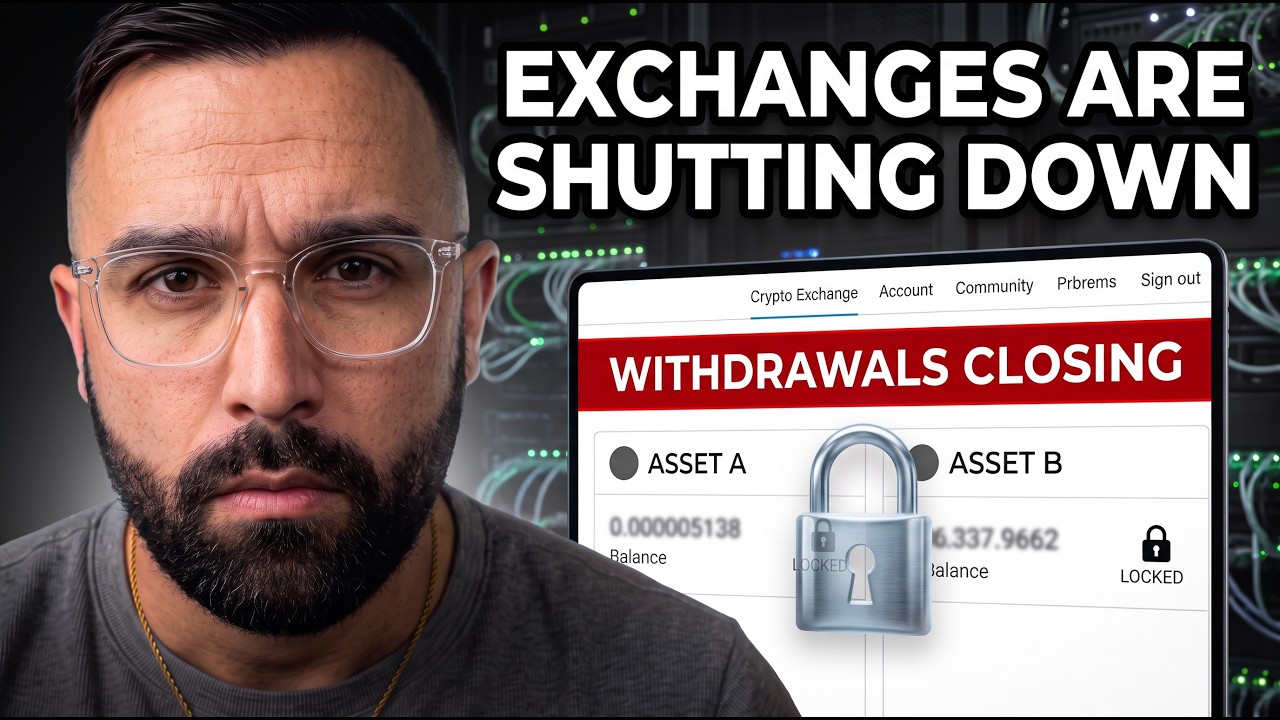
Key takeaways
- An exchange balance is a claim on a company, not crypto you control.
- Exchange wind-downs remove features in stages, so the headline withdrawal deadline is the last door, not the first.
- No legitimate exchange will ask for your seed phrase, password or a fee to speed up a withdrawal.
- When sending XRP to an exchange, always include the destination tag, and remember a new XRP wallet needs at least 1 XRP to activate.
- Do a small test withdrawal while things are calm, and export your trade history before you need it.
Since July, four crypto exchanges have announced they are closing. According to the video, they are AscendEX, BitMEX, BitMart and CoinEx, and at CoinEx withdrawals close for good on December 22.
These were orderly shutdowns, not collapses. But the video argues that even a well-run closure has traps for anyone who keeps coins on an exchange. This article walks through what happened, how a wind-down actually unfolds, the warning signs, and the five-step plan the host, a trader, uses so an exchange email never catches him off guard.
Is your exchange balance actually your crypto?
No. The video’s core point is that an exchange balance is a claim: a promise from a company that it owes you that crypto. A company can close for reasons that have nothing to do with you, on a timetable you didn’t set.
That is what has been happening. Per the video, AscendEX wound down on July 1. On July 23, BitMEX said it was closing after 11 years. BitMart said it was winding down too. And on September 15, CoinEx said it was closing after 9 years.
CoinEx says its reserves are above 100% and that every user balance is fully backed. The video calls that the good version of the story, and then shows why even the good version has traps.
How does an exchange shutdown work?
It happens in stages, and each stage takes something away. The video uses CoinEx’s timeline as the lesson:
- September 15: New signups stopped and futures moved to “reduce only” (you can close positions but not open new ones).
- September 22: Everything except spot trading ended, and open futures positions were closed out.
- September 29: Spot trading stopped altogether.
- December 22: Withdrawals close and the platform shuts for good.
The headline said users had until December. But if you held an altcoin you wanted to swap before withdrawing, the real window was two weeks.
There’s another detail the video flags. Reports on CoinEx’s notice say USDT left behind after the deadline goes into an independent custody arrangement with a monthly fee of 5% of the original balance. It can be claimed until August 2028, but the fee keeps eating into it the whole time.
What does this mean for holders?
The video draws three lessons:
- Orderly doesn’t mean relaxed. Trading, deposits or certain coins can disappear at each stage. The deadline in the headline is the last door, not the first.
- Withdrawals slow down when everyone leaves at once. When BitMart announced its closure, it said some withdrawal requests could face extra checks, including identity, device and IP checks, source of funds and sanctions screening. Some users on X reported USDT withdrawals sitting pending for hours. The video stresses that this isn’t proof anything was wrong, and compares it to a fire exit: the door works fine until thousands of people hit it at once.
- Scammers follow shutdowns. Both BitMart and CoinEx warned users. Nobody legitimate will ever ask for your seed phrase (the recovery words for a wallet), your password, or a fee to speed up a withdrawal. Per the video, a DM offering priority withdrawal is a scam every time.
The video also notes that orderly closures are the good ones. When FTX went down in 2022, customers got no notice at all.
What are the warning signs an exchange might close?
The video says the signs were visible before the announcements, if you knew where to look:
| Warning sign | Example from the video |
|---|---|
| The exchange’s own token falls hard | BitMart’s BMX token fell about 58% in 24 hours after the announcement, after already falling around 70% over the year. BitMEX’s BMEX token fell about 90% shortly after its notice. |
| Money quietly leaves the exchange’s wallets | Arkham data showed wallets linked to BitMart held about $102 million in early July and about $71 million by the day it announced, roughly a third gone in under three weeks. |
| Withdrawals take longer and support goes quiet | Slower processing and fewer replies |
| Delistings and maintenance pauses | Coins removed and frequent unexplained pauses |
None of these alone means an exchange is about to close. The host’s view as a trader is that he doesn’t wait for confirmation when the cost of acting early is close to zero. Moving coins you aren’t trading costs a small fee and about 10 minutes. Being late can cost weeks in a queue, or worse.
What is venue risk?
Venue risk is the idea that every place you keep money can fail, freeze or close. The host says he doesn’t try to pick the single safest exchange. Instead, he builds a plan that survives any one venue going away.
The 5-step plan from the video
- Map where everything lives. Open a note and list every exchange, app and wallet, with roughly what’s on each. You can’t protect what you can’t see.
- Split trading money from holding money. An exchange is a tool for trading, not a vault. Coins you’re actively trading can sit there. For coins you plan to hold for months or years, ask why they’re still on a company’s balance sheet.
- Run a fire drill. Do a small test withdrawal now, while things are calm, so you know exactly how it works before a shutdown email arrives.
- Keep your records. Export your trade history while the exchange still exists. Selling or swapping crypto can be taxable depending on where you live, so the video suggests checking your tax authority’s official guidance and speaking to a qualified adviser. You can’t do that if the records are gone.
- Set a venue rule and write it down. For example: no more than a set share of your crypto on any one platform. You choose the number. The point is to decide before a panic, not during one.
The XRP mistake that can make a withdrawal go missing
The most common XRP trap is a missing destination tag. When you send XRP to an exchange, most exchanges use one shared address for many customers. The destination tag is a number that tells the exchange which customer the XRP belongs to.
Forget the tag and your XRP can land in the exchange’s wallet with no way for them to know it’s yours. You then end up in a support queue, possibly at the same moment everyone else is trying to leave.
Sending to your own wallet is different. You usually don’t need a tag. But a brand new XRP wallet needs at least 1 XRP to activate, because that is the account reserve, and that reserve can’t be sent out.
The drill is the same for XRP and every other coin: send a small amount first, check it arrives, then send the rest. And check that the network matches on both the sending and receiving side before you hit send.
Your exchange exit card
The video closes with a five-question card to screenshot and revisit:
- Where is every coin right now?
- Which is trading money and which is holding money?
- Have I done a test withdrawal this month? For XRP, did I check the destination tag?
- Have I exported my trade history?
- What is my maximum on any one platform?
What to watch next
If you hold anything on AscendEX, BitMEX, BitMart or CoinEx, check each platform’s official notices for the remaining stages and deadlines, and don’t rely on the headline date alone. Ignore any DM offering faster withdrawals.
For every other exchange you use, keep an eye on the four warning signs: the exchange token’s price, wallet outflows, withdrawal times and support response, and delistings or maintenance pauses. Then work through the exit card above, starting with a small test withdrawal while things are calm.
Frequently asked questions
Which crypto exchanges announced they are closing?
According to the video, four exchanges announced closures since July: AscendEX, BitMEX, BitMart and CoinEx. CoinEx said withdrawals close for good on December 22.
What happens to funds left on CoinEx after the deadline?
The video cites reports that USDT left behind after the deadline moves into an independent custody arrangement with a monthly fee of 5% of the original balance. It can still be claimed until August 2028, but the fee reduces it the whole time.
What are the warning signs an exchange might close?
The video lists four: the exchange's own token falls sharply, money leaves the exchange's wallets, withdrawals slow and support goes quiet, and coins get delisted with frequent maintenance pauses. None of these alone proves an exchange is closing.
Do I need a destination tag to withdraw XRP?
When sending XRP to an exchange, yes, because most exchanges use one shared address and the tag identifies your account. Sending to your own wallet usually doesn't need a tag, but a brand new XRP wallet needs at least 1 XRP to activate.
Is someone offering priority withdrawal during a shutdown legitimate?
No. The video says anyone who DMs you offering priority withdrawal is a scammer every time, and both BitMart and CoinEx warned users about scams.
Education and commentary only, not financial advice. Crypto is volatile and you can lose money. Do your own research and speak to a qualified advisor before making investment decisions. Figures and quotes are as reported in the video on October 7, 2026 and may have changed since.