XRP and the Garlinghouse Solana Clip: The Full Quote in Context
A resurfaced clip of Ripple CEO Brad Garlinghouse saying he owns some Solana went viral. Here is the full quote, the context and what it means for XRP.
Key takeaways
- According to the video, the viral Garlinghouse clip was months old and came from a Consensus Miami stage, not a new interview.
- In the full answer, Garlinghouse said Ripple picks XRP or a stablecoin for each payment corridor, based on what solves the customer's problem.
- Garlinghouse said Ripple built RLUSD after a period when it was minting about 20% of all USDC for its institutional payment flows.
- Before reacting to a clip, check its date and watch the full answer it was cut from.
- Ripple's business choices and the XRP price are separate questions; a Ripple win is not automatically an XRP win.
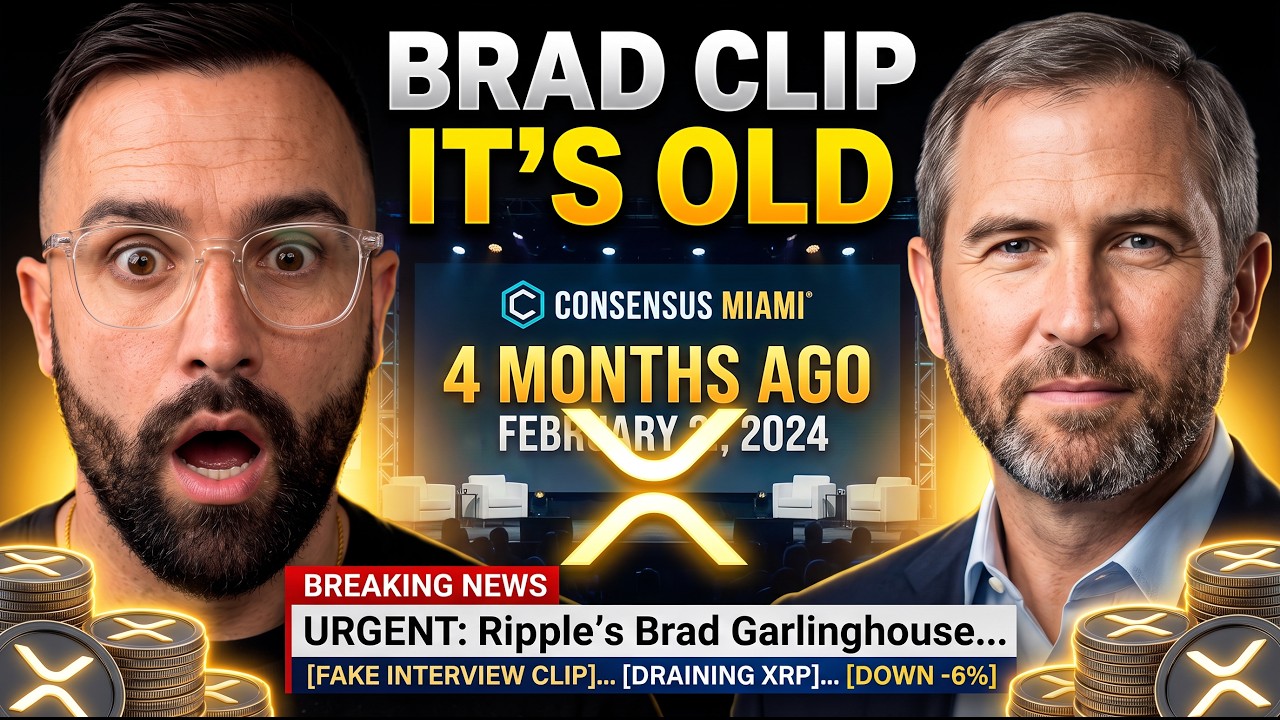
A resurfaced clip of Ripple CEO Brad Garlinghouse saying he owns “a little bit of Solana” and is not an XRP maximalist went viral on X. According to the video, XRP fell about 6% in one session afterward. The video says the clip was months old, from a Consensus Miami stage, and that the full answer adds context the viral version cut.
For XRP holders, the episode shows how fast an old quote can move the price. It also raises a fair question: if Ripple’s CEO won’t tell people to buy only XRP, what does Ripple actually do with XRP? The video argues the full clip answers that. This article lays out what was said, what was cut and what holders can check.
What did Brad Garlinghouse say about Solana?
Brad Garlinghouse said he owns a little Solana, is not an XRP maximalist, and that his own suggestion would be to buy the top five cryptocurrencies and hold them for five years. He was answering an audience question about why someone should choose XRP over Solana.
The full exchange, as played in the video, went like this. The questioner asked why they should choose “your currency instead of Solana.” Garlinghouse replied that he honestly tells close friends “I’m not here to convince you to buy XRP.” He then said that what he would tell the questioner is to buy the top five and hold them for the next five years. He added that he owns a little Solana, that he is “not one of these people who’s an XRP maximalist,” and that he is “bullish on a bunch of cryptos for a bunch of reasons.”
According to the video, the viral version on X boiled down to a single headline: Ripple’s CEO is not an XRP man, owns Solana and wants holders to spread out. Accounts critical of XRP framed it as Garlinghouse turning his back on the token.
The video reads it differently. It points out that Garlinghouse was handed an easy chance to criticize a competitor and declined. The host cited another XRP-focused account on X that responded to the clip and summed up the answer as a founder “being an adult with his audience.” Whether the remark is bullish or bearish is opinion. The wording is not in dispute, and it was a personal view on diversification, not an announcement about Ripple’s strategy.
Was the clip old?
According to the video, yes. The video says the interview was recorded months earlier on a Consensus Miami stage and had sat on YouTube with almost no attention. An XRP researcher on X then clipped a roughly 45-second segment and posted it. The video says it was spreading widely within about 18 hours.
The video says the account that resurfaced the clip wrote in a follow-up post that the clip had not been hidden by Ripple or buried by an algorithm. Instead, the researcher pointed to the death of Darren Moore, a well-known figure in XRP research. The video says the YouTube feeds Moore had followed went unwatched after he died.
The video also notes that Garlinghouse had said much the same thing in public more than a year earlier. In a Bloomberg Japan clip shown in the video, he said Ripple already used stablecoins in its payment flows for certain corridors, such as Australian dollars or Philippine pesos. He explained that in certain corridors “it’s more efficient to use a stablecoin at times.” According to the video, that earlier remark drew little reaction.
What did the viral clip leave out?
The part cut from the viral clip explains how Ripple chooses between XRP and stablecoins. In the same answer, Garlinghouse described a dollar-to-Philippine-peso payment. He said XRP “could be” the best bridge asset, or a stablecoin could solve the problem better. A bridge asset is the asset a payment passes through on its way from one currency to another.
He said Ripple’s priority is solving the customer’s problem, because if it doesn’t, it gets no share of that business. He then explained why Ripple launched its own stablecoin. There was a period when Ripple was minting about 20% of all USDC and using it in payment flows for institutions.
In the video’s reading, Ripple asked why it was sending that business to Circle, USDC’s issuer, rather than building its own coin. That led to RLUSD, Ripple’s dollar stablecoin, which the video says has passed $2 billion in less than two years. For more on how the two assets differ, see how RLUSD differs from XRP.
The video also says that on the same stage, Garlinghouse called XRP Ripple’s “North Star” and said Ripple remains the largest holder of XRP. According to the video, he also said Ripple’s acquisitions and products aim to increase XRP adoption, liquidity and institutional use. None of the clips played in the video show those lines, so they are reported here as the video’s account.
Is Ripple moving away from XRP?
The video argues no and lists what it sees as evidence. Its points, as stated in the video:
- Ripple is still the largest single holder of XRP.
- Ripple still releases up to 1 billion XRP a month from escrow.
- Ripple spent $1.25 billion acquiring the brokerage Hidden Road, now run as Ripple Prime.
- Ripple launched RLUSD in Japan and Turkey after local regulatory approval.
- Ripple Prime joined the DTCC’s tokenization working group.
- Ripple has a pending Federal Reserve master account application, which would connect it to Fedwire if approved.
These points show Ripple building a payments and finance business. On their own, they do not show demand for the XRP token. Bullrunners has covered that gap in why a Ripple win isn’t automatically an XRP win. Garlinghouse said each customer gets whichever asset fits, which means some Ripple payments use XRP and some do not.
What about the ACI Worldwide news?
The video says that in the same news cycle, ACI Worldwide extended its platform onto Swift’s new multichain ledger. According to the video, ACI named the XRP Ledger among the settlement rails it supports. Bullrunners has not confirmed ACI’s exact wording, so this is reported as the video’s claim. The video describes ACI as handling about 9% of Swift payment traffic, a figure that comes from ACI itself. It calls the news the year’s biggest institutional sign for XRP.
That is the video’s framing. The video also gives a figure of roughly $155 trillion a year, but reports differ on what that number measures, so it is left out here. Supporting a rail is not the same as banks actively settling payments with XRP. The 9% figure also refers to ACI’s share of Swift traffic, not to payments made with XRP. Bullrunners examined this claim in detail in what ACI Worldwide actually announced.
Why do old clips move the XRP price?
The video describes a pattern it says repeats every cycle. A quote is clipped out of context, the price drops, some holders sell in a panic and larger holders buy. The video says the story usually fades within weeks. That is the host’s view of market behavior, not a measured finding, and nothing guarantees a price recovers after any given drop.
What holders can control is how they react to a headline. A simple check before acting on a viral clip:
- Find the original video and its date.
- Watch the full question and answer, not just the excerpt.
- Ask whether the remark is a personal opinion or a company announcement.
- Check whether the speaker has said the same thing before, and how the market reacted then.
- Separate news about Ripple the company from news about demand for XRP.
Bullrunners has also covered why XRP sometimes falls even after good news, which explains how price and fundamentals can run on different timelines.
What to watch next
The full answer is on the record. Garlinghouse described a tool-by-tool approach to payments, choosing XRP or a stablecoin depending on the job. The open questions are the ones the video points to. Watch whether Ripple’s Federal Reserve master account application is decided and how RLUSD’s supply changes. Look for details on what ACI Worldwide’s Swift ledger integration looks like in practice. And watch whether Ripple publishes figures on how much of its payment volume uses XRP versus stablecoins.
Frequently asked questions
Did Brad Garlinghouse say he owns Solana?
Yes. In a clip the video says came from a Consensus Miami stage, he said he owns 'a little bit of Solana' and is not an XRP maximalist. He also said his personal view is that buying the top five cryptocurrencies and holding them for five years would do well.
Was the Garlinghouse Solana clip new?
According to the video, no. The video says the clip was months old and had sat on YouTube with little attention before an XRP researcher on X clipped and posted it, and that the researcher acknowledged this in a follow-up post.
Why did Ripple create RLUSD?
Garlinghouse said there was a period when Ripple was minting about 20% of all USDC and using it in payment flows for institutions. The video says that led Ripple to build its own stablecoin rather than send that business to Circle.
Does Ripple always use XRP for payments?
No. Garlinghouse said that for each corridor, such as dollars to Philippine pesos, Ripple decides whether XRP or a stablecoin is the better bridge asset for the customer.
How much did XRP fall after the clip went viral?
The video says XRP was down about 6% in a single session by the time the clip passed six figures of views. That figure comes from the video and was not independently checked.
Full video transcript
From the video's captions, lightly formatted. Captions can mishear names and numbers, so check figures against the article above.
Brad Garlinghouse just cost you 6% of your XRP bag with a clip they'd been sitting on for months untouched. The guy on camera is the same guy whose company holds the single largest XRP position on the planet. But check the timestamp on the video they used to do it. That interview isn't from this week. It's not from last week.
It's from a Consensus Miami stage months and it sat on YouTube with zero attention until the market needed a bear case bad enough to go digging for one. And here's the piece nobody told you. In the exact same news cycle they were draining your bag on the old clip, ACI Worldwide, the company that handles 9% of the roughly $155 trillion a year moving through Swift, quietly extended its platform onto Swift's new multichain ledger and named Ripple XRP ledger among the settlement rails it supports. And that's the biggest institutional XRP green flag of the year. And it got buried right under the shakeout.
And here's what makes it worse. Brad has been saying this exact same thing on public tape for over a year. Just watch this.
We already have used stablecoins in our payment flows for certain corridors depending upon whether you're going to Australian dollar or Philippine peso. Certain corridors it's more efficient to use a stablecoin at times.
Now come on, that was Brad calmly on Bloomberg Japan over a year ago telling you the exact thing he'd get crucified for saying in Miami later. Now nobody dumped their bag over that one because it wasn't wrapped in a click headline. So today we're going to pull the full clip the panic sellers never saw showing you why one of the most respected XRP researchers on X called this the tribalism trap. And we're going to look at whether Brad Garlinghouse saying I'm not a maximalist is bearish for your bag or the most bullish sentence he said in a year. Now let's jump straight into it.
[music]
Now if you're feeling bullish like this video and if you're going to become the first millionaire in your family tree, confirm it right now by subscribing to the channel and commenting 777 down below. All right, bull runners, welcome back to the channel. So, let's start with what actually happened because the version on your timeline is missing the receipts. An account on X called Eryk Carp DM, one of the sharpest XRP researchers on the platform, clipped a 45-second segment of Brad Garlinghouse and posted it. Now, within 18 hours, the entire crypto internet was screaming.
The headline that clip was carried was one sentence. The CEO of Ripple is not an XRP man. He personally owns Solana, and he's telling you to spread your bag across the top five. But, here's what the timeline did with that. Every anti-XRP account, every stablecoin bag holder, every guy who has been calling XRP dead for 2 years, you name it, they all turned it into the same story.
The CEO of Ripple just betrayed the XRP army. He's rotating. He's telling holders to walk away from the token. And the price responded fast because XRP had been grinding right around the levels holders had been watching for weeks. And by the time the clip crossed six figures of views, the bag was down already 6% in a single session.
The short accounts that had been begging for a reason to bet against XRP for the last 6 months finally gone. But, there is a fact about that clip that changes the entire story. The clip is from Consensus Miami stage. It's It's months old, long before it ever hit your feed. The account that resurfaced Eryk actually said it out loud in a follow-up post.
Just take a look. Now, come on, do you feel that? One of the sharpest XRP voices on the platform just admitted the clip wasn't buried by Ripple, and it wasn't hidden by some algorithm. The reason it slipped through was that the community lost Darren Moore, a legend in XRP research, and the YouTube feeds nobody else was watching went dark with him. So, think about what actually means for a second.
In the middle of a soft, choppy market with Washington still dragging its feet on crypto rules in a week where XRP holders needed something to be excited about. Somebody pulled a month-old quote off a shelf and the whole market treated it like breaking news. The bear case on XRP is now so thin that people had to go dig up an old conference stage clip to make it stick. Now, let's watch what the guy actually said. The timeline gave you six seconds, but I'm about to give you the whole thing.
Just watch this.
Hi, Brad. Just a quick question. Why would I choose your your currency instead of Solana and how would you compare the two?
Look, what I honestly tell my close friends is I'm not here to convince you to buy XRP. What I would tell you is buy the top five and hold them for the next five years and you're going to do great. So, I I I'm not going to like I own a little bit of Solana. I'm not one of these people who's an XRP maximalist. I'm I'm bullish on a bunch of cryptos for a bunch of reasons.
Now, that's a CEO handed the perfect open goal to trash a competitor and he refused to take the shot. The question was framed to make him sell XRP as a superior and he refused to sell anybody anything. He pointed the viewer at the whole top of the market and said do your own homework. That's the behavior every mature founder in this industry should have and a well-known XRP researcher on X called Ripple Wink said the quiet part out loud right after the clip dropped. Take a look.
Now, do you feel that? Ripple Wink read the exact same 20 seconds the panic sellers read and he saw a founder being an adult with his audience. Telling holders to spread risk is good advice. Refusing to swing at an open goal against a competitor is maturity and that is the split screen on this clip. It tells you everything about who's actually paying attention right now.
The piece the time line cut off is the piece that seals it. Because in the same interview, on the same stage, in the same breath, Brad said this next thing. Just listen to what he had to say next.
So, we go to a customer and say, "Hey, we can solve your payments problems to get into the Philippines." Let's say, you're going dollar to Philippine peso. Well, it could be that XRP is the best bridge asset for that purpose. Or it could be that no, a stable coin is going to solve that problem better. And what I don't want to do, I I want the customer to be happy, right? Ultimately, I got to solve the customer's problem.
If I'm not doing that effectively, then uh then I don't get any of the share of wallet. So, what we do at Ripple is we say, "Look, we're going to solve this problem. We're going to figure out is XRP the base the best bridge asset or is a stable coin the best bridge asset?" We launched our own stable coin because there's a period of time where we were minting 20% of all USDC. We were using it in our payment flows for institutions.
The finance media took that 30 seconds and spun it into Ripple's own founder throwing XRP under the bus, which is exactly backwards. And here's what Brad actually said. The customer's problem decides which tool gets used. And then he told you why Ripple even built RLUSD. Because before they launched their own stable coin, they were quietly minting 20% of all the USDC circulating on Earth.
One out of every five USDC tokens on the entire planet, and nobody knew. Ripple was pushing USDC through their institutional payment flows because their institutional customers were asking for stable coins. And Brad's response was, "Well, if we're minting one out of every five USDC on Earth, why we handing the fees to Circle instead of building our own?" So, they built RLUSD. And RLUSD has grown into one of the fastest growing regulated stable coins on Earth. Now past $2 billion and climbing.
Less than two years after launch. Ripple is not rotating out of XRP. The company already runs the payment rail, and XRP is the native asset of that rail. RLUSD is a settlement asset that lives on the same rail. Both of them exist so that when a bank in Brazil, in Japan, in Turkey, in the Philippines wants to move dollars, they pick whichever asset solves their problem, and Ripple collects the toll either way.
And here's the piece Brad said on that same Miami stage that never made it into a single clip on Twitter. He called XRP Ripple's North Star, and those are Ripple's own words. He said Ripple is still the largest holder of XRP on Earth, which makes them permanently accountable to the XRP ecosystem, and that every acquisition and product expansion is aimed at increasing XRP adoption, liquidity, and institutional use. So, the guy who isn't a maximalist on stage is running a company that holds the single largest XRP position on Earth, still releases up to a billion XRP a month from escrow, and spent 1.25 billion dollars acquiring an institutional brokerage arm called Hidden Road that now runs as Ripple Prime. Now, that's not a man who lost faith in his bag.
That's a payments company CEO whose job isn't to sell you a token. His job is to build the rail every dollar in the world is about to move on top of. And this is where the ACI receipt comes back around, because while the timeline was freaking out over a month's old clip, ACI, the company that handles roughly 9% of Swift payment traffic on Earth, roughly 155 trillion dollars a year, quietly extended its platform onto Swift's new multi- chain ledger, and named Ripple's XRP ledger among the settlement rails it supports. XRP is sitting inside the plumbing of 9% of Swift traffic, and that is the story that will still matter 12 months from now when the Garlinghouse clip is forgotten. So, let's just zoom out.
Ripple spent the year closing payments deals across the map, expanding across Brazil into cross-border payments, custody, stablecoins, prime brokerage, treasury management, you name it. Ripple launched RLUSD in Japan and Turkey after local regulatory approval. Ripple Prime earned a seat in the DTCC's tokenization working group, helping shape how tokenized settlements gets built in the same room as JP Morgan, BlackRock, and Goldman Sachs. Ripple has a pending Federal Reserve master account application that if it clears, plugs the company straight into Fedwire. And the CEO of that company said on a Miami stage that XRP might not be the best asset for every single customer problem.
Now, that's a mature CEO refusing to lie to institutional buyers. The institutions Ripple is actually trying to sign do not want a tribal founder. They want a founder who says, "Here are five tools. We'll use the one that fits your problem. And by the way, we own the rail of all five of them run on top of." Now, look at what the timeline did with that maturity.
Turned it into betrayal. They pulled a months-old clip out of the archive, ran it as breaking news, dropped your bag around 6%, and the short accounts got their reason. Retail once again is the one holding the bag while the pros use the fake sell-off to accumulate underneath them. Now, you have watched this happen every single cycle. The mechanism is always the same mechanism.
Somebody clips a quote out of context, the price drops, retail panic sells, and whales load up quietly. A few weeks later, the story is dead, and the price is typically moved higher than where the dump started, which is exactly why our team has been telling you for months that positioning through this chop is the whole game. That means not selling into a misread, not chasing a Solana pump because the CEO said he owns a little bit of it. Positioning through the chop so that when the ACI, the DTCC, the Fedwire, and the ISO 20022 all fire in the same window, you're holding the asset, not chasing it after the news is out. Because the bridge is forming right under your feet right now.
And months-old clips do not stop bridges from forming. They just shake out the people who weren't going to make it across anyway. Now, look, every time you start to feel like the market is finally about to break your way, some clip nobody watched for months lands on your feed and drops your bag another 6% overnight. You're tired of finding out which sell-off was real and which was shakeout only after the pros have already positioned on the other side of it. I get it.
I've been that guy. But, let me tell you about one of our members who was staring at the exact same trap this Garden House clip just walked the timeline into and what he actually did about it. One of our members, Peter, walked into the accelerator as a self-described part of the XRP army and he will tell you straight up he was investing like a one-trick pony in XRP. All eggs one basket, hoping the flip happens tomorrow. But, that is the exact kind of position that gets shaken out the hardest when somebody clips a month-old quote and the price dumps 6% overnight, which is the mechanism this whole video has been unpacking.
So, Peter didn't fold and he didn't chase Solana, either. He used the team's framework to diversify around his XRP core, learned to see risk he'd never appreciate before, and turned his portfolio from a one-coin gamble into a position book that can survive five weeks, exactly like this one. Now, results aren't typical, so don't be typical. And inside the accelerator right now you've got operators from Wall Street, retired guys protecting what they built, and people who found XRP three months ago trying to do this right. Weekly calls with the research team, one-on-one coaching, and a group chat where the conversation is the actual signal.
So, the Great Reset briefing link below takes you to a 15-minute call with our team. We'll walk you through your portfolio and tell you exactly whether the accelerator is the right move for where you're at right now. you're already positioned to survive whatever this cycle throws at you, we'll tell you that, too. But, you don't find out by sitting on the sidelines watching another Miami clip do 6% damage to your back. You find out by booking the call. Now, crypto carries risk and past performance doesn't guarantee future results.
This is education, not financial advice. I will see you at the top. You know what to do. Stay bullish. Peace.
Education and commentary only, not financial advice. Crypto is volatile and you can lose money. Do your own research and speak to a qualified advisor before making investment decisions. Figures and quotes are as reported in the video on October 22, 2026 and may have changed since.