Algorand and Quantum: Why Google Named ALGO and Why It's Down 90%
Google's quantum security paper cited Algorand's post-quantum signatures, yet ALGO is down over 90%. What the tech does, the supply problem, and what to watch.
Key takeaways
- Algorand has signed its state proofs with Falcon, a NIST-selected post-quantum signature scheme, since 2022, and its August 2026 upgrade put Falcon accounts in ordinary users' wallets.
- Google's 2026 quantum security white paper cited Algorand as a chain that already supports post-quantum signatures, but most experts quoted in the video expect Q-day in the 2030s or later.
- ALGO is down more than 90% from its June 2019 trading start, and over 9 billion of its 10 billion maximum supply has already been issued.
- Good technology and a good investment are separate bets; real usage and fees are what turn a network into demand for its coin.
- Patience needs a reason, a time frame and a position size you can afford to be wrong on; without those it is just hope.
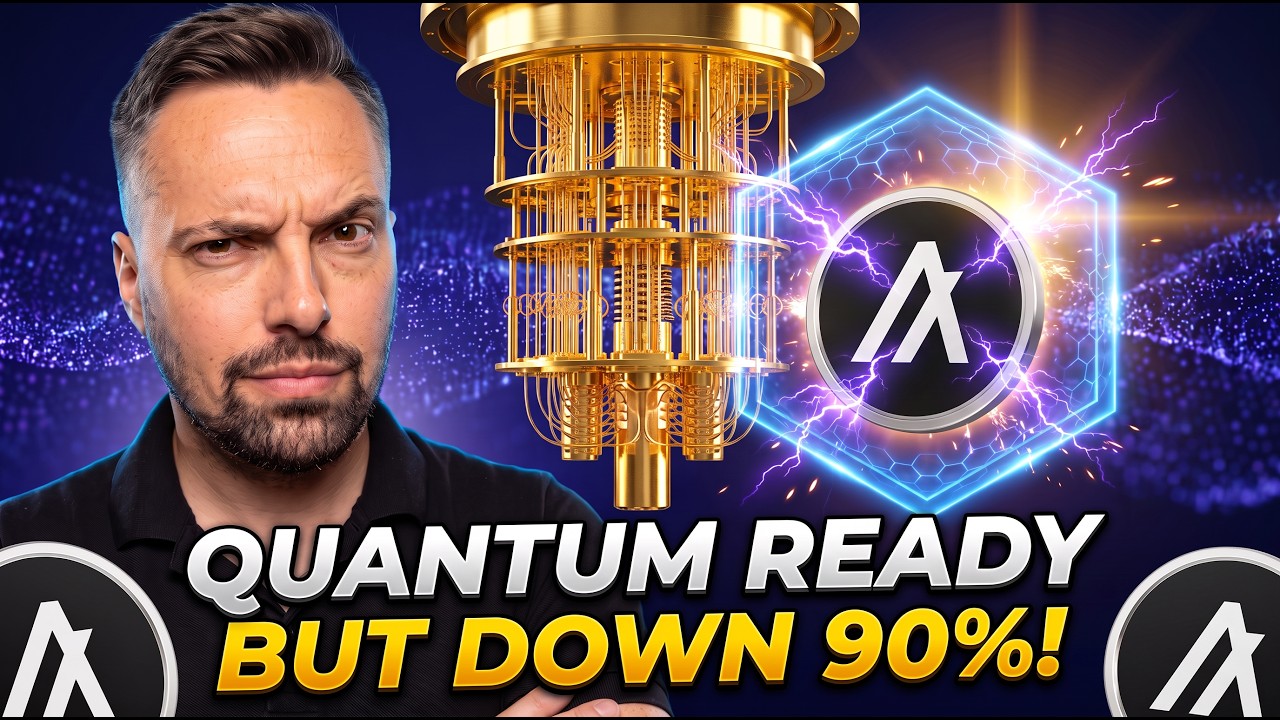
Google’s quantum research team published a security white paper in 2026, and one of the blockchains it pointed to as already supporting post-quantum signatures was not Bitcoin. It was Algorand. Yet ALGO, the network’s coin, is down more than 90% from where it began trading in 2019.
That gap is the subject of a recent Bullrunners video. It looks at what Algorand actually built, why the quantum angle is getting attention again, why the price has not followed, and a simple test for anyone who has held a coin for years without being sure what they are waiting for.
Who built Algorand?
Algorand was built by Silvio Micali, an MIT professor, not a crypto influencer. In 2012 he and Shafi Goldwasser won the Turing Award, often called the Nobel Prize of computing, for work that helped lay the foundations of modern cryptography.
That work includes zero-knowledge proofs: a way of proving something is true without revealing the secret behind it. The video’s example is showing a bouncer you are old enough to enter without handing over your birth date.
Micali has said he was drawn to crypto by the idea, common at the time, that no blockchain could be secure, decentralized and scalable all at once. He set out to prove that wrong. In a May 2022 Kitco interview, Algorand was introduced as a protocol with more than $4.8 billion in market cap. As the video puts it, on paper the project had everything.
What is Q-day and why does it matter for crypto?
Q-day is the point when quantum computers become powerful enough to break today’s widely used public key cryptography. Almost every crypto wallet is protected by math that normal computers cannot crack, but a large enough quantum computer could.
Algorand’s own channel, in a September 2026 explainer, described Q-day as a capability milestone rather than a calendar date. It would allow a quantum computer to break algorithms such as RSA and elliptic curve cryptography. That video said most experts expect Q-day in the 2030s or later, though the timing is uncertain.
Interest picked up in March 2026, according to the video, when Google’s quantum team published research suggesting that breaking the kind of cryptography Bitcoin uses could take far fewer resources than previously assumed.
What has Algorand done about quantum risk?
Algorand started preparing years ago, and the video calls this part real. The main steps it describes:
- 2022: Algorand began signing its state proofs, compact records that let anyone check the chain’s history, with Falcon, a post-quantum signature scheme selected by the US standards body NIST.
- August 2026: The version 5 upgrade made Falcon accounts available to ordinary users directly in the wallet.
- End of 2027: Algorand says it is aiming for broad quantum resilience by this date.
Micali explained in a July 2026 Binance interview why starting early matters. Quantum computers could not only attack a chain going forward but potentially alter its past history if that history was not quantum secure.
Switching later is hard. The video cites a CoinGecko explainer on Bitcoin’s challenge: every node has to agree to new encryption, users have to sign with their old keys to move to new ones, and inactive wallets that never upgrade would be left exposed. CoinGecko’s example is the roughly 1 million bitcoin in wallets said to belong to Satoshi.
Algorand is not finished either. Ordinary accounts still have to move over to Falcon.
Why is ALGO down more than 90%?
According to the video, part of the answer is supply. ALGO started trading in June 2019 at over $3, and by early October 2026 it was more than 90% below that level.
In an interview with the Algorand Foundation’s new CEO, who joined in September 2026 from Chainlink, an Algorand host noted that more than 9 billion ALGO had been issued against an absolute cap of 10 billion. The host asked how the foundation could become sustainable without selling ALGO, which at some point it will no longer be able to do.
The CEO called it a question the whole industry should have started asking earlier. He said there were too many years when projects did not have to think about it, because interest in the underlying tokens seemed almost endless.
The video’s reading: brilliant technology on one side, a coin that needs real demand on the other. Being early to a real problem does not pay holders if people will not need the solution for years.
Is the technology the same bet as the coin?
No, and the video argues Micali’s own work shows it. In the July 2026 Binance interview he described a new project: a tokenless consensus blockchain he called a “fiat chain.” It has no coin to buy.
The video stresses this is not bad news for Algorand, which has its own foundation and CEO. But it shows that even the people who build networks do not always see the coin as the point.
Micali has also described money, on Lex Fridman’s podcast, as essentially a social construct: it works because you know you can spend what you receive. The video’s takeaway is that a coin is worth what enough people believe it is worth, and keep believing. Strong math does not guarantee that.
The video also pushes back on the idea that money will rush into prepared coins when Q-day arrives. Micali himself said some chains are utterly unprepared but others are already working on the transition. If large networks upgrade in time, any quantum premium for one coin could shrink. Markets also tend to move on news long before the event itself.
A balanced view came from the Computerphile channel, quoted in the video. Such a quantum computer does not exist yet, and the speaker remained skeptical one will appear in 20 or 30 years, but compared preparing for it to buying house insurance. The video adds that you would not pay any price for insurance without checking what it covers and when it pays out.
The two-minute patience test
The video’s most practical point is that patience is only a strategy if you know what you are waiting for. Try this with the coin you have held the longest. Write down:
- The date you bought it.
- The one thing that has to happen for you to be proven right.
- The date by which, if it has not happened, you would rethink.
If lines two and three stay blank, the video says, you are not being patient. You are waiting without knowing for what.
| Patience | Hope | |
|---|---|---|
| Reason | You know why you hold the coin | A story you bought into |
| Time frame | You know when you will check if the reason still holds | Open-ended |
| Size | An amount that would not wreck you if wrong | Not considered |
| Target | A specific outcome | A price you would like to see one day |
The video notes this is not a judgment on Algorand. The same pattern happens with coins that go on to do well. The difference is whether you control the decision or the chart does.
What to watch next for Algorand
For anyone following ALGO, the video suggests tracking four things instead of headlines:
- Real usage: people and businesses using the chain every day and paying fees, not mentions in reports or logos on slides.
- The funding model: whatever replaces coin sales to fund the foundation, whether fees, revenue sharing or something else, will show whether holders benefit from the network’s success.
- The roadmap: whether Algorand reaches broad quantum resilience by the end of 2027, or quietly slips.
- Competitors: if other large chains upgrade quickly, Algorand’s head start matters less; if they struggle in the way CoinGecko describes, it could matter more.
Frequently asked questions
Why did Google's quantum report mention Algorand?
According to the video, Google Quantum AI's 2026 quantum security white paper cited Algorand as an example of a blockchain that already supports post-quantum digital signatures, noting that USDC is available on the chain.
Is Algorand quantum resistant?
Partly, per the video. Algorand's state proofs have been signed with the post-quantum Falcon scheme since 2022, and Falcon accounts became available to users in August 2026, but ordinary accounts still have to move over, and Algorand is aiming for broad quantum resilience by the end of 2027.
What is Q-day?
Q-day is the point when quantum computers become powerful enough to break widely used public key cryptography such as RSA and elliptic curve cryptography. It is a capability milestone rather than a calendar date, and Algorand's own channel says most experts expect it in the 2030s or later.
How much ALGO supply is left to be issued?
In an interview cited in the video, an Algorand host said more than 9 billion ALGO had been issued against an absolute cap of 10 billion.
Who founded Algorand?
Algorand was founded by Silvio Micali, an MIT professor who shared the 2012 Turing Award with Shafi Goldwasser for foundational work in cryptography, including zero-knowledge proofs.
Education and commentary only, not financial advice. Crypto is volatile and you can lose money. Do your own research and speak to a qualified advisor before making investment decisions. Figures and quotes are as reported in the video on October 10, 2026 and may have changed since.