
Cardano Out of the Top 10: What It Means for ADA Holders
Cardano fell out of crypto's top 10 as Zcash, Hyperliquid and Monero rose. What ADA staking pays, who holds the keys, and the risks to weigh.
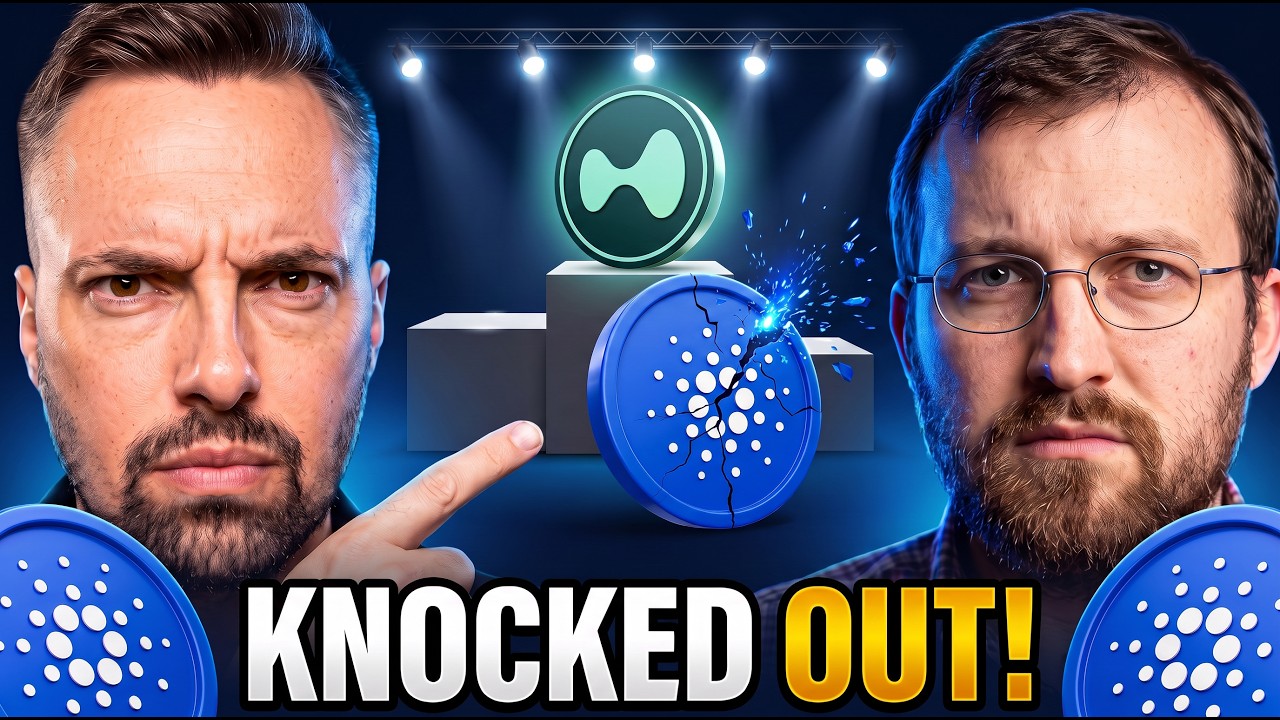
Key takeaways
- Cardano dropped out of the top 10 (excluding stablecoins) as Zcash, Hyperliquid and Monero moved up. The video dates the change to late September.
- ADA staking paid about 2% a year in October, according to Staking Rewards. When you stake from your own wallet, the coins stay in that wallet and are not locked up.
- The video says ADA staking rewards come mostly from a reserve set aside at launch. Hyperliquid's buyback is different: it spends exchange revenue buying HYPE on the open market.
- If an exchange stakes your ADA, it holds the keys and takes a cut. According to the video, it also decides whether airdrops ever reach you.
- Cardano staking never needs your recovery phrase. Anyone who asks for it is running a scam.
Cardano (ADA) has fallen out of crypto’s top 10 by market cap, leaving stablecoins aside, as Zcash, Hyperliquid and Monero moved up. Chainlink dropped out too. A Bullrunners video hosted by Rory dates the change to late September. It argues the money went to coins that earn revenue or offer something unique.
For holders, the ranking itself pays nothing. What matters, the video says, is whether your ADA is earning anything and who holds the keys while it does. According to the video, ADA was trading around 22 to 24 cents in early October. That is down more than 90% from just over $3 in September 2021, which gives those two questions extra weight.
Why did Cardano drop out of the top 10?
Cardano dropped out of the top 10 because three other coins grew faster: Zcash, Hyperliquid and Monero. The video’s explanation is that money went to coins that either make money or offer something people can’t get elsewhere.
Cardano founder Charles Hoskinson appears to be watching the same coins. In a clip the video says is from his livestream on September 18, he said: “We take a look at Hyperliquid. We take a look at the surge of Zcash. We take a look at the surge of Monero.”
The video also plays a clip in which Hoskinson criticizes the industry for tying a project’s worth to its place on CoinMarketCap. He recalls that people saw him as “the greatest entrepreneur ever” when Cardano was number three in 2021.
How is Hyperliquid’s buyback different from ADA staking?
Hyperliquid spends real revenue buying its own coin. ADA staking pays holders in extra ADA. That difference is at the center of the video’s argument.
Hyperliquid is a crypto exchange, and it uses its fees to buy its HYPE token on the open market. According to 24/7 Wall St, Hyperliquid had spent more than $1.26 billion on HYPE buybacks by mid-October. The video rounds this to $1.25 billion. Reports put the exchange’s revenue above $1.4 billion. The host compares it to a pub putting its takings into buying back its own shares, so each share becomes a little scarcer.
ADA staking works differently. When you stake, you back an operator who helps run the network, and you receive extra ADA. The video says most of those rewards come from a reserve of coins set aside at Cardano’s launch for that purpose. You end up with more coins, but nobody is buying ADA with outside money every day the way Hyperliquid buys HYPE. The video puts it this way: a big fund wants cash coming in, the way a landlord wants rent, not just a bigger pile of the same thing.
Hoskinson has floated the idea himself. According to the video, he hinted in March at ADA buybacks funded by Cardano’s treasury, the large pool of ADA the network holds to pay for its own development. Later reports described a formal buyback proposal from Hoskinson. Still, the host said he couldn’t find any ADA buyback that had actually started. In the video’s words, a hint isn’t a buyback.
Zcash, the privacy coin, drew money for a different reason. Grayscale said its Zcash fund passed $1 billion in assets in late September. Bullrunners has covered who holds the keys inside the Grayscale Zcash ETF separately.
What does Cardano staking actually pay?
Cardano staking paid about 2% a year in October, according to the tracking site Staking Rewards, as cited in the video. On $10,000 of ADA, that is roughly $200 a year.
A few points are worth knowing:
- When you stake from your own wallet, the coins stay in that wallet.
- There is no lockup, so you can sell at any time.
- Hoskinson says about 1.4 million people stake ADA worldwide. The video says he gave that figure on the same livestream.
The video ties this to the Federal Reserve raising rates to a range of 3.75% to 4% in September. Cash in a decent savings account now earns something. The host’s point is that idle crypto, like money in a current account, earns nothing while prices rise. For a fuller walkthrough of the mechanics, see how Cardano staking works.
Why does it matter where you stake your ADA?
Where you stake ADA decides who holds the keys and who takes a cut. According to the video, it can also decide whether you receive airdrops. The video describes two routes: staking yourself from your own wallet, or letting an exchange such as Coinbase stake for you.
In a clip the video says is from a July CoinDesk interview, Hoskinson says Midnight, a sister network to Cardano, adds value for ADA holders. His reasoning is that partner chains send airdrops (free token distributions) to ADA holders, so staking produces “not just ADA” but a portfolio of partner-chain tokens. The catch, according to the video, is that if your ADA sits on an exchange, the exchange decides whether those tokens ever reach you. The video says that in your own wallet, they come straight to you, although some airdrops have to be claimed.
| How you hold ADA | Who holds the keys | Staking rewards | Airdrops (per the video) |
|---|---|---|---|
| Staked in your own wallet | You | Paid to you | Can reach you directly, though some must be claimed |
| Staked through an exchange | The exchange | Paid to you, minus the exchange’s cut | Up to the exchange |
| Not staked | Depends on where it sits | None | Depends on where it sits |
One rule from the video has no exceptions. Cardano staking never needs your recovery phrase, the list of words that unlocks your wallet. If any website, app or “support” person asks for it to help you stake, it is a scam. Bullrunners explains what a seed phrase is and how to store it safely.
What are the risks for ADA holders?
The video weighs several setbacks against some good news. The good news first: in mid-September Cardano joined Mastercard’s crypto partner program. CoinMarketCap showed ADA up about 8.5%, crediting both the Mastercard news and Fireblocks adding support for ADA.
The setbacks the video lists:
- Grayscale withdrew its Cardano ETF application in early August. Crypto.news reported this was two days before Cardano would have become eligible under US rules that make such funds easier to list. Grayscale also withdrew its applications for Hedera and Polkadot.
- The 2026 Cardano Summit, planned for Singapore, was called off after a funding vote failed.
- The Cardano card, a Visa card some holders used to spend ADA, switches off on October 31. The reason is that Wirex, the company behind it, is changing how it operates. Reports say no replacement provider has been announced.
- The price is down more than 90% from its peak, and nobody can promise it recovers.
The video also plays Hoskinson saying, “Mistakes were made and I own the lion’s share of them as the leader.”
These risks are not unique to Cardano. Hyperliquid’s buyback only works while people keep trading on it. In October, HYPE’s price and the value of open trades both fell even as revenue passed $1.4 billion.
Staking doesn’t protect against price drops either. If ADA falls 10% in a month, a 2% annual reward doesn’t come close to covering it. The host calls staking a bit extra on top, not a safety net. He also says chasing whatever has just gone up is how many investors get burned. For a broader way to assess any coin, see three checks for spotting a bad altcoin.
The 2-minute ADA check
The most practical part of the video is a short check any holder can do on their phone:
- Open whatever app or wallet holds your ADA.
- Tap on Cardano and look for words like “staked”, “earning” or “rewards”.
- If there is a number, note how much it has paid you.
- If there is nothing, your ADA is not earning. Most apps don’t stake unless you ask, so a zero is common.
- Write the number down.
- While you’re there, confirm who holds the coins: you, or the app.
What to watch next
The video’s view is that Cardano may or may not return to the top 10, and nobody knows which. There are concrete things to track:
- Whether any proposed treasury buyback becomes a running program.
- Whether a new Cardano ETF filing appears after Grayscale’s withdrawal.
- What partner chains like Midnight distribute to holders.
- The October 31 shutdown of the Wirex-run Cardano card, if you use it.
For your own holdings, two questions stay the same whatever the price does: is your ADA earning, and who holds the keys?
Frequently asked questions
Why did Cardano fall out of the top 10?
According to the video, Zcash, Hyperliquid and Monero pushed into the top 10 by market cap in late September, not counting stablecoins, which knocked Cardano and Chainlink out. The video argues the money went to coins that earn revenue or offer something unique, such as privacy.
How much does Cardano staking pay?
According to the video, the tracking site Staking Rewards showed ADA staking paying about 2% a year in October. On $10,000 of ADA, that works out to roughly $200 a year, paid in ADA.
Is ADA locked up when you stake it?
Not when you stake from your own wallet. The video explains that the coins stay in your wallet and there is no lockup, so you can sell whenever you want.
Has Cardano started buying back ADA?
Not as far as the video could find. The video says Charles Hoskinson hinted in March at ADA buybacks funded by Cardano's treasury, and later reports described a buyback proposal from him, but the host said he found no buyback that had actually started.
Do I need my recovery phrase to stake ADA?
No. Staking on Cardano never requires your recovery phrase, and the video warns that any website, app or support person asking for it is a scam.
Full video transcript
From the video's captions, lightly formatted. Captions can mishear names and numbers, so check figures against the article above.
I was a smart guy, too, when Cardano was number three and everybody thought I was the greatest entrepreneur ever. In this industry, we fetishized and have become addicted to where you sit on the market cap, and your entire worth as a human being, the quality of your ideas, and other things is completely indexed to where you sit on CoinMarketCap.
Right, Bull Runners, that's Charles Hoskinson, the man who started Cardano. Back in 2021, Cardano really was number three. But in late September, Zcash, HyperLiquid, and Monero pushed into the top 10, leaving out the stablecoins, and Cardano got knocked out of the top 10, and Chainlink went with it. So, ADA holders, the big money went elsewhere, and 24/7 Wall Street had it in October. HyperLiquid bought back 1 and 1/4 billion dollars of its own coin.
So, if you own Cardano, and your ADA could be sitting there doing nothing while the big money gets paid, what did your ADA earn? Well, watch this. Because that's out over 1.4 billion dollars in revenue, which is mad, because it's a business spending the money it makes on its own coin every single day. And I'll show you exactly where the rest of the big money went. And there's a link in the description, the first one, that I'll get to in a few minutes.
It's for anyone whose crypto has been sitting there going nowhere. And for a lot of people, it's changed what their coins actually do for them. My name's Rory. I've been trading crypto and forex since 2020, and it's given me a full-time income and the freedom to travel the world while I do it. So, hang on.
Why does a top 10 list matter to you and me? Well, think about your everyday money first. Back in September, the Fed put interest rate up to between 3 and 3/4 and 4%. That pushes up what a mortgage or a credit card costs, right? But it also means cash in a decent savings account earns you something.
And the money sat in a current account earns next to nothing while your shopping bill keeps going up, doesn't it? So, it's the same with crypto. And ADA's had a rough run. It was just over $3 at the top 10 in September 2021, and in early October, it was trading around 22 to 24 cents. That's down more than 90%, which if you held it the whole way, is properly painful.
But, here's a bit a lot of holders miss. Cardano lets you stake your ADA, and staking is basically putting your ADA behind someone who helps run the network. And you get a bit of new ADA for it. And the coins never leave your wallet, and there's no lockup. So, you can sell whenever you want.
On the tracking site staking rewards, it was paying out 2% a year in October. It's not a fortune, but on $10,000 of ADA, that's roughly $200 a year you're either getting or you're not. So, here's one for your phone. Open whatever app your ADA's in. Tap on Cardano and look for the word staked or earning or rewards.
If there's a number, check how much it's paid you. And if there's nothing there at all, your ADA's sitting there doing nothing. And don't panic if it's zero, because most apps don't stake it for you unless you ask. Just write the number down, and while you're in there, check who's actually holding the coins, you or the app. That's 2 minutes, and it's the same check I'd want a mate to do before anything else.
Like if you're bullish, let's run it. Hey, bull runners, welcome back. So, look, if you've held ADA for years, it's a horrible feeling watching coins you'd barely heard of fly past yours, isn't it? You start doubting your own moves, and then you end up letting the headlines decide for you. I get it, and I've been there.
Back in 2022, I felt the drop from the top land in my own portfolio. And I held it though, because I'd done the research myself, and I believed in what I held. But holding through is one thing. Holding coins that just sit there earning nothing for years is something else and that's the bit we can actually fix. Am I telling you to buy Cardano?
Well, no. There may be better opportunities for your situation. But if you're holding $50,000 or more in crypto that's just sitting there, that's exactly what we sort out at Altcoin Pro. We help you put the crypto you're already hold to work in full self-custody on your own keys where it can't be flagged, frozen, or wiped out. So, click the first link in the description, watch the short video, hit the button underneath it, fill in the short form, and book your free 15-minute call.
Someone on the team will look at what you actually hold and if you're already well set up, they'll tell you that, too. And if you're watching on your phone, just tap more under the first video and it's the first link you'll see. And there's a real date on this one. The Cardano the card, the Visa card some ADA holders used to spend their coins, switches off on the 31st of October. So, if any of your crypto's tied up in an app like that, get the call booked before then so you've got a plan before the deadline, not after it.
Right, so where did the money go? Well, it went to coins that make money or that offer something people can't get anywhere else. Take HyperLiquid. It's a crypto exchange and the fees it earns gets used to buy its own coin, HYPE, on the open market. Think of a pub that puts every bit of its takings into buying back its own shares.
So, every pint poured makes the same shares a little bit scarcer. So, that's why so many traders rate it. And it's not the same as staking, by the way. When you stake ADA, you get paid in extra ADA and most of it comes out of a big reserve of coins that was set aside at the start for exactly that. So, you end up with more coins, which is nice, but nobody's out there buying ADA with real money every day the way HyperLiquid buys HYPE.
And that's a difference the big money cares about. A big fund wants something that brings in cash, a bit like a landlord wants rent, not just a bigger pile of the same thing. And Zcash is the privacy coin. Grayscale Zcash fund topped a billion dollars in late September. And remember, that's the same Grayscale that walked away from Cardano fund back in August, which I'll come back to in a minute.
And what I found interesting is that Cardano's own founder is watching exactly the same coins. Here's Hoskinson on his own livestream back on the 18th of September.
We take a look at Hyperliquid. We take a look at the surge of Zcash. We take a look at the surge of Monero.
So, he's studying what worked for them, and he's not daft. His network once sat at number three, which to me says a lot because the founder's looking at the coins that knocked his out. And he's floated the same idea himself. Back in March, Hoskinson hinted at buybacks for ADA using Cardano's treasury, which is a big part of ADA the network holds for paying for its own development. But a hint isn't a buyback.
Hyperliquid's machine runs every day. And when I looked into it, I couldn't find any ADA buyback that had actually started. So, what does Cardano give you then? Well, to be fair, quite a bit if you use it. Hoskinson reckons about 1.4 million people stake ADA around the world.
He said that on the same livestream. And he says staking pays you in more than ADA. Here he is with CoinDesk in July.
Midnight added a lot of value to the ecosystem, and the success and existence of Midnight means a lot of followers will come on. And every time they launch, airdrops come to ADA holders, and staking produces more yield because you get not just ADA, but you get the partner chain portfolio as well.
So, in plain English, Midnight is a sister network to Cardano. And its point is that when price projects like that launch, they hand out free coins to people holding ADA. That's what an airdrop is. But, you have to be holding it in the right place to get them. And that's the catch, isn't it?
Because if your ADA is sitting on an exchange, it's up to the exchange whether any of those free tokens ever reach you. In your own wallet, they come straight to you. Because there's two ways to stake. You can do it yourself in your own wallet with your own keys. Awesome apps, Coinbase for one, will stake it for you.
Now, that's easier, but they hold the keys. And they take a cut of the rewards. So, it's not just whether your ADA is earning, it's who's holding it while it does. And one thing to be really clear on, staking on Cardano never needs your recovery phrase. That's the list of words that unlocks your wallet.
So, if any website app or so-called support person asks you for those words to help you stake, it's a scam every time. Close it down and walk away. And Cardano's had some good news. Back in mid-September, it joined Mastercard's crypto partner program and ADA jumped on the news. CoinMarketCap had it up about 8 and 1/2%.
Right, the other side because I'm not going to sell you a dream. First, Grayscale, one of the biggest crypto fund managers out there, pulled its application for a Cardano ETF in early August. And crypto.news reported it was 2 days before Cardano would have become eligible. That's a fund you'd buy like a share, and they walked away from it. And eligible here means Cardano would have met the American rules that let a fund like that get listed more easily.
And Grayscale pulled out right before that door opened, which to me tells you something about how keen the big money was. Second, the 2026 Cardano Summit, which was meant to be in Singapore, was called off after a funding vote failed. Third, that Cardano card was switching off at the end of October because Wirex, the company behind it, is changing how it runs. And fourth, the price. Down more than 90% from the top is a lot to claw back and nobody can promise you it will.
Even Hoskinson owns the mistakes. Here he is again.
A mistakes were made and I own the lion share of them as the leader.
Which is honest of him to be fair. But it's not just Cardano that cuts both ways. Hyper liquid's buyback only works while people keep trading on it. And in October, as its revenue went past 1.4 billion, the high price and the amount of money in open trades both did. So the shiny coin with the buyback can fall too, right?
And staking doesn't protect you from the price either. You're paid in ADA, so if ADA drops 10% in a month, your 2% a year doesn't come close to covering it. It's a bit of extra on top, not a safety net. Now you might be thinking 2%. Why would I even bother?
And that's fair, but 2% of something beats nothing at all. And it's the habit that matters. Most people never even look, so their coins sit there for years without earning a penny. So what's my honest take? Getting knocked out of the top 10 stings, but where a coin sits on a list doesn't pay you a thing.
What matters for us is what our coins are actually doing and who's holding the keys while they do it. Cardano might climb back into the top 10 or it might not and nobody honestly knows which. But whether your ADA is earning and whether it's in your own wallet, that's something you can check and sort out in a couple of minutes, whatever the price does. And look, I'm not telling you to dump Cardano and chase hyper liquid either because jumping on whatever's just gone up is how a lot of us get burned in the first place, isn't it? The fix isn't a different coin.
It's knowing what every coin you hold is doing for you and having a plan for it before the next big headline lands. And knowing what you hold is what one of our members, Tom, was after. He left us a real review on Trustpilot and what he was after was structure, not another signal group. So the team organized everything with him. And now he knows what he holds and where it all sits.
His coach went through the wallets with him and setting up a hardware wallet one step at a time and by the end he felt a lot more sure about which coins to keep offline and which ones to put to work. Tom's result is his own and I'm not promising you the same, but if you've got 50 grand or more in crypto that's just sat there, the first link in the description is where to start. Book the free call before the Cardano card switches off on the 31st of October. So, top 10 or not, the question was never really where Cardano sits on a list. It's whether your ADA is working for you or just sitting in an app waiting for a headline.
Tell me in the comments. Be honest with me. Is your ADA staked in your own wallet, staked on an exchange, or doing nothing at all? And look, none of this is financial advice, guys. It's just my take after a lot of digging.
Crypto carries risk and what's happened before is no guarantee of what comes next. So, stick with me, subscribe, and there's a new one every day. Thanks for watching, guys. Keep your head, stack with purpose, and I'll keep you in
Education and commentary only, not financial advice. Crypto is volatile and you can lose money. Do your own research and speak to a qualified advisor before making investment decisions. Figures and quotes are as reported in the video on October 24, 2026 and may have changed since.


