Monero and Zcash Delistings: What Happened After Each Crackdown
Exchanges have delisted Monero and Zcash since 2018, and Binance dropped Monero in 2024. What followed, where the pattern breaks, and the 2027 EU rule.
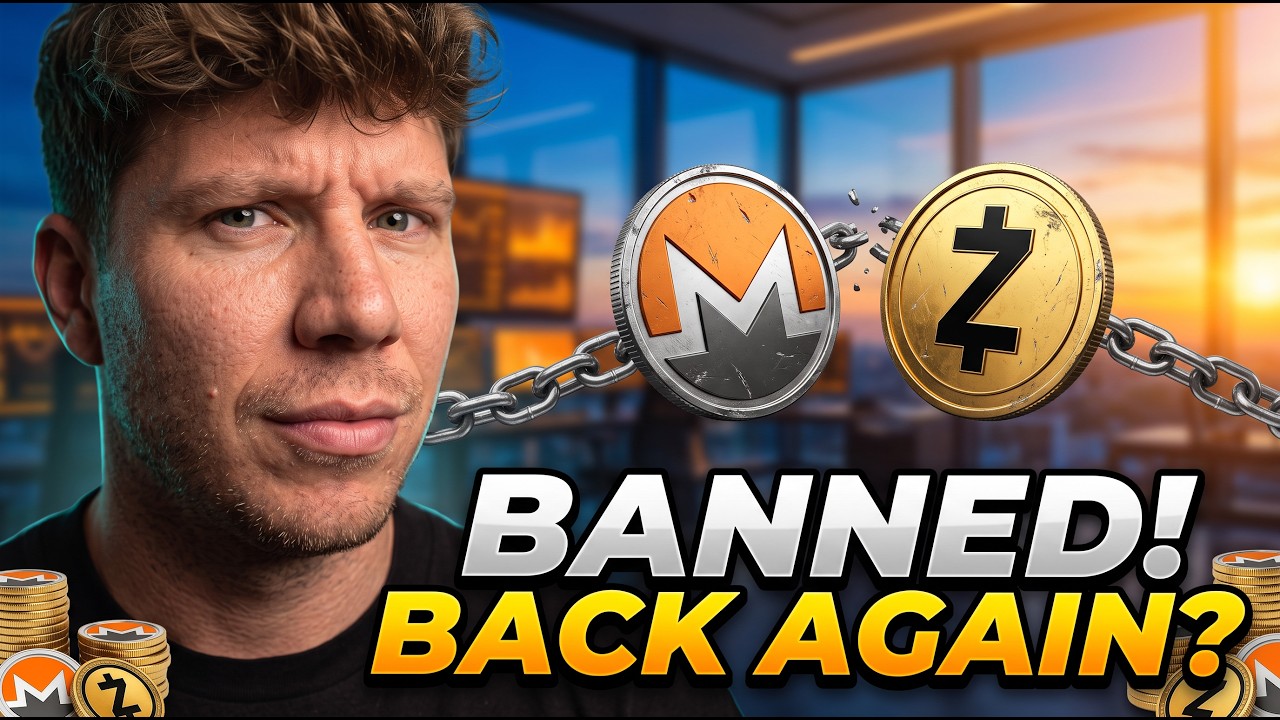
Key takeaways
- A delisting removes a coin from one exchange. The coin keeps running, and coins in your own wallet are unaffected on the day.
- According to the video, Decrypt reported privacy coins falling about 10% after Bittrex's delisting and The Block reported Monero falling about 15% after Binance's, yet both Monero and Zcash later set new highs.
- The pattern has limits: fewer exchanges means thinner liquidity, the video says recent highs may not be a pure privacy story, and smaller privacy coins may not follow the big two.
- According to the video, the EU rule applying from July 10, 2027 stops banks and crypto firms from handling privacy coins but does not make holding one in your own wallet a crime.
- The video's checklist: know your lawful exits, keep records (view keys can help), and avoid relying on a coin that could be delisted overnight for money you may need in a hurry.
Privacy coins like Monero and Zcash have been delisted, restricted or banned repeatedly since 2018, from Japan and South Korea to Bittrex, Binance and Kraken. A Bullrunners video hosted by George Lee traces what followed: price drops after some announcements, then new highs for both coins years later. The video also explains where that pattern breaks.
The next date on the timeline is July 10, 2027, when a European rule starts applying to firms that handle privacy coins. If you hold Monero or Zcash on an exchange, it helps to know how past delistings played out, and what they did and did not change, before the next email arrives.
What actually happens when an exchange delists a privacy coin?
A delisting means one exchange stops letting its customers buy and sell that coin and sets a deadline for them to withdraw it. The coin keeps running on its own network exactly as before. Anyone holding it in their own wallet notices nothing on the day.
The video stresses that the word sounds more final than it is. A delisting changes where people buy the coin and where they keep it. Holders who moved their coins to their own wallets before the deadline kept every coin and could still sell or hold as they chose. For background on why exchange closures matter in general, see how to protect your coins when an exchange shuts down.
The timeline of privacy coin crackdowns
The video walks through the major events one at a time. Here they are in order, as the video describes them:
- 2018, Japan: The exchange Coincheck dropped Monero, Zcash and Dash, reportedly in connection with Japan’s financial watchdog.
- September 2019, South Korea: Upbit, one of the country’s biggest exchanges, delisted the same three coins, citing money laundering concerns. Korean rules that took effect in March 2021 reportedly barred exchanges there from handling them at all.
- January 2021, Bittrex: The US exchange said it would remove Monero, Zcash and Dash. Decrypt reported privacy coins falling around 10%.
- August 8, 2022, Tornado Cash: The US Treasury sanctioned the Ethereum mixer.
- February 2023, Dubai: The regulator VARA wrote a ban on privacy coins into its rules.
- Late December 2023, OKX: The exchange said it would drop Monero, Zcash and Dash in early January 2024.
- February 6, 2024, Binance: The exchange said it would delist Monero. The Block reported Monero falling around 15%.
- October 2024, Kraken: The exchange delisted Monero for European customers.
- July 10, 2027, EU: According to the video, a European rule starts applying that stops banks and crypto firms from handling privacy coins.
What happened to Monero and Zcash after each ban?
According to the video, the two biggest privacy coins kept coming back. Four months after the Bittrex announcement, in May 2021, Monero was trading above $500. The host notes that nearly everything in crypto rose in 2021, so the delisting did not cause the rise. It just did not stop it.
The 2024 wave felt as if every door was closing. The video says Zcash moved first after it. In autumn 2025 Zcash climbed from the tens of dollars into the hundreds, and reports put its November peak at $744. Monero followed. It broke its 2018 record on January 12, 2026 and peaked at about $798 on January 14, according to CoinDesk and other market reports. That was less than two years after Binance delisted it. In early September 2026, Zcash went above $1,000 for the first time in about a decade.
The video adds two caveats. First, it says Zcash’s move above $1,000 came alongside heavy buying through a Wall Street fund, so it is not a pure privacy story. Second, when Monero set its January record, the on-chain investigator ZachXBT pointed to a theft. According to The Block and others, someone stole around $282 million in Bitcoin and Litecoin from one victim and swapped a large part of it into Monero. The video says some of that record may have been a thief’s buying.
How did the Tornado Cash sanctions end?
The Tornado Cash sanctions lasted about two and a half years before the US Treasury reversed them. Tornado Cash is not a coin. It is software on Ethereum called a mixer, which pools many people’s coins so it is hard to tell whose money went where.
The Treasury sanctioned Tornado Cash on August 8, 2022, alleging it was used to launder more than $7 billion, including funds stolen by North Korean hackers. The video shows a Bloomberg clip with Ari Redbord, a former federal prosecutor now at the blockchain analytics firm TRM Labs. In it, Redbord said the Treasury saw Tornado Cash as the chief money laundering tool for North Korean cybercriminals, which turned the issue into a national security matter.
Some of the mixer’s users sued the Treasury with Coinbase’s support. On November 26, 2024, a panel of judges ruled that Tornado Cash’s immutable smart contracts are not property and cannot be blocked. The ruling still validated the Treasury’s money laundering concerns. On March 21, 2025, the Treasury removed Tornado Cash from the sanctions list.
The video warns that this is not a free pass. Tornado Cash developer Roman Storm went on trial in New York. On August 6, 2025, a jury found him guilty of one charge, conspiracy to run an unlicensed money transmitting business, and could not agree on the others. Prosecutors asked for a retrial, which The Block reported was pushed back to April 2027.
Monero and Zcash were never on the sanctions list. But the case put the same question to every exchange, bank and regulator: should ordinary people be able to move money without being watched?
Why do privacy coins keep coming back?
The video gives three reasons and frames them as the host’s own research.
- Surveillance. A public blockchain is an open book. Once someone links your name to an address, they can follow what you do with it. In a CoinDesk interview shown in the video, which the video dates to October 2025, Mert Mumtaz, who runs the Solana company Helius, said he can learn more about people on-chain than he could if they used traditional finance. The host’s example: if you pay a friend from your wallet, they can see what else is in it. Every new tool that makes public chains easier to read makes a private chain look more useful.
- Fungibility. Fungible means every unit is as good as every other. On public chains, coins carry their history, and a coin that passed through a hacked or sanctioned address may be treated differently by some services. Privacy coins hide that history, so one coin is simply one coin.
- Delistings move coins, they don’t delete them. When a big exchange drops a privacy coin, many holders move their coins to their own wallets or to smaller and decentralized venues. Mumtaz described getting a coin on Solana, bridging it to Zcash and shielding it. He added that people should not break the law, and that wanting to keep your financial life private does not mean you are committing a crime.
For more on each coin’s design, Bullrunners has explainers on Monero’s origin and privacy technology and how Zcash’s supply works.
Where does the pattern break?
The video is clear that a pattern is not a promise. It lists three problems.
| Risk | What the video says |
|---|---|
| Liquidity | Each delisting means fewer big markets and fewer buyers when you need to sell. The drops on the news were real: about 10% after Bittrex and about 15% after Binance. Records don’t last, either. By late January 2026, Monero was reportedly more than a quarter below its January high. |
| The law | Rules depend on where you live. Exchanges in Japan and South Korea dropped these coins, and Dubai banned them in its rules. The EU rule targets banks and crypto firms from July 10, 2027, not personal wallets, but buying or selling through an EU exchange will no longer be possible from that day. |
| Survivorship | The pattern covers only the two biggest names. It says nothing about the many smaller coins that call themselves private, and even Zcash holders waited about a decade to see $1,000 again. |
In a second clip, Redbord explains why regulators push back. He said that after about 11 years as a prosecutor at the US Department of Justice, he sees blockchains as giving investigators unprecedented visibility into financial transactions. That visibility is exactly what privacy coins remove.
A calm, lawful holder’s checklist
The video closes with practical steps for anyone who holds privacy coins:
- Check the rules where you live. Get them from your regulator or a qualified adviser, not a forum. They differ by country.
- Know your exits. If your coins sit on one exchange, write down exactly where else you could lawfully sell them.
- Decide in advance. Know what you would do if your exchange emails you a delisting notice.
- Keep records. On-chain privacy does not change your tax bill. Monero and Zcash both let you share a view key, a read-only key that shows your transactions without letting anyone spend your coins.
- Size sensibly. A coin that could be delisted overnight should not be the one you need to sell in a hurry.
The host ends on one point. Privacy and hiding money from the authorities are different things, and regulators say the crackdowns are aimed at the second.
What to watch next
The next date on the timeline is July 10, 2027, when the EU rule starts applying to banks and crypto firms. If you hold privacy coins through a European exchange, check whether that platform has announced its plans and where your coins will sit on that day. The Roman Storm retrial, reportedly set for April 2027, is also worth following for what it shows about how US courts treat the people who build privacy tools.
Frequently asked questions
What happens to my coins when an exchange delists Monero or Zcash?
The exchange stops trading the coin and gives customers a deadline to withdraw. The coin itself keeps running on its own network, and coins already in your own wallet are not affected.
Did Monero and Zcash recover after being delisted?
Both later set new highs. Monero broke its 2018 record in January 2026 and peaked at about $798 on January 14, less than two years after Binance delisted it, and Zcash passed $1,000 in September 2026. The video notes that Zcash's rise came alongside heavy buying through a Wall Street fund and that some of Monero's record may have been a thief's buying.
Is Tornado Cash still sanctioned?
No. The US Treasury sanctioned it in August 2022, a court ruled in November 2024 that its immutable smart contracts are not property, and the Treasury removed it from the sanctions list on March 21, 2025. Developer Roman Storm still faces a retrial, reportedly pushed to April 2027.
Will holding privacy coins be illegal in the EU in 2027?
According to the video, the EU rule that applies from July 10, 2027 is aimed at firms: banks and crypto firms cannot handle privacy coins. Holding one in your own wallet is not made a crime, but EU exchanges will stop offering them.
What is a view key in Monero and Zcash?
A view key is a read-only key that shows your transactions without letting anyone spend your coins. The video says it can help you account for your activity, for example for taxes.
Full video transcript
From the video's captions, lightly formatted. Captions can mishear names and numbers, so check figures against the article above.
Japan's 2018, South Korea 2019, Bittrex January 2021, Tornado Cash August 2022, Binance February 2024, and a European rule that actually applies from the 10th of July 2027. Every one of those days I just said was reported as bad news for privacy coins and plenty of headlines treated it as the beginning of the end. So, privacy coin holders, here's the odd part. Delisted, banned, blocked, yet the big ones keep coming back. And if you own privacy coins, the big crackdowns since 2018 have followed the same pattern.
And it's so worth understanding before the next one lands, right? So, attention Monero and Zcash holders, because the exchanges kicked them out and you'll want to look at what happened next. Now, I'm not going to tell you this is a one-way bet, because it isn't. I'm going to show you where the pattern breaks. But it's a story about how markets react to bans, and nobody tends to lay it out from the start to finish.
So, before I go on, guys, there's a first link in the description to mention, all right? And this is because it's changed my life, it's changing hundreds of people's lives right now, and it could change yours. All right, I'm going to come back to it in detail later on, but if you want to go and check it out now, I'm going to have zero offensive opinion on you. Go and check it out right now, cuz it's probably the most important part of this video. So, who has ever opened an email from an exchange and felt their stomach drop?
Because that's how most of us meet these stories, right? It's not through a law or a court ruling, but it's through an email, and your exchange is removing a coin, or here's the date, please withdraw it before then. We didn't choose the timing, and we definitely didn't see it coming, all right? Somebody else made the decision for us, and we're left to react to it. Now, as we get deep into this video, you're going to be understanding different ways that cycles work, different patterns, okay?
And for example, we're going to be taking the pattern one cycle at a time, starting in Japan. But we're going to be doing that after the intro. Now, we're about to hit 400,000 subscribers, so if you could do me one favor from this video, and if you've not already clicked the link, please hit the subscribe button. If you're a returning subscriber, please please make sure you subscribe. If you're brand new to it, my name is George Lee.
We're about to hit the intro, we're about to get deep into this. Make sure you hit subscribe, and let's get going. In 2018, the Coincheck exchange reportedly published a Japan's final watchdog, right? It dropped Monero, Zcash and Dash. And the next year it was South Korea in September 2019 and Upbit, one of the country's biggest exchanges, they delisted the same three citing money laundering concerns.
So Korean rules that took effect in March 2021 went further and according to reports barred exchanges there from handling these coins at all. It's worth being clear about what a delisting actually is because the word sounds more final than it is, right? The exchange its customers buy and sell that coin. It gives them a deadline to move their coins out. The coin itself carries on exactly as before.
It just doesn't change and it's just on its own network. And anyone holding it in their own wallet doesn't notice a single thing on the day. Then at the very start of January 2021 the American exchange Bittrex said it would remove Monero, Zcash and Dash. Decrypt actually reported privacy coins falling around 10% after that announcement. And here's the first sign of the pattern, right?
Four months later in May 2021 Monero was trading above $500. To be fair, nearly everything in crypto went up in 2021. So the delisting didn't cause the rise, but it didn't stop it either. Holders who moved their coins to other wallets before the deadline kept every coin and could sell or hold as they choose. What it changed was where people bought the coin and where they kept it.
And that's the thread that runs through it. This whole video is going to be about that. But again, if I've not said it as always this is not financial advice. It's my research. It's my opinion.
I'm just giving it to you as an entertainment value. Plus I want you to have the real information, right? Cuz there's many YouTubers out there that will just tell you what they want for views. So you might not like what I'm about to say, but I'm going to say it and I hope you stay with me. So here's what I promised you.
When a delisting costs us money, it's usually not the coin's fault. It's because we had no plan. So we sold in a panic along with everyone else. Now I'm not telling you to buy Monero or Zcash, right? Cuz there might be better opportunities for your current situation.
But if your plan for a coin is really just hoping your exchange keeps listing it, then Altcoin Pro, the course that we built, helps you swap that hope for an actual plan. You work out ahead of time how you hold each coin, where you could sell it and what you would do if a door just shuts. So an email doesn't get to decide this for you, okay? Start now by clicking the first link in the description, fill in a short form, and then book your free 15-minute call, and one of the team's going to walk you through your own strategy and your own situation. If you're watching this on your phone, just tap more, and under the video it's the first link you're going to see.
Guys, just grab a slot before you forget, right? The strangest chapter in this whole story is up next, and it does involve the American Treasury changing its mind. Tornado Cash is not a coin, it's a piece of software on Ethereum called a mixer, which pulls lots of people's coins together, so it's hard to tell whose money went where. Now, on 8th of August 2022, the US Treasury put it on its sanction list, which actually meant Americans were not allowed to use it. Ari Redbord, a former federal prosecutor who works at the blockchain analysis from TRM Labs, explained the government's thinking on Bloomberg.
All right, check this clip out.
I think the way the US Treasury was thinking about these sanctions is they were going after a what they saw as the chief money laundering tool for North Korean cybercriminals. And you know, we've seen these huge hacks in the crypto space over the last year or so, which in many respects, when they involved North Korea, moved this issue from sort of a fraud and financial crime issue, which is still very serious, to really a national security issue.
It's a serious one, but then the courts got involved. Check this out.
For background, the Treasury sanctioned the mixing service back in 2022, [music] alleging it was used to launder more than $7 billion, including funds stolen by North Korean hackers. The Treasury was consequently sued by some of the mixer's users with the support of Coinbase. A panel of judges ruled yesterday that Tornado Cash's immutable smart contracts are not property, [music] and therefore cannot be blocked. The ruling does, however, validate the Treasury's concerns regarding money laundering by illicit foreign actors.
That ruling came on 26th of November 2024, and on the 21st of March 2025, the Treasury took Tornado Cash off the sanctions list. All right, so a ban that looked permanent actually lasted about 2 and 1/2 years. But please don't read that as a free pass, it's absolutely not. One of Tornado Cash's developers, Roman Storm, went on trial in New York, and on the 6th of August 2025, a jury found him guilty of one charge, conspiracy to run an unlicensed money transmitting business, and could not agree on the others. Prosecutors then asked for a retrial, and according to the block, it was pushed back to April 2027.
So, we don't know the results yet. Now, it's also worth noticing that Tornado Cash story did the privacy coins themselves. Monero and Zcash, they were never on the sanctions list, but the case put the same question in front of every exchange, every bank, every regulator, "Should ordinary people be able to move money without the world watching?" The question sits underneath every single day on our timeline. So, the lesson from Tornado Cash cuts both ways. Rules can be reversed, and the developers behind these tools can end up in court.
Both of those things are true. Then, came a bigger wave. And at the end of December 2023, OKX said it would drop Monero, Zcash, and Dash in early January. That was in 2024. So, on the 6th of February 2024, Binance said it would delist Monero.
Now, I know this because it was 2 days before my birthday, and I had Monero. And the block reported Monero falling around 15%. Kraken did the same for the European customers in October 2024, and then Dubai, the regulator VARA, had actually written a ban on privacy coins into the rules in 2023 February. So, if you held Monero in early 2024, like I did, it did feel like every door was closing, right? Here's what happened next.
Zcash moved first, and in the autumn of 2025, it climbed from the tens of dollars into the hundreds. And actually, reports put it in November's peak $744. Monero followed. On the 13th of January 2026, CoinMarketCap posted that it had hit another new all-time high above $689, and that's less than 2 years after Binance showed it the door. Then, in early September 2026, Zcash went above $1,000 for the first time in about a decade, according to reports.
Now, two honest footnotes before anyone gets carried away. Zcash's move above $1,000 came alongside heavy buying through a Wall Street fund, and according to reports, guys, it isn't a pure privacy story. And when Monero set its record in January, the on-chain investigator ZachXBT pointed at a theft. All right, according to the block and others, someone stole around $282 million in Bitcoin and Litecoin from one victim and they swapped a large part of it in Monero. So, some of that record may well have been a thief's shopping trip.
Okay, so you have to take that into consideration. So, why does this keep happening? Well, I point to three reasons personally and again it's my research and none of them is about getting rich in this case, right? So, the first is surveillance. A public blockchain is an open book and once someone links your name to an address, they can actually follow what you do with it and Mert Mumtaz, who runs the Solana company Halios, he put it bluntly on the CoinDesk in October 2025.
Yet, crypto today is more public in terms of I can see anybody who is transacting on chain basically interacting with whether it's their card payments, uh whether which exchange they use, I can find out a lot of information about them that I couldn't even find out if they were using the traditional finance system.
Picture how that plays out day-to-day. If you pay a friend from your wallet, then they can see what else is in your wallet. If the shop knows your address, it can see everything that comes in and goes out. Most of us would never accept that from a bank, right? And every single new tool that makes public chains easier to read, that makes a private one look a little more useful.
That's the first reason. Now, the second is fungibility. Fungible just means every unit is as good as every other, like one pound coin and the next. On a public chain, coins carry their history. If a coin passes through a hacked wallet or a sanctioned address in the past, some services may treat it differently from a coin that didn't.
Now, privacy coins are designed so that history isn't on display and so one coin is simply one coin. Now, for something that wants to be money, that matters a lot. The third reason is the one that explains the pattern, right? A delisting changes where a coin trades. It doesn't actually delete it.
So, when a big exchange drops a privacy coin, the holders don't vanish. Many of them actually move their coins into their own wallets or onto smaller and decentralized venues. Now, here's Mert again, all right? Check this out.
So, I don't [snorts] care about some centralized exchange. I'm just on Solana and then once I get it, I can bridge it to Zcash. And that's it. And then I can shield it. That is really you know, like there's obviously limits to this like people shouldn't be breaking the law by any means, obviously.
However, just because you want to not disclose your financial life for everyone to surveil forever, that doesn't necessarily mean you're you're committing a crime, right?
Notice his line about not breaking the law, right? Keep that in mind for the end of the video. The pattern looks like this. A crackdown hits, the price then drops on the news, and coins move off the big exchanges, and the people who wanted privacy in the first place, they keep holding. Then the next wave of surveillance worries arrives, and new buyers come looking for exactly what was banned.
Here's the honest part, because a pattern isn't a promise. The first problem is liquidity. Liquidity just means how easily that you can sell without moving the price, and every single delisting means fewer big markets and fewer buyers on the day you need one. The news itself hurts, too, right? We saw about 10% come off after Bittrex and around 15% after Binance.
And records don't last forever. So, later in January 2026, reports had Monero more than a quarter below its January high. The second problem is the law, which does depend on exactly where you live, right? Big exchanges in Japan and South Korea dropped these coins back in 2018 and 2019. Dubai banned them in its rules, and the European rule on our timeline is aimed at firms.
It's not wallets. Banks and crypto firms in the EU cannot handle privacy coins from that July date, but holding one in your own wallet isn't made a crime. So, if your only way in and out is a European exchange, then that door closes on that date. And it's worth hearing why regulators pushed back so hard. Here's Ari Redbord again, right, on what a public blockchain gives investigators.
Check this out.
I was a prosecutor at the US Department of Justice for about 11 years, and I can tell you that, you know, there there's there's no TRM to trace both cash smuggling and networks of Hawalas and shell companies and high-value art. Um, and I think, you know, look, what the blockchain allows for is unprecedented visibility on financial transactions.
Unprecedented visibility, and that's exactly what privacy coins take away, and it's why they draw so much fire, right? The third problem is survivorship. This pattern is about the two biggest names, and it tells you nothing about the many smaller coins that call themselves private. And it to be fair, even Zcash holders waited about a decade to see $1,000 again. There's no rule that says the next cycle has to rhyme with the last one.
So, what does a calm lawful holder actually do with all this? Well, start with the rules where you live. You get them from your regulator for a qualified advisor, not from a forum, and they really do differ from country to country. Then, know your exits. If your privacy coins sit on one exchange, then write down where exactly you could lawfully sell them.
And then just decide in advance what you would do if the exchange emails you. Keep records. Privacy on the chain doesn't change your tax bill, right? Monero and Zcash both let you share what's called a view key, and a read-only key that actually shows your transactions without letting anyone spend your coins. That can help you show and account exactly what you did.
And it can also help you size it sensibly. A coin that could be a delisted overnight shouldn't be the one you'll need to sell in a hurry. Remember, Mertz lying about not breaking the law, right? That's the point to finish on. Privacy and hiding money from the authorities are different things, and regulators actually say the crackdowns are aimed at the second, okay?
Wanting privacy is normal. Just make sure you're never on the wrong side of the law. Now guys, as always, all right, with these delistings or bans, I want to ask you, did you live through as a holder, or what did you actually do with your coins? I lived through this as a holder, and it's partly why I joined Altcoin Course, because I was making the wrong decisions. So guys, if you want to hit that link and change the way you see these things, please do.
As always, hit the subscribe button, right? If you want the pattern behind the headlines, we're going to be here every day, especially me. I'm going to be making videos like this all the time for you, so you can get the real information. The next day on that timeline is the 10th of July 2027. Whatever you hold, it's worth knowing where your coins will be sitting on that day, so make sure you hit that link.
Cryptocurrency carries risk, and past results are no guarantee of future ones. I love you guys. Stay bullish.
Oh.
[music]
Education and commentary only, not financial advice. Crypto is volatile and you can lose money. Do your own research and speak to a qualified advisor before making investment decisions. Figures and quotes are as reported in the video on October 24, 2026 and may have changed since.