
Zcash Counterfeit Bugs: Could Fake ZEC Exist, and Can You Check?
Zcash had two counterfeiting bugs, one kept quiet for 11 months. What happened in 2018 and 2026, and how the Ironwood turnstile lets anyone check ZEC supply.
Key takeaways
- Zcash's 2016 launch ceremony split a key that could have printed fake coins across six people, and only one of them had to destroy their piece for it to be safe.
- A 2018 flaw in the math behind Zcash could have allowed undetectable counterfeiting, and the team kept it quiet for about 11 months before disclosing it in February 2019.
- A second counterfeiting bug was found in Zcash's Orchard private pool in late May 2026, fixed within days and disclosed within a week.
- The Ironwood upgrade, live since July 28, 2026, seals the Orchard pool behind a 'turnstile' so no more coins can leave than went in, and anyone running the software can check the totals.
- A quick self-check from the video: if your app never had you write down 12 or 24 recovery words, the company holds your keys, not you.
Zcash has had two counterfeiting bugs, covered in the video, that could have let someone create fake ZEC without anyone noticing. One was found in 2018 and kept quiet for 11 months. The other was found in May 2026 and disclosed within a week. The company says no fake coins have been found, and the Ironwood upgrade now lets anyone check the supply.
This matters to holders of any coin, not just Zcash. On a private blockchain nobody can see inside to count the coins, so holders have to rely either on promises or on checks they can run themselves. The same question applies to every holding: who holds the keys, and can you verify what you own?
What was the Zcash key ceremony?
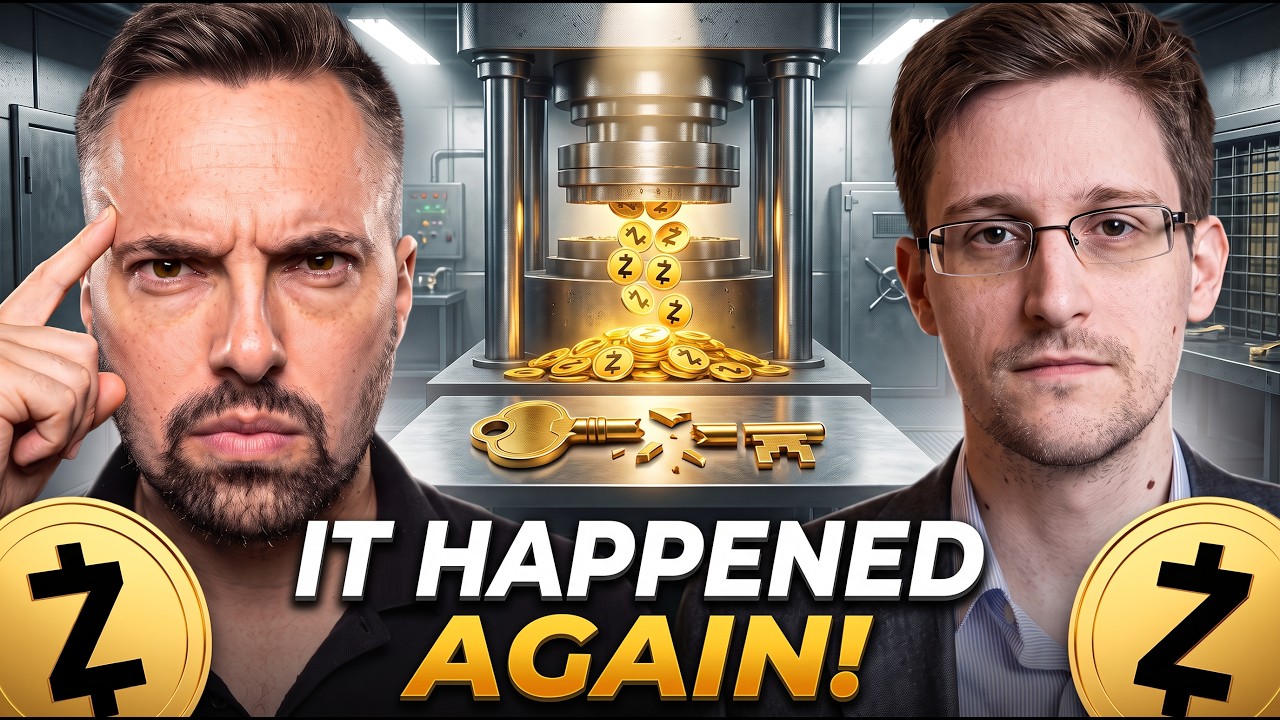
The Zcash key ceremony was a 2016 event in which six people jointly created the public parameters Zcash needed to work. Each held one piece of a private key and was meant to destroy it afterwards. That key could not break anyone’s privacy, but it could have been used to create counterfeit Zcash. The host compares it to a mold at a mint: anyone who keeps a copy can stamp out coins identical to the real ones. Cutting the mold into six pieces meant only one honest participant out of six was needed.
The sixth participant used the name John Dobbertin. In April 2022 he was revealed as Edward Snowden, the former NSA contractor. The full story of the ceremony and Snowden’s role is in how Snowden held a piece of the Zcash launch key. This article focuses on what came after: the two bugs that could have let someone counterfeit ZEC, and how holders can now check the supply.
What was the 2018 Zcash counterfeiting bug?
The 2018 Zcash bug was a flaw in the mathematics underneath the coin, not in the ceremony itself. In March 2018, Zcash cryptographer Ariel Gabizon spotted a mistake in an academic paper that Zcash’s proof system was built on. In the company’s own words, someone could have made fake Zcash without anybody spotting it, which was exactly what the ceremony was designed to prevent.
Zcash engineer Sean Bowe has described the setup as containing an “escape hatch” that had to be destroyed. The host compares the system to a maze whose builder knows every shortcut. The ceremony was meant to make sure nobody kept the map. Gabizon’s discovery was a gap in the maze itself, so nobody would have needed the map at all.
The video calls what followed the most troubling part:
- The video says that the day after the discovery, the record of the ceremony was deleted, and that the company kept up a story that it had gone missing by accident.
- Only four people knew about the flaw: Gabizon, Bowe, Zooko Wilcox and Nathan Wilcox.
- The team fixed it quietly in the October 2018 Sapling upgrade and told the public in February 2019, about 11 months after it was found.
The company said it searched for counterfeit coins afterwards and found none. Snowden later said on camera that supply checks built since then showed no counterfeiting had happened. The video says he was referring to the 2018 flaw.
The video also says that in December 2017, while still known only as John Dobbertin, Snowden posted about the risks. He wrote that the chance of all six ceremony participants being compromised was close to zero, but that an undetected flaw in the new cryptography was more realistic. Gabizon found that kind of flaw about 10 weeks later.
What happened with the 2026 Zcash bug?
On May 29, 2026, security researcher Taylor Hornby found another counterfeiting bug, this time in Orchard. Orchard is Zcash’s newer private pool, launched in 2022, and its design did away with the ceremony. An emergency fix went in between June 1 and June 3. Zooko Wilcox, Jason McGee and Hornby published the details on June 4 and 5.
Shielded Labs, the Zcash development group Wilcox now runs, also said something most projects would not put in writing. It said there was no definitive way to determine, using cryptography alone, whether the bug had been exploited. Because private pools hide balances, nobody could simply look inside and count. Shielded Labs said Hornby’s exploit would have produced unlimited counterfeit ZEC on the main network. The video says the founder later posted that Hornby did not create a single counterfeit coin.
A Zcash leader interviewed in the video explained the faster disclosure this time by saying “transparency is worth the price.” He acknowledged that it eroded some trust in the shielded pool, because people could not see inside. He said it increased trust in the teams.
How does the Ironwood turnstile let holders check supply?
Ironwood, formally the NU6.3 upgrade, went live on July 28, 2026. It seals the Orchard pool, so coins can only leave through a “turnstile” that never lets out more than went in. The host compares the turnstile to ticket barriers at a train station. If anyone had printed fake coins inside, the totals would not add up, and anyone running the software can see it.
According to the video, the founder said in June that he does not believe any counterfeit Zcash exists. He said Ironwood’s purpose is not to convince people of that but to let them check the supply themselves. The video says Zcash’s own account reported that more than a million ZEC had gone through the turnstile within a week of launch. CoinDesk reported about 176,000 ZEC crossing on the first day. Snowden described a similar turnstile, used after an earlier bug, as the reason he believes no counterfeiting happened.
The video sums up the lesson as “don’t trust, verify”: the Zcash team learned that “trust us” was not enough, so it built a way to count.
How can you check who holds your keys?
The video offers a simple self-check: open the app where your coins sit and ask whether it ever made you write down a list of 12 or 24 words. If it never did, the company holds the keys, not you. That list is your recovery phrase, explained in what a seed phrase is and how to store it.
The host points to Mt. Gox as the cost of not knowing. Its customers held Bitcoin on the platform until February 2014, when they could no longer withdraw. Repayments did not start until July 2024, more than 10 years later. For more on that risk, see how to protect coins before an exchange closes.
A short version of the check:
- List every app, exchange and wallet where you hold coins.
- For each one, note whether you were ever given 12 or 24 recovery words.
- Where you were not, the platform holds the keys and controls when you can withdraw.
- Where you were, confirm the words are stored safely offline.
What to watch next for Zcash
The next milestone is NU7, a Zcash upgrade targeted for November 5, 2026 and already running on the test network. The video says it would cut the time between blocks from 75 seconds to 25, roughly three times quicker. Bullrunners explained that change in Zcash NU7 and 25-second blocks.
The video also cites research firm Delphi Digital as saying Zcash’s private pools are back near record levels. Delphi’s report puts shielded supply at about 30% of all ZEC. Holders can keep checking Ironwood’s turnstile totals as more coins pass through. That is the part of this story that no longer depends on anyone’s word.
Frequently asked questions
Did Edward Snowden help launch Zcash?
Yes. Snowden was one of six participants in Zcash's October 2016 key ceremony, using the pseudonym John Dobbertin. He named himself in an April 2022 Zcash Media video and said he was never paid and had no stake.
Has anyone printed counterfeit Zcash?
No counterfeiting has been shown. The company said it searched after the 2018 flaw and found nothing. For the 2026 bug, Shielded Labs said cryptography alone could not settle whether it was exploited, which is why Zcash built the Ironwood turnstile so the supply can be checked.
What is the Zcash Ironwood upgrade?
Ironwood, formally the NU6.3 upgrade, went live on July 28, 2026. It seals Zcash's Orchard private pool so coins can only leave through a turnstile, and more can never come out than went in. Anyone running the software can check the totals.
When was the 2018 Zcash bug disclosed?
The flaw was found in March 2018, fixed quietly in October 2018 and disclosed in February 2019, about 11 months after it was found. A Zcash leader interviewed in the video said the faster disclosure in 2026 was because 'transparency is worth the price.'
What is the next Zcash upgrade?
The next upgrade, NU7, is targeted for November 2026. According to the video, it would cut the time between blocks from 75 seconds to 25 seconds.
Full video transcript
From the video's captions, lightly formatted. Captions can mishear names and numbers, so check figures against the article above.
Not all analysts have the ability to target everything, but I sitting my desk certainly had the authorities to to wiretap anyone from you or your accountant to a federal judge to even the president if I had a personal email.
From you or your accountant to a federal judge to even the president. Now, that's Edward Snowden in a hotel room in Hong Kong in 2013. And this one's been doing my head in all week. Three years later, the same bloke was holding one piece of tea that would have printed Zcash out of thin air and nobody would have ever known, which is mad, right? And he did it under a fake name, John Dobbertin.
For nearly six years, nobody had a clue it was him. But that's not even the strangest bit, right? Not long after launch, the team behind Zcash found a hole that could print fake coins and they kept it quiet for 11 months with a cover story. Then this summer, it happened again. So, the big question in this one is could anybody have printed fake Zcash without us ever knowing?
And is there any way to check? Well, I'll give you the answer. And before we're done, I'll get you to check one thing on your own phone, which is whether you actually hold the keys to your coins. If you're holding Zcash or any coin really, right? On a promise that somebody did the right thing with the key, I'm right there with you.
If you've got a proper bag, this all comes down to one question, doesn't it? Who actually holds the keys to our coins? And could we ever check? And by the end, I'll show you the check Zcash lot built so nobody has to take their word for it. And the three decisions it leaves with us.
So, stay with Right, welcome back to Bull Runners. It's me, a coffee, and a pile of old ceremony files. And this is my take. So, tell me yours in the comments. I'll give you the good and the bad on this one because you can't make a proper call with your own money on half the story.
[music]
So, picture it. It's October 2016 and six people in six different places are switching on brand new computers from random shops. They physically ripped the Wi-Fi and the Bluetooth out so they can never go online. Each one makes a piece of a key and when they're done, they're meant to destroy their bit. Now, that sounds a bit over the top, doesn't it?
Well, the company that built Zcash explained why in its own film back in 2017.
While the private key would not have allowed the violation of anyone's privacy, it would have allowed the creation of counterfeit Zcash. So, we went to extraordinary lengths to make sure that it never came into existence at all. The ceremony's first core defense was multi-party computation. Six participants in undisclosed locations across the globe collaborated [music] to construct the public key needed to make Zcash work.
It would have allowed the creation of counterfeit Zcash.
[snorts]
If that sounds like gobbledygook, think of the mold at the Royal Mint. Keep a copy of the mold and you can stamp out the coins that look exactly like the real ones. And with a private coin like Zcash, nobody can see inside to count them. So, they cut the mold into six. And as long as just one of those six people destroyed their bit, it could never be put back together.
Which is clever because you only need one honest person out of six. Five of the six were known names. But, the sixth went by John Dobbertin and nobody knew who that was until Zooko Wilcox, the bloke who founded Zcash, finally let it out on camera in April 2022.
Last night, I sent a note to John Dobbertin. [music] Sir, I said, long ago, about 5 years ago, I told you I would keep the secret of your participation in the ceremony until you told me it was okay to [music] share it. And just now as we started recording, I got a message back from John Dobbertin. He said, as long as it's clear that I was never paid and had no stake, it was just a public interest thing,
[music]
I think you can tell people. And today I can finally let go of the last secret. My name is Edward Snowden. I participated in the Zcash original ceremony under the pseudonym John Dobbertin.
Now, did you catch what he asked for before his name came out? I was never paid and had no stake. The man who walked out of the NSA with its secrets wanted it on record that he never made a penny out of it, which I respect, okay? But this is the president talking about him in 2013.
No, I don't think Mr. Snowden was a patriot. Mr. Snowden's been charged with three felonies.
You've got a man the US had charged with three felonies holding a sixth of a money printer, and the whole thing only worked if one of the six kept their word. To me, that's the best crypto law going because every word of it on the record. If you're already clocked Snowden was in that room, stick Zcash in the comments. Now, it's a cracking story, but the key I'd actually want to know about, right, is the one to your own coins, and I've got that one wrong myself. You know, I've been there.
You can lose a whole evening down a rabbit hole like this while your own coins are sat on a platform where somebody else holds the key. Back in March 2018, a Zcash cryptographer called Ariel Gabizon was at a conference when he spotted something in the mass under the coin. Now, it wasn't the ceremony at all. It was a mistake in a 2013 science paper the coin was built on. And in the company's own words, someone could have made fake Zcash without anybody spotting it, which is kind of mad because that's the exact thing the whole ceremony was meant to stop.
The very next day, the record of the ceremony got deleted and the company kept up a story that it had gone missing by accident. Well, only four people knew and one of them was Shawn Baugh. So, here he is that August.
If they can get to the end they they can compute the proof. But the person who creates the environment knows all the shortcuts and knows all the ways around it and knows how to traverse it without actually performing the computation. So, this is the trade-off that we get where where we get Zcash snarks, we get this magical these magical proofs that are really tiny, but there's this escape hatch which we have to destroy. We have to try to destroy when we construct these this environment. So, that's what the parameters are.
They're basically just this environment. And the parameter generation ceremony is an attempt to construct it in a way where we can feel more confident that the actual, you know, toxic waste or the the second approach to constructing a constructing a fake proof is not possible. That is destroyed.
An escape hatch which we have to destroy. So, picture a maze, right? Where whoever built it knows every shortcut. The ceremony was there so nobody kept the map. But what Gabberson found was a gap in the maze itself.
So, you didn't even need the map to use it. And to be fair to them, the company did say it went looking for fake coins afterwards and found nothing. So, for nearly a year, Zcash holders were running on a company's word without even knowing it. Most of us do the same with our own bags, don't we? We bought on a headline and left it on an exchange where the platform holds the key, writes the rules, and decides when we get our money out.
Now, the ones who come through these things fine, right? Usually bought the same coins as the rest of us. They just had a plan for where their key sits, and most of us were never shown one. And while I think of it, the team's put together a free briefing. It's basically how to get what you're already holding doing something, and how to get it off the exchange and into your own wallet.
It's the first link in the description. So, have a look once you've finished this one. Right, back to it. Then this summer it happened again, which really got me. At the end of May, a researcher found another counterfeiting hole.
This time in the newer private pool. If you don't know what that is, it's a private side of Zcash, the 2022 version that did away with the ceremony. They had it fixed within a few days, and within the week the founder had put the whole lot out in public. There is no way to cryptographically prove whether the vulnerability was exploited. And that's them saying that about their own coin, which is wild, because most teams would never put in that in writing.
So, what do you do with that? Well, here's the team's answer about a week later.
If if it has been exploited, there will be proof that it has been exploited because the origin pool will go to zero. Um and other people will be um in the origin pool not able to move funds. Uh so, we'll we'll soon know. We'll have an upgrade called Iron Maiden next um next month. You needed to be able to verify the turnstile in Zcash will allow us to uh have a verification of the circulating supply, but the the character of the of the security research you're uh Taylor is um unbelievably high, and so uh I would take issue with anybody that would that would challenge that about him, but I know you ultimately at the end of the day um you know, don't trust, verify.
So, uh we'll see.
Don't trust, verify. And that's what they went and built. At the end of July, Zcash switched on an upgrade and called it Ironwood. Every coin leaving the old private pool has to go through a turnstile, like the barriers at a train station, and more can never come out than actually went in. So, if anybody had printed fake coins in there, the sums just wouldn't add up.
And anybody running the software can actually see it, which is brilliant. You don't have to trust anybody anymore. You just count it. Which brings it back to our coins. Well, it's the same question, isn't it?
Who's got the key to yours? Well, here's one for free. Open whatever app your coins sit on, right? Has it ever made you write down a list of 12 or 24 words? If it never did, the key's with them, not you.
That's how Mount Gox customers held their Bitcoin right up until February 2014, when it stopped them taking it out. There's still the darker question though, isn't there? Did anybody print fake coins while those holes were open? Well, Snowden had his say on that, too, and I'll play you his answer in a minute. Most of us only find out where our coins really live on the worst possible day.
Not because we're daft, right? It's because nobody ever walked us through it, did they? And the thing is, I'm not just saying that. That was me. I once passed a funded challenge with a trading firm, you know, on a hundred grand account.
If you don't know what that is, it's where they back you with their own money once you pass their test. And then they refused to pay out around 30 grand. It took a long time and a lot of emails, and I genuinely thought I'd never see that money. It was paid in the end, and I've never used them since, but I still remember that feeling, right? My own money and somebody else is holding the key to it.
And I bet some of you have been there, but it is an easy one to fix. That's what our private intelligence network is for, guys, right? Most of what I bring you on this channel comes from inside of it, and in there it goes a lot deeper than I can in one video. Basically, the research team digs into where this is heading, and members hear it first. They'll help you get it on your own key.
So, no bank or exchange can freeze it like Mount Gox did. They'll show you how to get what you're already holding earning, instead of just sat there. And every week there's a call where the team says when they're buying and when they're taking profit, so you're not guessing. And everyone in there is holding a decent bag and is in it for the long haul, so same as you and me. And honestly, I'd personally be a lot further along myself if we had actually started Altcoin Pro sooner.
And listen, if you opened your app earlier and it never once asked you to write those words down, that's exactly what the 15 minutes is for. So, here's what I'd do. Tap more under this video and hit the very first link. Watch the short free briefing, then book your free 15-minute call with someone on the team, right underneath it, okay? They'll look at what you're holding and tell you straight whether it's right for you.
That is the first link. So, pause this, do it now, and come straight back, okay? I'll be right here. It's built for people holding $50,000 or more in crypto. And if that's not you yet, that is absolutely fine.
Keep watching these videos with me. They're up every day. They're free, and we will keep learning this together. Right, Snowden's answer, because I promised you that. Years after the ceremony, he took on the darker question himself on camera.
[laughter]
And I I think it's pretty clear now, so many years later, uh that we've seen validators and um checks built into the deco- uh the uh Zcash ecosystem to see has there been any sort of uh currency counterfeiting? Have there been more coins created than should have been created? Uh there's a turnstile that they created at one point um when there was a bug that uh showed it might be possible for someone to have exploited that. And so many years later we've seen that it's never happened. Um and I think, you know, that that's a a wonderful thing.
So many years later we've seen that it's never happened. He's talking about that first hole here from 2018 and his answer is no, it never happened. And that turnstile he mentions is basically the same idea Iron Wood now runs on the newer pool. And here's what blew my mind because he'd seen it coming. Back in December 2017, while he was still John Dobbertin to the rest of us, right?
He posted that the chance of all six being compromised was close to zero. But then he added that an undetected flaw in the novel cryptography is more realistic. 10 weeks later, that's just what Gazebon found. Whether that [snorts] was luck or not, right? He called it first, which to me is crazy.
Now, the bit that stinks, they fixed it quietly that October and only told everybody in February 2019. 11 months after they found it by the founder's own count. So, it was more than a year after Snowden's post before any of us were told. And a lot of holders reckon that's what they'd rather we never saw. That's a sort of detail the research team digs out for our members, okay?
So, where's it all up to now? Well, within a week of Iron Wood going live, Zcash's own account was saying more than a million Zcash had already gone through it. Back in June, the founder said he doesn't believe there's any counterfeit Zcash at all. But the whole point of Iron Wood, he said, isn't to convince people of that. It's so you can check the supply for yourself.
Then, later in the summer, he posted that the researcher who found the hole had a tool that could make endless Zcash, and he didn't create a single counterfeit penny, which says a lot about that bloke because he could have printed whatever he wanted. Search Zcash or Ironwood on your phone, and it's all there. 10 years on from those six computers, anyone running the software can check the sums for themselves. So, what's next then? Well, Delphi Digital, a research firm, put out that the private pools are back near record levels.
The next upgrade is planned for November, cutting the wait between blocks from 75 seconds to 25, so roughly three times quicker. And the block had holders voting a million and a half dollars in grants to the find. Why tell everybody inside of week this time when they kept it quiet for 11 months in 2018? Well, that comes straight from the boss.
Yeah, I think transparency I think transparency is is worth the price. Um I mean, the nature of what we're building it it it it it the the the weird thing here is like, right? Is like it it eroded some trust in this shielded pool, right? Because people are not sure, um you know, if there was an exploit because they can't see inside, but it increased the trust of the teams, I think.
He says, "Transparency is worth the price." And that's a long way from a cover story, isn't it? Some of you are going, "Fine. I'll leave my coins where they are and sort it all out once the price moves." But, look at what waiting cost the Mt. Gox customers, okay? They weren't waiting on a price.
They were waiting on their own coins, and the repayments didn't start until July 2024, which is over 10 years. So, waiting's fine, but sort out who's holding the key while you wait. That's a big part of what the team helps members with. Well, my honest take, I don't think anybody printed a single fake coin. And I'd put money on Snowden's piece of that key being long gone.
But the Zcash lot learned the hard way that trust us was never going to be enough. So, they built a way to count it. And that's a lesson I'd take for your bad and mine. So, where does that leave us? Well, Snowden held a piece of key that could print money, and the team kept a whole quiet for 11 months back in 2018.
When it happened again this summer, they built a way for anyone to count the coins. Meanwhile, most of our own coins are still behind a key we've never seen. And that leaves you and me with three decisions, okay? So, who holds the keys to our Zcash and the rest of the bag? Us or a company?
Is any of it doing something while we wait, or is it just parked? And if another headline like this one in June lands overnight, do we already know when we'd get in and when we get out? Because if we haven't decided, the headline decides for us. So, for me, the time to get a plan sorted is before the next one of those headlines lands, not the morning after. Now, not being able to get at your own money is a horrible feeling, and I never want it again, right?
I send money back and forth to Asia and America all the time, and it still takes more than 3 days. That's my own money stuck on pending with somebody else deciding when it lands. And if you've ever sent money abroad, you'll know that feeling. So, yeah, sort it before you need to. It's the same with where your coins are kept, right?
One of our members, Julio, has been in crypto since 2018, teaching himself mostly off YouTube and storing his coins the wrong way cost him. Now, this is a genuine review he left on Trustpilot. In his own words, he had profitable trades but also major losses from not using a secure way of storing his coin. Now, he's got a coach who'll explain the same thing a different way until it clicks even in the evenings and at weekends while he runs his business. Now, that's what it looks like when somebody finally shows you where the key should sit.
Results like Julio's are exceptional and they didn't happen by sitting still. So, be exceptional. Look, you could leave it and hope the timing works out or try and piece it together yourself at midnight reading the old ceremony files like we all have. I'd rather you just spent 15 minutes with the team and came away with a plan for your bag. It's free and worst case, you come away clearer.
So, tap more, hit the first link, watch the free briefing and book the call. 15 minutes, right? And you'll know where your keys are and what the plan is. And look, none of this is financial advice, guys. It's just my take after a lot of digging.
Crypto carries risk. What's happened before is no promise of what happens next. And a member's result isn't a promise of yours, either. So, stick with me, subscribe and there's a new one up every day. Tell me in the comments, if you'd been around in 2016, would you have trusted six strangers with a key that could print money knowing one of them was Snowden?
And keep an eye on that November upgrade because it's the next big change since Ironwood went live. Thanks for watching, guys. Keep your head stacked with purpose and I will keep you posted. Oh.
[music] [music]
Woo.
[music]
Education and commentary only, not financial advice. Crypto is volatile and you can lose money. Do your own research and speak to a qualified advisor before making investment decisions. Figures and quotes are as reported in the video on October 19, 2026 and may have changed since.


