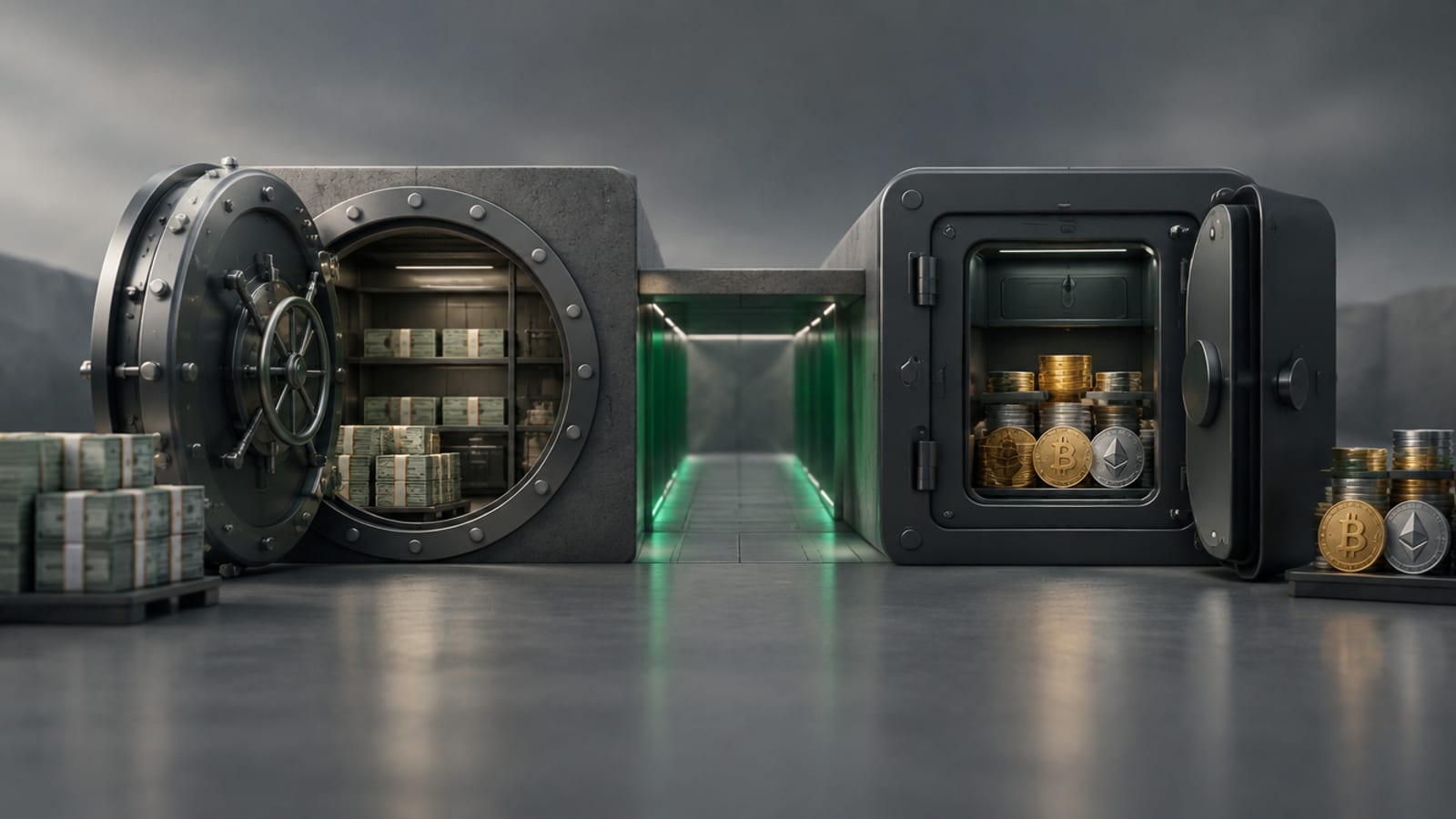
DTCC on Canton: Who Gets In and Who Holds the Root Key
DTCC ran tokenized Treasuries and shares across Canton. What the trades showed, what the SEC letter says about the root wallet, and where Canton Coin fits.

Key takeaways
- DTCC ran its first live trades with tokenized Treasuries and shares on July 15, 2026, across its own private network and Canton.
- According to the video, Canton Coin played no stated role in those trades and the Treasuries were not settled in it, though Canton's fees are paid by burning the coin.
- The SEC staff's December 2025 no-action letter to DTC, a DTCC subsidiary, says only DTC participants can register wallets, and DTC keeps a root wallet that can move, mint or burn tokens without the owner's keys.
- DTCC's full tokenization service is due in October 2026 for eligible DTC participants. The video says it depends on operational readiness and regulatory clearance.
- For your own coins, check where they sit, who holds the keys and whether the terms of use mention 'title'.
The DTCC, the firm that settles the US stock market, ran its first live trades with tokenized Treasuries and shares on July 15, 2026, partly on the Canton Network. According to the video, Canton Coin played no stated role in those trades, and an SEC staff letter gives DTCC’s subsidiary DTC a root key over the tokens.
For anyone holding Canton Coin, the details matter more than the headline. The video’s view is that Wall Street is building on Canton, but through a door marked “eligible participants,” with the coin sitting beside that door rather than inside it. The same question about who writes the rules applies to wherever your own coins sit.
What is the DTCC?
The DTCC is the back office that settles the American stock market. People inside the firm, in a clip played in the video, call it “the most important company you never heard of.”
The firm grew out of a paperwork crisis. In June 1968 the New York Stock Exchange began closing every Wednesday for the rest of the year because back offices were buried in paper certificates. A veteran quoted in the video recalls that the first settlement change he lived through made the cycle longer, not shorter, just to cope with the volume. The video says that by the end of 1970, nearly one in six brokerage firms had been forced to merge, close or go public.
The Depository Trust Company (DTC) was set up in 1973. Shares went into one place and stayed there, held in the name of a nominee called Cede & Co. That arrangement still shapes ownership today. If you own shares through a broker, the name on the company’s register is usually Cede & Co., holding for your broker, who holds for you.
What did DTCC run on Canton in July?
On July 15, 2026, DTCC processed live transactions using tokenized versions of shares and Treasuries that DTC already holds. A tokenized asset is a digital twin of the real thing: the same Treasury, able to move on a blockchain.
A DTCC spokesperson in the video said the firm worked with nearly 40 institutions across traditional finance and decentralized finance, covering collateral, treasury and equity workflows. The video says DTCC’s release names more than 30 firms, and lists these:
- BlackRock, Goldman Sachs, JPMorgan and Vanguard
- Citadel Securities
- The New York Stock Exchange, Nasdaq and CME
The same morning, according to the video, JPMorgan tokenized its holdings in QQQ, the large Nasdaq tracker fund, and used tokenized assets to cover its margin at CME. Margin is the deposit a trader puts up to keep positions open.
DTCC ran the trades across two networks that day: its own private network and Canton, which it calls the public one. The video says Canton’s account posted that every completed use case ran on Canton. DTCC had also joined Canton’s super validators, the small group of firms that help run the network, in December 2025. For more background on how Canton and its coin connect to these firms, see Bullrunners’ earlier look at Canton Network, CC and what LSEG, DTCC and Visa mean for the coin.
Did Canton Coin play a role in the DTCC trades?
No. According to the video, Canton Coin has no stated role in the DTCC trades, and the Treasuries were not settled in it. Anyone claiming DTCC money flows through Canton Coin is going beyond what the documents say.
That doesn’t make the coin irrelevant. Yuval Rooz runs Digital Asset, the company that built Canton. He describes Canton Coin as a fully public, permissionless crypto asset with no issuer, whose transactions everyone can see. Super validators validate it. Per the video:
- Canton’s documentation says fees for using the public side are paid by burning Canton Coin.
- Canton’s blog says the coin launched with no pre-sale and no pre-mine.
In the video’s view, the coin sits next to the rails even though it isn’t what gets settled. Whether more institutional traffic ends up feeding demand for the coin is the open question for holders. The host thinks there’s a real chance it heads that way but that it may take longer than people want. That is his opinion, not something the documents show.
The video says some holders describe Canton Coin as “the retail shadow of a permissioned system”: retail gets a coin, big firms get the rails. The host calls that theory half right.
Who holds the master key on DTCC’s rails?
DTC, the DTCC subsidiary that holds the securities, keeps the master key under an SEC staff no-action letter issued to it on December 11, 2025. A no-action letter is a regulator saying, in effect, “do it this way and we won’t come after you.” The letter sets out these rules:
- Only DTC participants can register a wallet.
- The tokens can only move between those registered wallets.
- DTC keeps a root wallet on each blockchain, and its keys let DTC convert, transfer, mint or burn the tokens without the wallet owner’s keys.
The host says he isn’t calling this sinister. He sees a master key as a sensible safety net for a firm settling the whole market. His point is that even on blockchain rails, the operator at the top kept a key that works on everyone else’s wallet, and wrote that into the rules before day one.
Regulators have also opened the door further. In a clip in the video, the SEC chairman described three steps:
- a joint interpretive release with the CFTC defining what counts as a tokenized security
- a proposed rule on raising money onchain, which he said the SEC is pursuing even though the Clarity Act “failed in Congress”
- an “innovation exemption” for trading tokenized securities, which he likened to a sandbox
JPMorgan put the institutional view plainly in another clip. Firms need to know who can participate, who can see what, and when a transaction is truly final.
Is Canton a closed Wall Street network?
Yuval Rooz says Canton is not a closed Wall Street network. In the video he explains that new super validators join by a supermajority vote of existing ones. He says they range from small wallet providers and DeFi protocols to Broadridge, Tradeweb, SBI, DRW and Visa. “This is not a closed-source network of the… Wall Street cabal,” he said.
The host agrees that anyone can hold Canton Coin and see its transactions. But in the same debate Rooz also said that permissionless means anyone can build on and connect to the infrastructure. Connecting does not give access to every asset or application on it. The video’s conclusion is that both things are true: the network is open, and DTCC’s flows have their own entrance for eligible participants.
Rooz made a related point about stablecoins. Real-world assets, he said, expose users to control by the issuer, whatever chain they sit on. He added that he was “pretty confident” stablecoin issuers have smart contract features that let them freeze, or in some cases burn, coins in your wallet. Bullrunners explains how that works on the XRP Ledger in Ripple’s RLUSD freeze and clawback settings.
Why the Celsius ruling still matters
The Celsius case shows that terms of use, not the balance on your screen, can decide who owns your coins. On June 12, 2022, Celsius paused all withdrawals, swaps and transfers. In January 2023 a bankruptcy judge ruled on its Earn accounts, about 600,000 of them according to the video. The judge found that Celsius’s terms of use had transferred title and ownership of the coins in those accounts to the company, not the customers.
Those were ordinary account holders, not banks. The size of anyone’s holdings didn’t matter; where the coins sat did. The big firms on DTCC’s rails arrive with lawyers who read every line. Most retail holders arrive with an app and an “accept” button. Bullrunners’ guide on who owns your XRP on an exchange, in an ETF or in a wallet goes deeper on the same lesson.
The access map: a quick check for your own coins
The video calls this an access map. For each holding, note where it sits, who holds the key and whose terms decide what happens to it. The video suggests starting with three steps:
- Open whatever app your coins sit on.
- Check how you log in. If it’s an email and password, that usually means the platform holds the keys, not you.
- Find the platform’s terms of use and search for the word “title.” That is the word at the centre of the Celsius ruling.
Repeat this for each place you hold coins, so you know which ones you control directly and which depend on someone else’s rules.
What to watch next
The key event is DTCC’s announcement that its full tokenization service is switched on. The launch is due in October 2026. The video says write-ups describe it as depending on full operational readiness and regulatory clearance, so the timing is not guaranteed. According to the video, Canton said in July that the service was on track for October, and DTCC has since published fresh answers about it.
When the announcement lands, read who it says the service is for. DTCC’s own page says it is for eligible DTC participants to tokenize select assets held at DTC. For Canton Coin holders, the separate question is whether any of that activity shows up in fees burned on the public side, since the trades themselves are not settled in the coin.
Frequently asked questions
Did DTCC use Canton Coin to settle Treasuries?
No. According to the video, Canton Coin plays no stated role in DTCC's July trades and the Treasuries were not settled in it. The video says Canton's documentation describes fees on the public side being paid by burning the coin.
What is DTC's root wallet?
The SEC staff's December 2025 no-action letter to DTC, a DTCC subsidiary, describes a root wallet DTC keeps on each blockchain. Its keys let DTC convert, transfer, mint or burn the tokens without the wallet owner's keys.
Who can use DTCC's tokenization service?
DTCC says the full service is for eligible DTC participants to tokenize select assets held at DTC. Under the SEC letter, only DTC participants can register a wallet, and tokens can only move between those registered wallets.
When does DTCC's full tokenization service launch?
DTCC has said the full service is due in October 2026. The video says write-ups describe the launch as depending on full operational readiness and regulatory clearance.
Is Canton controlled by Wall Street?
Yuval Rooz of Digital Asset, the company that built Canton, says no. In his account, super validators join by supermajority vote and range from small wallet providers to firms like Broadridge, Tradeweb, SBI, DRW and Visa. He also said connecting to the network does not mean access to every asset on it.
Education and commentary only, not financial advice. Crypto is volatile and you can lose money. Do your own research and speak to a qualified advisor before making investment decisions. Figures and quotes are as reported in the video on October 18, 2026 and may have changed since.