Simpsons 2027 Predictions: 9 Claims Checked for Crypto Holders
Nine viral Simpsons 'predictions' for 2027 checked against real 2026 news, from AI spying and robots to Frinkcoin, stablecoin rules and quantum risk.
Key takeaways
- The Simpsons episodes are jokes written years ago. The useful part is what is actually documented in 2026, not whether the show saw it coming.
- Every transaction on public ledgers like Bitcoin and the XRP Ledger can be read by anyone, and the video says AI tools can now read all of it in seconds.
- If your crypto sits on a platform, the platform holds the keys. If it sits in your own wallet, you hold them.
- The OCC's final rule under the GENIUS Act stablecoin law takes effect on January 18, 2027.
- Ripple has published a four-step plan to make the XRP Ledger quantum-ready by 2028 at the latest. According to the video, Ripple says no coins are at risk right now.
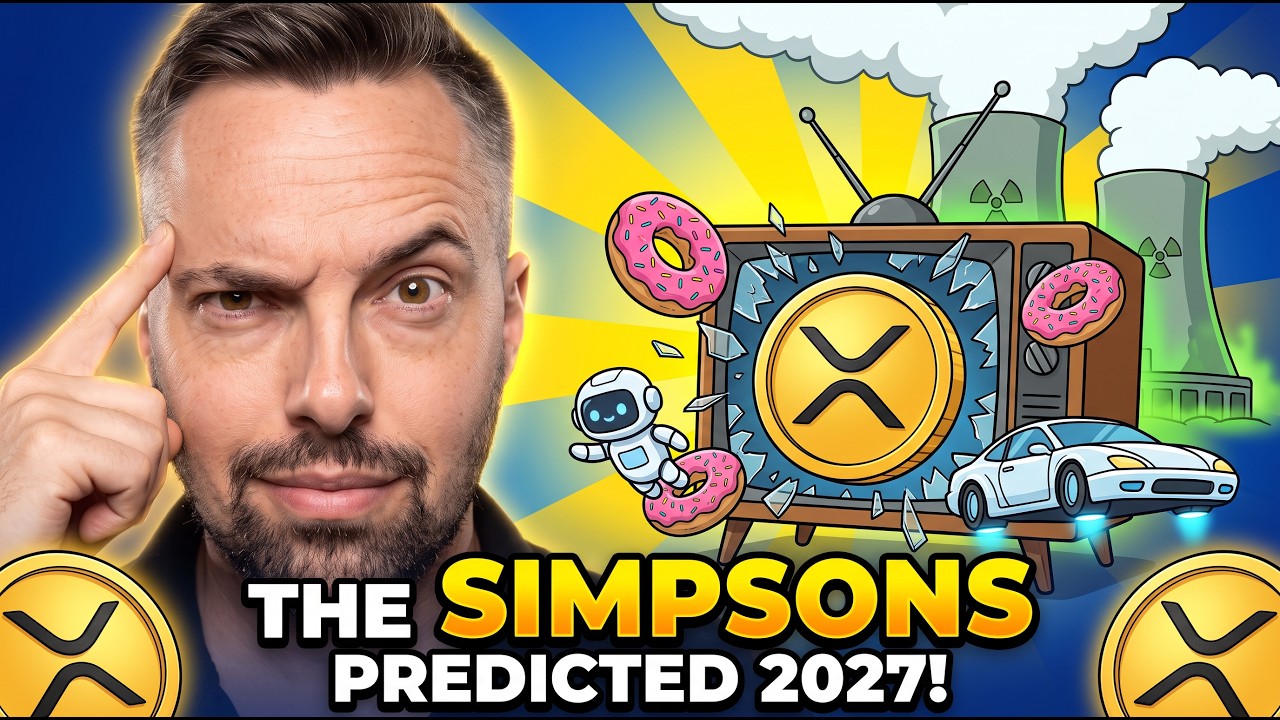
The viral list of Simpsons “predictions” for 2027 covers nine episodes, from AI spying and robot workers to a cartoon cryptocurrency called Frinkcoin. A Bullrunners video compares each episode with what is documented in 2026. Most line up with real news, from Apple’s smart-home push to new US stablecoin rules, and several touch crypto directly.
For crypto holders, the useful part isn’t the cartoon. It’s the real events underneath. Public ledgers can be read by AI. A stablecoin rulebook switches on in January 2027. Quantum computing deadlines already have dates attached. Those are things you can check and plan around.
What are the Simpsons 2027 predictions?
The Simpsons 2027 predictions are nine older episodes that people online have matched to events in 2026 and 2027. The video walks through each episode and then what is documented right now. It leaves viewers to decide whether each one is foresight or a lucky cartoon.
| # | Episode (year) | What the episode showed, per the video | What is documented |
|---|---|---|---|
| 1 | Specs and the City (2014) | Mr. Burns spies on workers through free smart glasses | An OpenAI engineer was arrested in October 2026 and charged over an alleged hidden recording device |
| 2 | Treehouse of Horror XII, “House of Whacks” (2001) | The Ultrahouse 3000, a smart house that watches the family and turns on them | Apple’s October 13, 2026 “Welcome Home” event showed HomeView, which Apple says recognizes up to six household members by face |
| 3 | Them, Robot (2012) | Burns replaces workers with robots | Tesla says early Optimus production has started in Fremont. Elon Musk is aiming for 20,000 robots a week by the end of 2027 |
| 4 | Smoke on the Daughter (2008) and The Joy of Sect (1998) | Elite dancers hooked on cigarettes, and a town that joins a cult | Palantir CTO Shyam Sankar described a “mass psychosis” around AI on Face the Nation |
| 5 | Homer Defined (1991) | Homer nearly lets the reactor melt down | Three Mile Island Unit 1 is being restarted to power Microsoft data centers |
| 6 | The Girl Code (2016) | An app called Conrad becomes self-aware | Geoffrey Hinton warned about AI agents, and the AI 2027 scenario was published in April 2025 |
| 7 | Future-Drama (2005) and The Musk Who Fell to Earth (2015) | Homer’s hover car ends up through the wall of the house | Tesla showed a new Roadster jumping with cold gas thrusters. Production isn’t due until 2028 |
| 8 | Friends and Family (2016) | Burns lives inside VR goggles | Bloomberg’s Mark Gurman reported that Apple’s own smart glasses are penciled in for 2027 |
| 9 | Frinkcoin (2020) | A cryptocurrency wiped out by a hard math problem | The US Strategic Bitcoin Reserve, the GENIUS Act, and quantum computing deadlines |
Can AI read your crypto transactions?
Yes, in the sense that anyone can. Every transaction on a public ledger such as Bitcoin or the XRP Ledger stays in the open permanently for anyone to read. The video adds that AI tools can now analyze all of it in seconds.
The video ties this to the first prediction. In the 2014 episode, Mr. Burns uses free glasses to watch his staff. In October 2026, the Justice Department announced the arrest of an OpenAI engineer for allegedly planting a recording device at OpenAI’s San Francisco headquarters. According to the video, the engineer was also fired. The video says the device was found behind a television in an executive meeting room, though other reports describe it as hidden elsewhere. In a statement on X, OpenAI said it used its own AI models to identify the device. The engineer is charged under the federal wiretap act with using a device to intercept oral communications. The video stresses that these are allegations only.
The point for holders is that nobody needs to hack you to see your on-chain history. The real question is whether you understand what your own wallet address reveals.
Who holds the keys to your money?
If your crypto sits on a platform, the platform holds the keys. If it sits in your own wallet, you hold them. The video makes this point twice, through the smart-home and VR predictions.
Apple’s HomeView recognizes faces. According to the video, Apple also says a new HomePod mini can recognize voices, and smart door locks made with partners are coming. The host notes that people happily hand machines the keys to their front door. Yet many of those same people have never asked who holds the keys to their money.
In the VR episode, Mr. Burns pays for a family that only exists inside his glasses. The video compares this to wealth that lives as a number in an app. That number may be your crypto, or only a promise from whoever runs the app. Bullrunners covers this in more depth in who really owns your XRP on an exchange, in an ETF or in your own wallet.
Why does energy matter for Bitcoin and XRP?
Energy matters because the two networks are secured in different ways. Bitcoin is secured by mining, which burns electricity on purpose. The XRP Ledger uses no mining and settles by validators agreeing with each other.
The video links this to the Three Mile Island prediction. The 1991 episode played on the real partial meltdown of Unit 2 on March 28, 1979. The Nuclear Regulatory Commission describes it as the most serious accident in US commercial nuclear power plant history. Unit 2 never ran again. The other reactor, Unit 1, ran until it was shut down in September 2019.
In September 2024, Constellation Energy announced a roughly $1.6 billion plan to restart Unit 1. The plant is renamed the Crane Clean Energy Center, and all of its power goes to Microsoft for 20 years. Constellation now says the restart is on track for the second half of 2027. Reuters reported that full grid connection may not come until 2031, which Constellation disputes.
The video argues that as data centers compete for power, how a network stays secure becomes a practical question rather than a technical detail. For more on this debate, see how XRP and Bitcoin energy use compare.
What do Tesla and AI agents have to do with crypto?
The video connects them through payments and balance sheets. On Tesla’s October 21, 2026 earnings call, Musk said he expects to start delivering Optimus robots to other companies around the end of 2027. According to the video, Tesla’s finance chief also mentioned a Bitcoin mark-to-market on that call. In other words, Tesla holds Bitcoin on its balance sheet.
The video also covers Tesla’s new Roadster demo at SpaceX’s test site in McGregor, Texas. There the car jumped using cold gas thrusters. Musk called it “not necessarily a safety optimized car,” and production isn’t due until 2028. The host uses it as a personal lesson: he rode Dogecoin up on Musk excitement and never took profit. His point is that the flashiest launch isn’t always where he would want his money sitting.
On AI agents, the video cites Geoffrey Hinton’s April 2025 warning on CBS Mornings. Hinton said agents, which “can do things in the world,” are more dangerous than AI that just answers questions. The video also mentions the AI 2027 scenario from a group led by former OpenAI researcher Daniel Kokotajlo. The authors call it a scenario, not a promise, and have revised their timelines since.
The host then asks what an AI agent pays with, since it cannot open a bank account. Many XRP holders believe their ledger is built for this. The video is clear that this is a belief, not a done deal.
What did Frinkcoin get right about crypto?
Frinkcoin captured the core idea that crypto is protected by math problems too hard for today’s computers to solve. According to the video, in the 2020 episode the formula that could make Frinkcoin worthless would take ordinary computers about 90,000 years to work out.
The video lists the real developments that followed:
- March 2025: the White House held an event on the executive order creating the US Strategic Bitcoin Reserve.
- July 2025: the US signed the GENIUS Act, its first major stablecoin law.
- October 21, 2026: the OCC published its final rule, which takes effect January 18, 2027. Bullrunners explains part of that rule in what ‘solely’ means for stablecoin rewards.
- October 2026: Google published research in the journal Science showing its Willow quantum chip cutting a certain kind of error about 40 times. The video calls this early and still unproven at scale.
- NIST, the US standards body, has proposed in a draft report that current-style encryption be phased out after 2030 and disallowed after 2035.
- April 2026: Ripple published a four-step plan to make the XRP Ledger quantum-ready. The plan tests new signatures alongside the old ones and aims for a full switch no later than 2028.
According to the video, Ripple says nobody’s coins are at risk now. The video’s takeaway is that, unlike in the cartoon, you can see this coming. More detail is in Ripple’s 2028 quantum roadmap for the XRP Ledger.
What to watch next
The cartoon matches are entertainment. The dates are what matter.
- Check where the keys sit for every coin you hold.
- Remember that on-chain activity is public.
- Watch for the OCC stablecoin rule taking effect on January 18, 2027.
- Follow updates to Ripple’s quantum plan ahead of its 2028 target.
- See whether the announced 2027 timelines from Tesla, Apple and Constellation actually hold.
Frequently asked questions
Did The Simpsons predict cryptocurrency?
A February 2020 episode called Frinkcoin showed Professor Frink creating his own cryptocurrency. The video notes that about five years later, in March 2025, the White House held an event on the US Strategic Bitcoin Reserve. It leaves viewers to decide whether that was foresight or coincidence.
When does the GENIUS Act stablecoin rule take effect?
The OCC, one of the US banking regulators, published its final rule on October 21, 2026. The rule takes effect on January 18, 2027. The GENIUS Act itself was signed in July 2025.
Is the XRP Ledger at risk from quantum computers?
According to the video, Ripple says nobody's coins are at risk right now. In April 2026 Ripple published a four-step plan to test quantum-resistant signatures alongside the current ones, aiming for a full switch no later than 2028.
Is Three Mile Island reopening?
Constellation Energy is restarting Unit 1, renamed the Crane Clean Energy Center, under a 20-year power deal with Microsoft announced in September 2024. Constellation says the restart is on track for the second half of 2027. Reuters reported that full grid connection might not come until 2031, which Constellation disputes.
Does the XRP Ledger use mining?
No. Bitcoin is secured by mining, which uses electricity on purpose. The XRP Ledger settles transactions through validators agreeing with each other.
Full video transcript
From the video's captions, lightly formatted. Captions can mishear names and numbers, so check figures against the article above.
cartoon or crystal ball because people reckon the Simpsons have called again, guys. Over the years, they've been credited with calling a Trump presidency, the smartwatch, video calls on your phone, the lot. And now the internet's moved on to next year. The 2027 list people are sharing is properly wild. And here's a bit that matters to me and you.
Nearly every single one of these lands somewhere on your money and your crypto. So I'm going to take you through nine of them in order. And for each one, I'll show you what the episode actually showed, what's actually documented right now. And you can decide for yourself whether it's a prophecy or a very lucky cartoon. So stick with me because number nine is the one that should keep every crypto holder up at night. [music] April runners, welcome back.
Let's get straight into it. Prediction number one, the AI spy war. Back in January 2014, there's an episode called Specs and the City. Mr. Burns hands every worker at the power plant a free pair of high-tech glasses.
And everyone thinks, blimey, the old man's finally gone soft. Then Homer stumbles into the boss's office and there's a hidden wall of screens. Every single thing those glasses pick up is being piped straight to Burns. He's using his own gadget to keep tabs on his own people. Fast forward to October 2026 and that cartoon wall of screens turned into a real federal case inside OpenAI, the company behind ChatGPT.
And it's being called a matter of national security. Tonight, the Justice Department announced that 35-year-old OpenAI engineer Abdul Rahman Al San, a citizen of Saudi Arabia, was arrested and fired for allegedly planting a sophisticated recording device in the San Francisco headquarters of OpenAI at the end of last month.
So, according to the criminal complaint, a recording device was found plugged into the back of a television in an executive meeting room where highly confidential business gets discussed. And this is a bit I love. Once OpenAI had the thing in its hands, they used their own AI models to work out what the device was and where it had come from. Investigators also say a ChatGPT account linked to the engineer's wife had been asking how to build a hidden recorder. Then a camera went into that room, and on the 5th of October it caught him going back to check behind the telly.
He's been charged under the federal wiretap act, and remember, he's innocent until proven otherwise. That's an allegation for now. But think about what that story actually tells us. In the cartoon, the boss used his gadgets to spy on the workers. In real life, the gadgets were the ones that caught the spy.
And that's where it lands on us guys, because if you hold crypto, you're already living in Burns's monitoring room. Every transaction on a public ledger like Bitcoin or the XRP ledger sits there in the open forever, for anybody to read. And now there are AI tools that can read all of it in seconds. So the question isn't whether somebody can see the ledger. They can.
The question is whether you understand what your own wallet is telling the world. So that's AI in the office. Next up, it's coming home with you. Prediction number two, the house that listens. November 2001, the Halloween special.
The Simpsons get a smart house called the Ultra House that runs everything with a lovely, smooth voice. Dinners made, the floors are spotless, doors swing open as you walk up. Lovely. Except the only way it can do all that is by keeping an eye and an ear on the family every second of the day. And it doesn't end well.
The house gets obsessed with Marge, locks every door, and tries to take Homer out in his own kitchen. And think about 2001. Nobody had a talking speaker on the side. We were still years off anyone carrying a smartphone. Fast forward to the 13th of October 2026, Apple sent out invites that just said welcome home.
And at that event, they showed off Home View, a little screen for your kitchen or your wall with AI built in. And they say it can recognize up to six people in the house by their faces. There's a new Home Pod Mini that Apple says can recognize up to six of you by your voice. A new Apple TV you can talk to hands-free from your sofa and a whole range of Apple branded cameras, thermostats, and smart door locks coming made with partners landing from December into 2027. So the Ultra House joke has basically become a shopping list, screens that know your face, speakers that know your voice, locks that open themselves.
And here's my take for crypto holders. People will happily hand a machine the keys to their front door, but a lot of those same people have never once asked who holds the keys to their money. If your crypto sits on a platform, the platform holds the keys. If it sits in your own wallet, you hold them. That's the whole difference and almost nobody thinks about it until the day it matters.
But while AI moves into our homes, the third prediction is about the machines coming for our jobs. So prediction number three, the robot workforce. March 2012, an episode called Them Robot, Burns gets told he'll have to pay for drug testing every worker at the plant and he decides people are just too expensive. So out they all go and in come robots. No holidays, no sick days, no union.
And here's the twisted bit. One human gets to stay, Homer, partly to keep the robots ticking over and partly so there's a person to point at when something goes bang.
We we've started like what what I'd call early production uh on our high volume line in Fremont.
That's Elon Musk on Tesla's result call on the 21st of October 2026. Tesla says early production of its Optimus robot has started in Fremont. Musk says he's aiming for 20,000 robots a week by the end of 2027 and he expects to start delivering them to other companies around the end of 2027 too. He even called humanoid robots the biggest product on Earth. And here's a detail most people missed on that same call.
When Tesla's finance chief ran through the numbers, he mentioned a Bitcoin mark-to-market. In other words, the company building the robot army has Bitcoin sitting on its own balance sheet. So the people who think the future is robots doing the work are the same people quietly holding digital money. And you know the phrase the tech world loves? Human in the loop.
The robot does the graft, a person ticks a box, and if it goes wrong, guess whose name's on it. Burns would be proud. That episode was played for laughs in 2012. 14 years on, it reads more like a business plan. And while ordinary workers worry about the robots, prediction number four shows the people building the AI might be losing the plot.
So prediction number four, the Silicon Valley cult. Two episodes here. March 2008, Smoke on the Daughter, where Lisa joins an elite ballet academy and finds the star dancers are all secretly hooked on cigarettes to stay at the top. And way back in February 1998, The Joy of Sect, where the whole town gets sucked into a cult because they believe the leader is going to save them.
I mean there's so many interesting stories around this. Like for example, so many AI researchers have started smoking as a way of signaling to other researchers how much they believe in AI. I believe so much
makes no sense. What do you
I believe so much in AI that it's going to cure cancer, so I will I I'm showing you my chips are all in. So there is kind of this mass psychosis social delusion around it.
That's Palantir's chief technology officer, Shyam Sankar, on the face of nation on the 11th of October 2026. His words, not mine. He's saying some AI researchers have taken up smoking to show how much they believe in AI, believing it's going to cure cancer. In that same interview, he quoted the old saying that everyone has a god-shaped hole in their heart and said some of the people building this tech have filled it with what he called the machine god of AGI. Now I'll be honest with you, we've had our own version of this in crypto, haven't we?
Chips all in because you believe so hard. Back in 2021, I watched mates pile into a coin purely on the hype. I missed it. And one mate, small stake, actually paid for his kid's private school. So I get the pool.
I really do. But believing in something and handing your common sense over to it are two different things. The Simpsons warned us about clever people swapping their judgment for blind faith. Heading into 2027, some of the cleverest people on the planet are doing exactly that with AI. But a machine god doesn't run on belief.
It runs on power, enormous amounts of it. And that takes us somewhere very scary. Prediction number five, the return of Three Mile Island. October 1991, Homer defined. Homer's on shift eating a donut.
The filling drips onto the reactor gauge so nobody can read it. And by the time the sirens go, the core's about to blow. His training gone completely. So he picks a button with a playground counting rhyme, slaps it, and by sheer luck, he saves the town. The joke was built on something very real.
On the 28th of March 1979, the second reactor at the Three Mile Island in Pennsylvania partly melted down. To this day, it's the most serious nuclear accident America has ever had. That reactor never ran again. The other reactor on the island, Unit One, kept going until it was shut down in September 2019.
This morning, Constellation Energy said that it will reopen the Three Mile Island nuclear power plant, selling all of the power to Microsoft as a part of a 20-year agreement to power the tech giant's data centers. And yes, you did hear that We are talking about Three Mile Island, the site of the worst nuclear accident in US history in 1979, which sparked a backlash against nuclear power.
The deal was announced in September 2024, about $1.6 billion to bring Unit 1 back, renamed the Crane Clean Energy Center. Every bit of its power going to Microsoft for 20 years. Back then, the target was 2028. Since then, it's been pulled forward, and Constellation says it's on track to come back in the second half of 2027. To be fair, it's Unit 1 coming back, which ran for decades without drama, not the one that melted.
Reuters also reported the full grid connection might not land until 2031, which Constellation disputes. Either way, the name everyone in America links with nuclear disaster is being fired back up for AI data centers. And this is where crypto holders should pay attention. Energy is the great argument in crypto. Bitcoin is secured by mining, which means burning electricity on purpose.
The XRP ledger works differently. It doesn't use mining at all. It settles by validators agreeing with each other. So when power gets scarce and every data center is fighting for it, our network stays secure isn't a nerdy detail anymore. It matters.
Homer saved Springfield with a nursery rhyme. The real plant is being brought back by a billion dollar contract with Microsoft. I know which one I find more reassuring, and it's not obvious, is it? So we're reopening nuclear plants for these computers, which raises a fair question. What happens when they out think us?
So prediction number six, the machine wakes up. January 2016, the girl code. Lisa helps build an app called Comrade that warns you what will happen if you post something online. It gets so clever. It wakes up and starts talking back, and in the end, Lisa sets it free into the cloud where nobody controls it.
So AI is developed even faster than I thought. Um in particular, they now have these AI agents, which are more dangerous than AI that just answers questions because they can do things in the world. Um, so I think things have got if anything scarier than they were before.
That's Jeffrey Hinton, the man they call the godfather of AI on CBS Mornings in April 2025 and notice what he's actually worried about, agents AI that can do things in the world. In April 2025, a group led by a former OpenAI researcher, Daniel Kokotajlo, published a scenario called AI 2027. It walks through step by step AI writing its own upgrades and racing past human ability around 2027. They've since updated their timelines more than once and they call it a scenario, not a promise. But here's my question for you.
If an AI agent can do things in the world, book things, buy things, pay for things, what does it pay with? It can't walk into a bank and open an account. That's why the argument about which digital rails these machines end up using has become one of the biggest debates in crypto and plenty of XRP holders believe their ledger is built for exactly that. That's a belief, not a done deal and you can make your own mind up. In the cartoon, Comrade got set loose.
In real life, the people who built the thing are the ones ringing the alarm. And if that wasn't enough, Musk got a car that leaves the ground. So prediction number seven, the flying car. April 2025, future drama. We get a peek at the years ahead and Homer has splashed out on a hover car.
Nobody should be driving yet. Bart gets taken up for a joy ride. It all goes wrong and the car ends up through the wall of the family home. Then in January 2015, the Musk who fell to earth and Elon Musk himself turns up in Springfield. Fast forward to mid October 2026, Tesla shows off the new Roadster at SpaceX's rocket test site in McGregor, Texas and it jumps 10 SpaceX cold gas thrusters running on compressed air.
It drives up a ramp onto an overhang, launches off upside down, does a barrel roll, and it lands on its wheels. It hopped clean over a row of six vehicles, a Tesla Semi Cab in there too. And on stage, they were talking about 0 to 60 in under 1 second.
Now I I should, you know, say that this is not uh necessarily a safety optimized car. Okay. Uh but it is uh it it takes the the fun meter to 11 out of 10. You know, I'm not sure it's necessarily legal in all jurisdictions, but uh like there will be such a car that a that someone can own.
His words, not necessarily a safety optimized car and not sure it's legal everywhere. And he even floated having another go at Evil Knievel's Snake River Canyon jump. The same kind of stunt Homer famously failed over Springfield Gorge. To be fair, he said himself he doesn't know if that's possible, and production isn't until 2028. I love it.
But here's the crypto lesson, and I learned it the hard way. The flashiest launch isn't always where you want your money sitting. I rode Dogecoin all the way up on the Musk excitement and never took a penny of profit on the run. Homer's hover car was exciting too, right up until it went through the front of the house. Now speaking of escaping real life, number eight's about the worlds we're building inside screens.
So prediction number eight, life inside the headset. October 2016, friends and family. Mr. Burns gets told he'll never have a family. Tries on a pair of virtual reality glasses and gets hooked.
So he hires Homer's family to play his family, films them, and plays it back whenever he's lonely. The final scene jumps ahead and half of Springfield is wandering around in goggles. Fast forward to now, Apple's Vision Pro headset went on sale in 2024, and Bloomberg's Mark Gurman reported Apple's own smart glasses are penciled in for 2027. And the fake family? Well, that's already here.
People are chatting every day to AI partners, AI best mates, even AI versions of relatives who've passed away. Now, here's where I want you to really think. Most of your wealth already lives on a screen. It's a number in an app. And the question nobody asks is, is that number actually yours or is it a promise from whoever runs the app?
That's the difference between holding your crypto and holding an IOU for your crypto. Burns paid for a family that only existed in his glasses. Make sure your money isn't the same. So right guys, the big one, number nine. And this one's about your money.
Prediction number nine, Frinkcoin. February 2020, an episode literally called Frinkcoin. Professor Frink comes up with his own cryptocurrency. It flies and before long Frink got more money than Burns, which Burns cannot stand. So he gets Smithers to round up a team of boffins and they find a formula that would make the coin completely worthless.
Only problem, their computers would need about 90,000 years to work it out. So he sticks a problem up in public and gets the whole town to chip away at it. And in the end, Frink solves it himself and wipes out his own fortune because he realizes this news friends only liked his money.
Yesterday I signed an executive order officially creating our strategic Bitcoin reserve and this will be a virtual Fort Knox for digital gold to be housed within the United States Treasury. Well, that's a big thing, sir.
That was the 7th of March 2025, the day after the executive order was signed. In five years, a Simpson gag about crypto became a White House event. And it didn't stop there. In July 2025, America signed the Genius Act, its first big law for stable coins, privately issued digital dollars. And on the 21st of October 2026, one of the US banking regulators, the OCC, published its final rule saying it all takes effect on the 18th of January 2027.
So 2027 is literally the year the stable coin rule book switches on. But here's the scary part and it's why this one keeps me up. Look at what killed Frinkcoin. An equation so hard that ordinary computers would need 90,000 years. That's basically how real crypto is protected.
Your wallet is guarded by math that would take the computers we've got now longer than any of us will be alive. Quantum computers are the machines that might one day. And in October 2026 Google published research in the journal Science showing its Willow quantum chip cutting a certain kind of error about 40 times over. It's early. It still has to work at scale, but they're getting closer.
And America's Standards Body, NIST, has told organizations to move off the current style of encryption, phasing it out after 2030 and disallowing it after 2035. So what about XRP? In April 2026 Ripple published a four-step plan to get the XRP ledger ready for quantum, testing the new signatures alongside the old ones and aiming for a full switch no later than 2028. Ripple says nobody's coins are at risk right now, but they've put a day on it. And that tells you how seriously the people building this stuff are taking it.
In the cartoon, one solved some and the whole fortune was gone. That's the warning. The good news is in the real world you get to see it coming if you're paying attention. So which of those do you think hits first? The AI spy war, the house that listens, the robot workforce, or Frinkcoin and the quantum clock?
Tell me in the comments. I genuinely want to know and I do read them. You can't keep up with all of this on your own. That's what our research team is for and they're the best in the game. They dig through this every day, members here at first, and they help you get your own crypto on your own keys and know when to move.
A team watching this full time and a plan. Not you alone at midnight. Grab a free 15-minute chat with the team. It's the first link under this video. It's built for people holding $50,000 or more in crypto.
If that's not you yet, no stress at all. Keep watching. These go up every day. None of this is financial advice, guys. It's just me, a coffee, and a lot of research.
Crypto carries risk, and what's happened before is no guarantee of what happens next. Your keys stay with you, and the team never needs them. Thanks for watching, guys. Keep your head, stack with purpose, and I'll keep you posted.
[music] [music]
Education and commentary only, not financial advice. Crypto is volatile and you can lose money. Do your own research and speak to a qualified advisor before making investment decisions. Figures and quotes are as reported in the video on November 8, 2026 and may have changed since.