
Wall Street Tokenization News, October 2026: What's Live, What's Not
October 2026 tokenization news from DTCC, Chainlink, Canton, BNY, Citadel, Franklin Templeton, ARK, the IMF and PwC, sorted into live, pilot and planned.
Key takeaways
- Several Wall Street tokenization steps are real but narrow: one repo trade, one swap, one fund-processing membership, each with no size disclosed.
- DTCC's Collateral AppChain with Chainlink is expected in Q4 2026, and DTCC planned its tokenization service for October 2026; neither had a launch notice as of mid-October.
- Most of these systems run on private or permissioned ledgers, and none of the primary releases ties them to a crypto token's value.
- The IMF says tokenized markets are still small, split across venues and less liquid than traditional markets.
- A tokenized fund share keeps the fund's own exit rules: ARK's venture fund token is still an interval fund with limited quarterly repurchases.
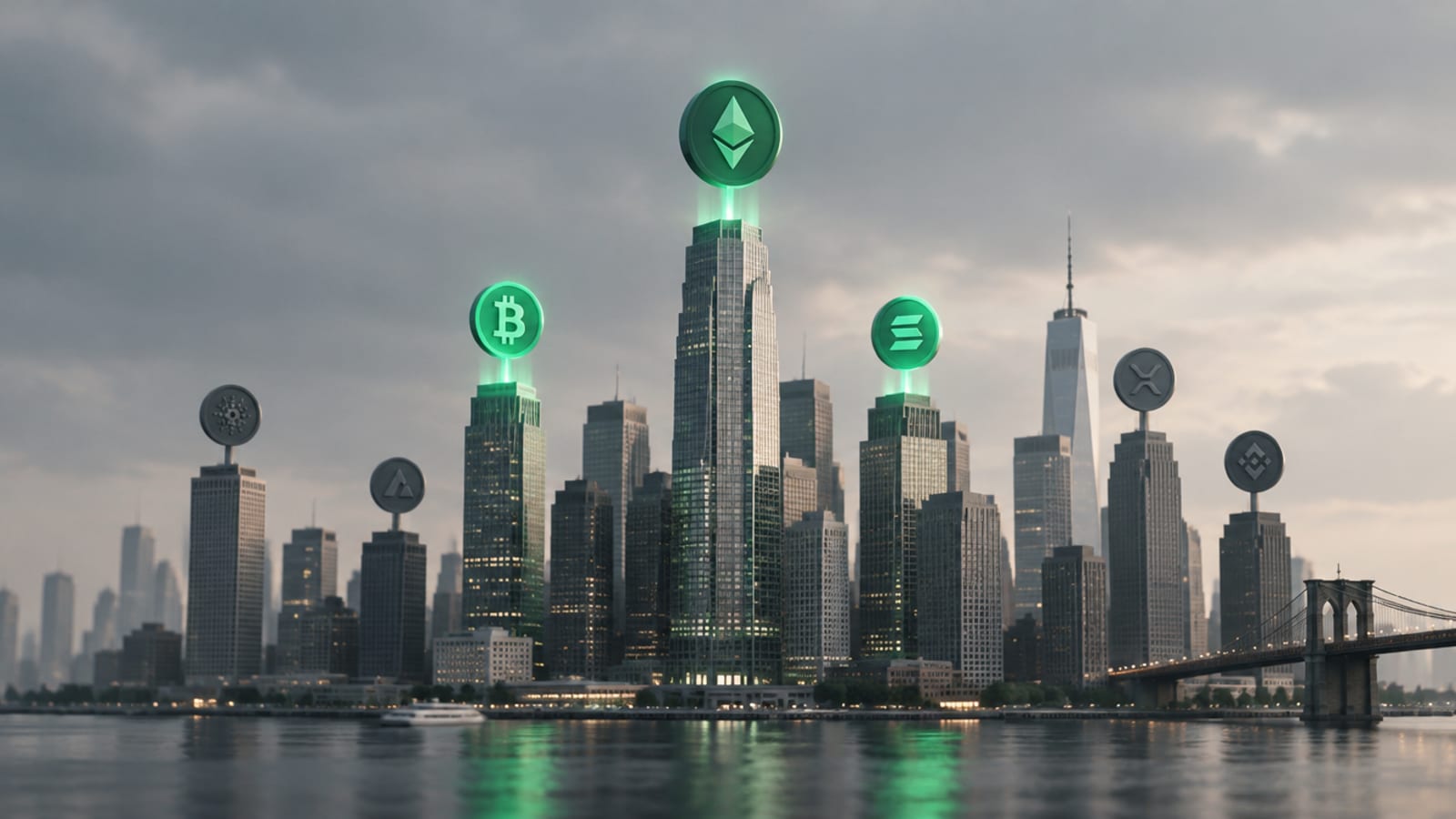
In September and October 2026, large financial firms announced a run of tokenization firsts: a repo trade with a tokenized Treasury, a swap on a tokenized index, a tokenized fund pledged as exchange collateral, and DTCC moving collateral and fund processing toward blockchains. For holders, the useful question is not “is Wall Street coming?” but “what exactly is live, for whom, and on which ledger?”
The pattern across these stories: most are live for institutions on private or permissioned systems, sizes are rarely disclosed, and none of the primary releases links the activity to any crypto token’s price. Facts are as of 15 October 2026.
What has Chainlink actually got live with DTCC and Swift?
Pieces, with more planned. On 12 May 2026, DTCC said its Collateral AppChain will use Chainlink’s Runtime Environment and is expected to go live in Q4 2026. On 30 September, Chainlink introduced Fulcrum, which it calls “the first cross-chain repurchase agreement (repo) flow”; Chainlink says Fulcrum does not custody assets or act as a counterparty, and is being integrated with venues “launching soon”. Chainlink and DTCC demonstrated it at Sibos, per Chainlink’s recap.
On 28 September, Chainlink said it is “working to enable” institutions to connect to Swift’s new ledger. Swift’s own July release names 17 pilot banks and no Chainlink, public blockchain or crypto token.
Why it matters: DTCC’s release does not mention DTCC buying or holding LINK, and the Fulcrum post does not mention the LINK token. Background: Chainlink and Swift explained.
Open question: a DTCC notice that the AppChain is live.
Has DTCC’s tokenization service on Canton launched?
Not that we could find as of 13 October. On 15 July 2026, DTCC said live production trades used DTC-tokenized assets on Besu, DTCC’s private network, and Canton, which DTCC calls a public network, with more than 30 firms including BlackRock, Goldman Sachs, J.P. Morgan, Nasdaq, NYSE and Vanguard. DTCC planned the service launch for October 2026.
The SEC staff no-action letter from December 2025 allows controlled production for three years on pre-approved blockchains, covering Russell 1000 stocks, major index ETFs and Treasuries, for DTC participants and their clients. The tokens are digital twins; the securities stay at DTCC. US Treasuries are the first asset class on Canton.
Why it matters: this is the plumbing behind most US securities, now working on-chain in a controlled form. Canton Coin is the network’s fee token; DTCC’s releases don’t mention it. See Canton and the CC coin.
Open question: the launch announcement itself.
What does the IMF say about tokenized markets?
That they are small, split and less liquid. On 8 October 2026, an IMF blog drawing on its October Global Financial Stability Report said tokenized markets “remain relatively illiquid and exhibit higher volatility than traditional counterparts”. It put tokenized repo at about $300 to $350 billion in daily transaction volume, against about $13 trillion in daily US repo.
The IMF found about 80% of tokenized equity trades are for less than one share, more than half happen outside normal market hours, and trading is fragmented, with overnight moves showing up after the open. CoinDesk reported the same findings.
Why it matters: scaling could amplify fire sales and runs if buffers disappear, the IMF warns. Its recommendations are legal certainty, technology-neutral rules, interoperability and what it calls “safe settlement money”. These are recommendations, not rules.
Open question: the full chapter was listed but not posted when we checked. An earlier IMF note is covered in our IMF tokenization post.
What did BNY and Citadel Securities do with a tokenized Treasury?
On 13 October 2026, Citadel Securities bought a two-year Treasury note through BNY on Tradeweb, BNY said. The note was represented as a tokenized security on BNY’s private digital ledger and used as collateral in an overnight triparty repo, with BNY providing cash. CoinDesk confirmed the transaction.
According to BNY, it settled within minutes rather than the usual one business day, and it calls this the first use of tokenized assets on a major triparty repo platform. No size, rate or cash amount was disclosed. BNY plans more digital cash and longer settlement hours next year.
Why it matters: triparty repo is how Wall Street funds itself overnight, and as of 2019 BNY was its only clearing provider, per the Federal Reserve. Speeding it up is real progress, on a bank’s private ledger.
Open question: risks the BIS lists, such as smart contract errors and key mismanagement.
What did DRW and Marex trade on a tokenized index?
A swap on data, not an asset. On 13 October 2026, DRW and Marex executed an over-the-counter total return swap on Derivnex, which runs on Canton, referencing S&P Dow Jones Indices’ iBoxx USD Liquid Investment Grade Index, according to S&P DJI and Kaiko and The Block. Kaiko tokenized the index: the token combines signed benchmark values with access permissions and usage rules.
The companies call it the first OTC derivative referencing a fully tokenized index; that is their word. S&P’s index methodology says: “It is not possible to invest directly in an index.”
Why it matters: OTC derivatives are a $846 trillion notional market, per the BIS. Putting reference data on-chain is a building block.
Open question: trade size, payment legs and any retail access were not stated. Links to digital cash are “expected”, which means planned.
What does Ondo joining DTCC’s Fund/SERV mean?
On 16 September 2026, DTCC said Oasis Pro Markets, an Ondo subsidiary and registered broker-dealer, joined Fund/SERV as its first tokenization member. Fund/SERV automates mutual fund orders and settlement and, by DTCC’s figure, handles more than 85% of US mutual fund transaction activity.
Ondo’s post and DTCC’s release do not mention the ONDO token, a named fund, a go-live date or a first trade. DTCC’s fine print says membership does not guarantee compliance and is not a regulator’s approval.
Why it matters: it is a door into mainstream fund plumbing for a crypto-native firm. It is not a product launch.
Open question: which tokenized fund, if any, moves through Fund/SERV first.
How does Franklin Templeton’s fund work as Bybit collateral?
On 28 September 2026, Bybit and Franklin Templeton said eligible Bybit clients can pledge tokenized money market fund shares issued through Benji as off-exchange collateral, held via ByCustody, for USDT and USDC trading credit. The value is mirrored at Bybit while the assets stay off the exchange. CoinDesk reported the fund has about $686 million in net assets. A similar program started with Binance in February 2026.
Why it matters: off-exchange collateral is designed to reduce counterparty exposure to the exchange, the companies say. But a money market fund is not FDIC guaranteed and can lose money, per Investor.gov, and pledged collateral can be liquidated.
Open question: loan-to-value, fees, liquidation terms and eligibility are not stated in the release. This is not a suggestion to borrow or trade.
Can you trade the tokenized ARK Venture Fund any time?
No. On 24 September 2026, ARK and Securitize tokenized ARKVX on Ethereum for eligible investors. The fund holds stakes in private companies such as OpenAI, Anthropic and Stripe, The Block reported, with about $1.3 billion in net assets.
The token does not change the fund’s rules. Its SEC filing describes a closed-end interval fund: liquidity is limited to quarterly repurchase offers of 5% to 25% of shares at net asset value, which may be prorated, and no secondary market is expected. The minimum is $500. ARK’s page lists a gross expense ratio of 3.49% and 2.90% net after waivers.
Why it matters: a token on a 24/7 blockchain can still sit on top of an asset you can only exit four times a year. The SEC’s interval fund bulletin explains the limits.
Open question: Securitize’s own eligibility and transfer terms.
What changed in PwC’s Stellar securitization payouts?
On 7 October 2026, PwC Germany announced an automated receivables settlement product: the payout “waterfall” for a securitization runs in a smart contract on Stellar, built by tokenforge, with AllUnity as the e-money issuer of a euro stablecoin. PwC says payouts that often take 30 days or longer can happen in a single day. The idea came from EOS Group, a receivables manager with more than 6,000 staff.
AllUnity, a joint venture of DWS, Flow Traders and Galaxy, holds a German e-money licence from July 2025, it says. Fees on Stellar are paid in XLM, with a tiny minimum fee.
Why it matters: faster payouts are a practical use case. PwC’s “one of the first worldwide” is its own assessment.
Open question: the release does not say whether it is live with clients or a pilot, and gives no client names or volumes.
What does BNY’s crypto custody in Europe cover?
On 8 October 2026, BNY said it expanded digital asset custody to select EU institutions under MiCA, covering BTC, ETH, SOL and USDC, with ambitions to add more. Its Belgian entity was added to the ESMA MiCA register in July 2026. BNY says its platform, launched in 2022, uses multiparty computation and segregated client wallets.
Multiparty computation splits a key into shares so it is never assembled in one place, as NIST explains.
Why it matters: a large custodian bank now holds SOL and other assets for European institutions. Bank custody is one model with its own rules and risks, not automatically better or worse than holding your own keys, as the SEC’s custody bulletin describes.
Open question: the release names no clients or amounts and describes no option for individual holders.
What does Paxos Labs’ PAXGy add to tokenized gold, and what does it risk?
In early October 2026, Paxos Labs, a 2025 spinoff from Paxos, launched PAXGy, a token “designed to accrue value in ounces of gold”, American Banker reported. PAXGy is backed by PAX Gold, and the gold behind it is lent to institutional borrowers, so the token is designed to become redeemable for more PAXG as borrowers pay back in ounces, CoinDesk reported.
PAXG itself represents one fine troy ounce of London Good Delivery gold held in segregated London vaults, per Paxos’s docs.
Why it matters: adding lending changes the risk. In CoinDesk’s words, “Lending returns are not guaranteed, and borrower defaults could erode the token’s value.” American Banker notes PAXGy’s value can go up or down relative to PAXG. We give no return figures here.
Open question: the borrowers, fees, chains, US eligibility and redemption steps were not stated in the sources we read, and we found no PAXGy terms page.
What to watch next
- Q4 2026: DTCC’s Collateral AppChain go-live notice.
- DTCC’s announcement that its tokenization service has launched.
- The full IMF chapter on tokenization.
- Fulcrum’s first named venue integration.
- BNY’s extended settlement hours and digital cash plans for 2027.
A five-rung ladder for any tokenization headline: announced, demonstrated, piloted, live for institutions, live for you. Most of this month’s news sits on the middle rungs.
Sources
- What Is Needed for Tokenization to Deliver, International Monetary Fund,
- The Dynamics of the U.S. Overnight Triparty Repo Market, Federal Reserve Board
- Financial stability implications of tokenisation, Bank for International Settlements
- OTC derivatives statistics at end-June 2025, Bank for International Settlements
- ARK Venture Fund Form N-2 post-effective amendment, U.S. Securities and Exchange Commission,
Frequently asked questions
Is DTCC's tokenization service live?
DTCC processed live trades with tokenized assets in July 2026 and said it planned to launch the service in October 2026. As of 13 October we had not found a DTCC release announcing the launch.
Does Wall Street tokenization use the LINK token?
DTCC's release on its Collateral AppChain does not mention DTCC buying or holding LINK, and Chainlink's Fulcrum post body does not mention the LINK token.
What did BNY and Citadel Securities do?
On 13 October 2026, Citadel Securities bought a two-year Treasury note through BNY that was represented as a tokenized security on BNY's private ledger and used as collateral in an overnight triparty repo. No trade size was disclosed.
Can I trade the tokenized ARK Venture Fund 24/7?
The fund's own documents say liquidity is limited to periodic repurchase offers and no secondary market is expected. Quarterly offers cover 5% to 25% of shares and may be prorated.
Education and commentary only, not financial advice. Crypto is volatile and you can lose money. Do your own research and speak to a qualified advisor before making investment decisions. Figures are as of October 27, 2026 and may have changed since.


