Can XRP Reach $100? The $6.3 Trillion Market Cap Math
What $100 XRP would mean: a $6.3 trillion market cap, above the crypto market's record peak. The math, the escrow, and a simple $3, $10, $100 plan example.
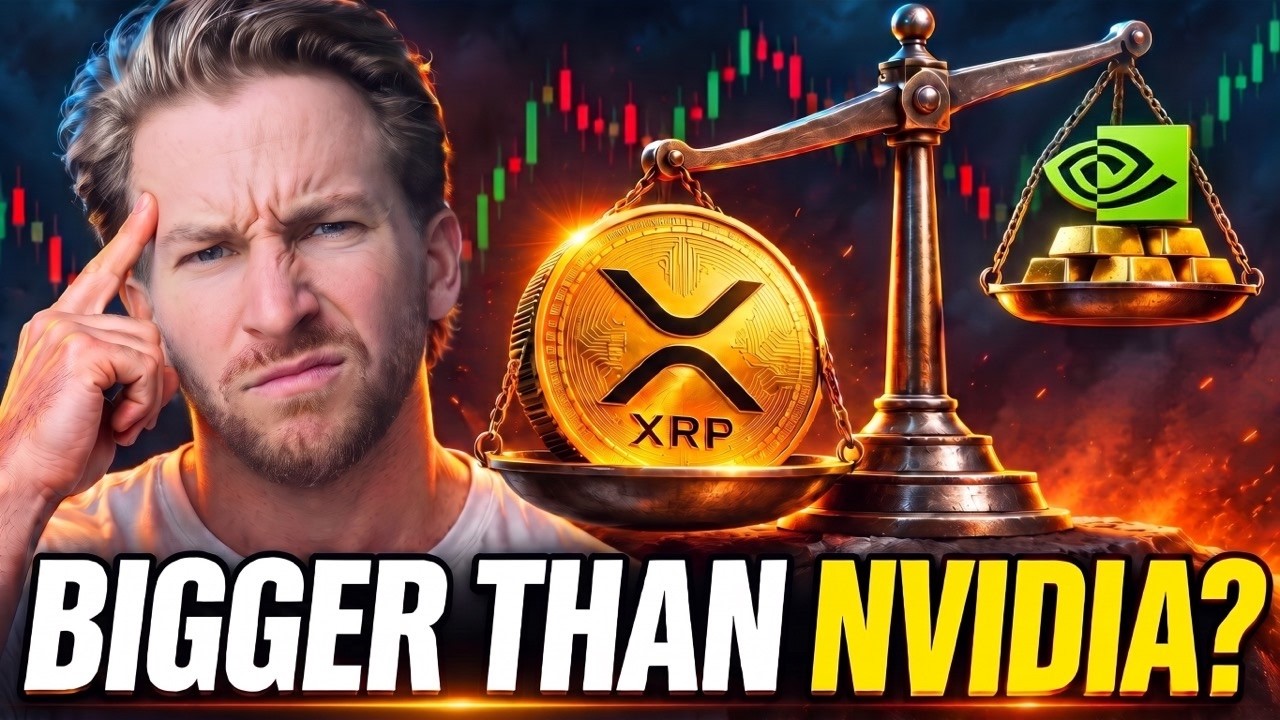
Key takeaways
- At about 63 billion XRP in circulation, $100 XRP equals a market cap of roughly $6.3 trillion, according to the video.
- The video says that would be larger than Nvidia and about four times Bitcoin's size at the time of recording. It would also exceed the crypto market's record of about $4.3 trillion, set in October 2025.
- Market cap is the last price times every coin, not money paid in. The real test of any price is whether there are enough buyers to hold it there.
- A price target is only useful with a date attached. A target with no date can never be wrong, so it can't help with planning.
- The video's example plan is written down while markets are calm: a maximum share of savings in XRP, what to do if it doubles or falls sharply, and one sentence on why it is held.
For XRP to reach $100, its market cap would need to be about $6.3 trillion, based on roughly 63 billion XRP in circulation. A Bullrunners video works through that math. It says $100 XRP would make XRP larger than Nvidia, about four times Bitcoin’s size and more than double the entire crypto market at the time of recording.
Why does this matter if you hold XRP? Big round targets like $100, $392 or $10,000 travel fast in video titles, and many holders build their expectations around them. The video’s point is simple. If you are holding for a number you have never checked, you have a hope, not a plan. This article walks through the video’s math, what XRP would actually need, and a simple way to think about different prices. None of it is a prediction.
What does XRP’s market cap actually measure?
XRP’s market cap is its price multiplied by the number of coins in circulation. At the time of recording, the video put XRP at around $1.29 with about 63 billion XRP circulating, for a market cap of roughly $81 billion. Prices have moved since, so live figures will differ. The method stays the same.
The video explains market cap with a street of 100 identical houses. If one house sells for $500,000, every house on the street is suddenly valued at $500,000, so the street is “worth” $50 million. Only one house changed hands. Market cap works the same way: it is the latest price applied to everything.
The same logic shows how extreme some targets are. At the current supply, the video says $10,000 XRP would mean a market cap of about $630 trillion. By the video’s numbers, that is more than five times the yearly output of every economy on Earth combined.
How big would $100 XRP be?
At $100 per coin and 63 billion coins, XRP would be worth about $6.3 trillion. The table compares that with other figures. All of them come from the video at the time of recording, except the crypto market peak, which comes from market data.
| Asset | Approximate value |
|---|---|
| XRP at $100 (circulating supply) | $6.3 trillion |
| XRP at $100 (full supply) | about $10 trillion |
| Nvidia (the video calls it the largest company on Earth) | about $5 trillion, per the video |
| Entire crypto market at the time of recording | about $2.7 trillion, per the video |
| Entire crypto market at its record (October 6, 2025) | about $4.3 trillion |
| All the gold in the world | about $27 trillion, per the video |
The video says $100 XRP would be bigger than Apple and Nvidia. On any count it would be bigger than the whole crypto market has ever been. Counting every XRP in existence, the video says it would be more than a third of the value of all gold. It adds that gold took thousands of years to earn that trust: central banks hold it, people wear it as jewelry, and almost every culture accepts it.
Why does the escrow change the number?
Ripple’s escrow matters because the circulating supply and the total supply are different numbers. The total supply is close to 100 billion XRP, and according to the video, more than 30 billion of it is still locked in Ripple’s escrow.
In 2017, Ripple locked 55 billion XRP into escrow on the XRP Ledger. Up to 1 billion XRP unlocks each month. Ripple can use some of it and usually puts most of it back into a new escrow at the end of the line. That is why the locked amount shrinks slowly over the years. For more detail, see how Ripple’s monthly 1 billion escrow release works.
The practical lesson: whenever someone quotes XRP’s supply or market cap, ask which number they mean, the coins in circulation or every coin that exists.
Does market cap mean money has to flow in?
No. A $6.3 trillion market cap does not mean someone has to wire $6.3 trillion into XRP. If one buyer pays a dollar more for one XRP, every XRP gets repriced, including coins that never moved. That is why prices can move much faster than the money behind them.
The video goes back to the street of houses. If one desperate buyer pays $1 million for a house, the street is suddenly valued at $100 million, and nobody else got paid. If the next house sells for $300,000, the street drops to $30 million just as fast. Crypto does this in seconds, all day.
That works in both directions. The real test is not whether someone can push the price up. It is whether the price can stay there. To hold a price, enough buyers must be waiting at that level to absorb anyone who wants to sell. Traders call this depth, or liquidity. The video compares a price with thin depth to a tall building on a small foundation. It can rise quickly, and it can fall quickly when a few large holders cash out.
What does XRP’s price history show?
According to the video, XRP’s highest price so far was a little over $3.60 in July 2025, when it was worth a bit over $200 billion. Some trackers still list a 2018 high of $3.84 as the official record. The whole crypto market peaked at about $4.3 trillion on October 6, 2025, according to market data from Decrypt and TradingView. The video cites a higher figure, but its point holds: $6.3 trillion is above the market’s record either way.
The video offers both sides. Big jumps do happen. It says Nvidia was worth less than $400 billion at the start of 2023, and less than three years later it was the biggest company on Earth. But Nvidia had sales behind it: its chips sold as fast as it could make them, and its profits rose year after year. On the other side, the video notes that several of the 10 biggest coins from early 2018 have since fallen far down the rankings, and some barely trade at all.
Professional forecasts miss too. In April 2025, Geoff Kendrick, Standard Chartered’s global head of digital assets research, forecast $5.50 XRP by the end of that year. XRP’s high that year was a little over $3.60, so the target was not reached. The video stresses that this does not make the analyst foolish. It shows how hard forecasting is. Standard Chartered has since cut its end-2026 XRP target, as Bullrunners covered in why Standard Chartered cut its XRP target.
What would XRP need to be worth trillions?
The video’s answer is that people would have to need XRP, not just hold it. It lists four conditions:
- Banks and payment companies using XRP itself to move money. Using Ripple’s software or Ripple’s RLUSD stablecoin would not be enough.
- Big funds holding XRP for the long run. The spot XRP ETFs that began trading in the US in late 2025 are where to watch this. In a CNBC clip shown in the video, a speaker said investors piled into the XRP ETFs during the slow fourth quarter. That was the opposite of spot Bitcoin and Ether ETFs, where buying tends to move with the coin’s price, and the speaker said buyers saw XRP as a less crowded trade. The video’s question is whether that demand lasts for years, not weeks.
- Real daily activity on the XRP Ledger, with stablecoins, tokenized assets and payments settling there. Steady growth over years would point to real use. Spikes that fade point to excitement.
- The rest of crypto growing too, because XRP rarely moves alone.
The video also gives a counterpoint that many XRP videos skip. If XRP is used as a bridge between currencies, one coin may sit in a payment for only seconds before it is swapped out. A single coin could then help move many payments in a day. Some analysts argue that payment use alone therefore doesn’t require a very high price. Others argue that at large scale, a lot of value would still need to sit in XRP to keep payment routes deep. Reasonable people disagree, and the video says anyone claiming payments guarantee a price is skipping a step.
In an older CNBC clip, Ripple CEO Brad Garlinghouse described XRP as a way to settle liquidity needs between banks. He pointed to $27 trillion parked at banks around the world for payments, and said XRP settles a transaction in about 3 seconds. The video notes that Ripple holds a lot of XRP, so his pitch should be weighed with that in mind. Still, his pitch is about use, not price. The same idea runs through why a Ripple win isn’t automatically an XRP win.
Why does the date matter as much as the price?
A price target without a date can never be wrong, which means it can never really help with planning. The video points out that reaching a price in 5 years is a very different result from reaching the same price in 25 years. Over 25 years, money in plain government bonds or a broad stock fund would also have grown. The video suggests asking two questions about any target: how much, and by when?
A simple XRP plan example at $3, $10 and $100
The video sets out the market cap at three prices, using the circulating supply at the time of recording:
| XRP price | Approximate market cap | Context from the video |
|---|---|---|
| $3 | about $190 billion | roughly where XRP was at its peak |
| $10 | about $630 billion | bigger than most of the world’s largest banks |
| $100 | about $6.3 trillion | bigger than the whole crypto market has ever been |
The video argues that one number matters more than any of these: how much of a person’s money is in XRP, and what they plan to do at each level. It offers a made-up example to show what a plan looks like. In the example, someone:
- Decides XRP will never be more than a set share of their total savings.
- Writes down what they would do if XRP doubles, such as taking a small slice off the table or rebalancing back to that share.
- Writes down what they would do if XRP falls sharply. In the example, that might be nothing, as long as none of the money is needed in the next few years.
- Writes one sentence on why they hold XRP at all.
- Checks the note twice a year, not every day.
The video says everyone’s numbers will be different. The point is to decide while calm, not while the price is moving. Bullrunners has covered a longer framework in this five-step XRP exit strategy.
What to watch next
The video suggests watching the numbers that would show real use, rather than tracking price targets. XRPScan shows how many transactions the XRP Ledger handles each day and how much RLUSD sits on it. Tokenized asset trackers show how much is issued on the XRP Ledger compared with other networks. Flows into the US spot XRP ETFs show whether long-term fund demand is holding up. If those numbers grow steadily for years, that points to use. If they spike and fade, it is mostly excitement. The video’s own framing is to treat $100 as a question to watch, not a promise to bank on.
Frequently asked questions
What would XRP's market cap be at $100?
About $6.3 trillion, using the roughly 63 billion XRP in circulation cited in the video. Counting the full supply of close to 100 billion XRP, it would be nearer $10 trillion.
Is $100 XRP impossible?
The video says nothing in XRP's code prevents it, but it would take adoption at a scale crypto has never seen. At $6.3 trillion, XRP alone would be bigger than the whole crypto market has ever been. That market's record was about $4.3 trillion in October 2025.
What was XRP's all-time high?
According to the video, XRP's highest price was a little over $3.60 in July 2025, when its market cap was a bit over $200 billion. Some trackers, including CoinMarketCap, still list a 2018 high of $3.84 as the official record.
Did Standard Chartered's $5.50 XRP forecast come true?
No. In April 2025, Geoff Kendrick, Standard Chartered's global head of digital assets research, forecast $5.50 XRP by the end of that year. The video notes that XRP's high that year was a little over $3.60.
Does market cap mean money invested in XRP?
No. Market cap is the latest price applied to every coin. If one buyer pays more for one XRP, every XRP is repriced, even though no new money reached the other holders.
Full video transcript
From the video's captions, lightly formatted. Captions can mishear names and numbers, so check figures against the article above.
Right now, there are videos ranking on Google that say XRP will be worth $392. Others say $100. Others say $10,000. Just to show you how far that last one goes, $10,000 of XRP with today's supply would be about $630 trillion. That's more than five times the yearly output of every economy on Earth combined.
Big round numbers stick in our heads. That's why they work so well in video titles. But a number sticking in your head isn't the same as making sense. And every time XRP drops, you see the same comment. Is a $100 still possible?
So, I did something most of those videos never do. I did the math, not a prediction, just the numbers with today's prices. By the end of this video, you'll know exactly what XRP at $100 would mean, how big it would have to be, what it would have to beat, and the one number that matters more than any price target. If you hold XRP, this is really about your plan. Because if you're holding for a number you've never checked, you don't have a plan.
You have a hope. Let's fix that. Along the way, you'll hear how CNBC covered XRP's big run, what a major bank's crypto analyst predicted and how it turned out, and how Ripple's own chief executive describes what XRP is for. This is education, not financial advice. I'm not predicting a price, and I'm not telling you to buy or sell.
If you're feeling bullish, like this video and subscribe. Let's run it. [music] Here's the first thing nobody shows you. The price of a coin doesn't tell you how big it is. Market cap does. Market cap is simple.
It's the price times the number of coins out there. As I'm recording this, XRP is around $129. There are about 63 billion XRP in circulation. So XRP's market cap is about 81 billion. Let me give you a simple way to picture market cap.
Imagine a street with 100 identical houses. One house sells for $500,000. Suddenly every house on the street is valued at $500,000. $50 million for the whole street. But only one house actually changed hands. That's market cap.
It's the latest price applied to everything. Hold on to that number.8. 81 billion. Now, let's run $100 time 63 billion coins. That's 6.3 trillion.
6.3 trillion would make XRP bigger than Nvidia, the largest company on Earth right now at about $5 trillion. Bigger than Apple, about four times the size of Bitcoin today and more than double the size of the entire crypto market today. Every coin added together is worth about 2.7 trillion. And that's only counting the XRP in circulation. The total supply is close to 100 billion XRP.
More than 30 billion of it is locked in Ripple's escrow released in monthly batches. Here's how that works because it confuses a lot of people. In 2017, Ripple locked 55 billion XRP into escrow on the XRP ledger. Each month, up to 1 billion unlocks. Ripple can use some of it and usually puts most of it back into a new escrow at the end of the line.
That's why the locked amount shrinks slowly over years. So, when people talk about XRP's supply, always ask which number they mean. The coins in circulation or every coin that exists. Count every coin and $100 of XRP is closer to 10 trillion. That's more than a third of all the gold in the world.
And gold is worth about 27 trillion. And gold took thousands of years to earn that. It's held by central banks, worn as jewelry, and trusted across almost every culture on the planet. That's the kind of trust and use that sits behind a number that big. So, is $100 possible?
Not so fast, because there's a catch in the math, too. And it cuts the other way. Market cap is not the amount of money that went into a coin. It's the last price times every coin. If someone pays a dollar more for one XRP, every XRP gets repriced, even the ones that never moved.
That's why prices can move much faster than the money behind them. Picture that street of houses again. If one buyer gets desperate and pays a million for one house, the whole street is suddenly valued at a h 100red million. Nobody else got paid. And if the next house sells for 300,000, the street drops to 30 million just as fast.
Crypto works the same way, only it happens in seconds, all day, every day. When there are few sellers, a small amount of buying can move the price a long way. When everyone wants out at once, the reverse happens in both directions. So 6.3 trillion does not mean someone has to wire 6.3 trillion into XRP, but it does mean the world would value every XRP at $100 all at once and the people holding them would have to be at happy holding at that price. That's the real test, not can someone push it up.
Can it stay there? Here's why that matters. To stay at a price, there have to be enough buyers waiting at that level to absorb anyone who wants to sell. Traders call that depth or liquidity. A price with thin depth underneath is like a tall building on a small foundation.
It can go up fast. It can also come down fast the moment a few big holders decide to cash out. Let's look at history, not hopes. XRP's highest price so far was a little over 3.6 in July 2025. At that peak, XRP was worth a bit over 200 billion.
The entire crypto market peaked at about 4.8 trillion in October 2025. So, a $100 of XRP would be bigger than the whole crypto market has ever been. That doesn't make it impossible. At the start of 2023, Nvidia was worth less than 400 billion. Less than 3 years later, it was the biggest company on Earth.
Big things do happen, but it's worth remembering the other side, too. Look at a list of the 10 biggest coins from early 2018. Several of them have since dropped far down the rankings, and some are barely traded at all. Being big once doesn't guarantee staying big, but they happened for a reason. Nvidia had sales behind it.
Its chips were selling as fast as it could make them, and its profits grew year after year. The price followed the business for XRP, the equivalent question is, what's the business? What makes people need to hold XRP rather than just hope it goes up? What would XRP need? This is where it gets interesting.
Here's the honest list. For XRP to be worth trillions, people would have to need it, not just hold it. One, banks and payment companies would have to use XRP itself to move money. Not just Ripple's software, not just RLUSD, XRP. Two, big funds would have to hold it for the long run.
The spot XRP ETFs that started trading in the US in the late 2025 are where you watch that. That's also when the mainstream financial press really started paying attention. Here's how CNBC covered XRP's run.
Well, it's actually been interesting is that during the doldrums of Q4, you actually saw a lot of people piling into those XRP ETFs, which is the exact opposite of what happens with the spot. Bitcoin and Ether ETFs where people really move in tandem with the price of the coin, but it was the fact that it is a way to have a higher percentage jump. So, people were buying the dip with XRP in Q4, thinking this is a less crowded trade than Bitcoin or Ether. That's CNBC describing the excitement at the time. Notice what they focus on.
New products, new buyers, and more attention. All of that can move a price for a while. The question for a $6 trillion valuation is whether that demand lasts for years, not weeks. Three, the XRP ledger would need real activity every day. Stable coins, tokenized assets, and payments settling on the ledger.
You can actually watch this for free. Sites like XRP Scan show how many transactions the ledger handles each day and how much of Ripple's dollar stable coin RLUSD sits on it. Tracker sites for tokenized assets show how much is issued on the XRP ledger compared with other networks. If those numbers grow steadily for years, that's real use. If they spike and fade, that's mostly excitement.
Four, the rest of crypto would have to grow, too, because XRP rarely moves alone. And there's one honest counterpoint you should hear because a lot of XRP videos skip it. If XRP is used as a bridge, the same coin can be used again and again. A payment might hold XRP for only a few seconds before it's swapped out on the other side. So, one coin could help move many payments in a single day.
Some analysts argue that means payment use alone doesn't automatically require a very high price. Others argue at a big enough scale, you'd still need a lot of value sitting in XRP to keep the routes deep. Reasonable people disagree on this, but anyone who tells you payments guarantee a certain price is skipping a step. If all four happen at scale we've never seen, the math gets closer. If they don't, the math doesn't care how long you've held.
And nobody can tell you the date. And the date matters more than people think. A price you reach in 5 years is a very different result from the same price in 25 years. Over 25 years, money in plain government bonds or a broad stock fund would have also grown. So when you hear a target, always ask two questions.
How much and by when? A target with no date can never be wrong, which also means it can never really help you plan. Not me. Not the video with the $392 in the title. Even professional forecasters miss.
In April 2025, Standard Charter's head of digital assets research, Jeff Kendrick, put out a forecast of $5.50 for XRP by the end of that year. Here's Kendrick explaining how the bank thinks about crypto targets. I like XRP. I like the I like the guys at Ripple. Um I think they've got a fabulous product, but really where we came into the year, we were looking um somewhat frothy, I guess, in XRP from a token perspective.
And obviously it was hurt um like everyone in the first few months of the year.
That's Kendrick's view and it's a serious analyst at a major bank doing real work. But XRP's high that year was a little over $360. The target wasn't reached. That doesn't make the analyst foolish. It shows how hard this is even for people who do it for a living.
And if a bank's forecast can miss by that much, a video with a giant number in the title deserves even more caution. So, here's the number that matters more than any target. Your number. How much of your money is in XRP? What do you do at $3, at $1050?
Let's put some numbers next to those prices using today's circulating supply. At $3, XRP would be worth about $190 billion. That's roughly where it was at its peak. At $10, about $630 billion. That's bigger than most of the world's largest banks. at $100, 6.3 trillion.
None of these is a prediction. They're just the maths. So, you know what each price would actually mean. If you can't answer that in one sentence, you're not investing. You're waiting.
Most XRP holders I talked to have one plan. Hold and hope. Hope is fine, but it's not a plan. So, what does a plan look like? Here's a madeup example just to show the shape of one.
Someone decides XRP will never be more than a set share of their total savings. They write down what they'll do if XRP doubles. Maybe take a small slice of the table or simply rebalance and back to that share. They write down what they'll do if it has maybe nothing as long as they never put their money they need in the next few years. And they write down why they hold it at all in one sentence.
Then they check that note twice a year, not every day. Your numbers will be different, but the point is to decide when you're calm, not when the price is moving. Ripple's own chief executive has been asked about XRP's purpose for years. Here's Brad Garlinghouse explaining it on CNBC back in the early days. We use this digital asset called XRP to settle to to settle liquidity needs between banks.
So today there's $27 trillion parked at different banks around the world so they can make payments between each other. Our view is you can use a digital asset like XRP to do that in real time. Because XRP has been so efficient, it settles a transaction about 3 seconds. That's Garlinghouse's own pitch. And Ripple holds a lot of XRP.
So weigh it that way. But notice that it's about what XRP is for, not about a price. That's the right order to think in. Use first, price later, if ever. So could XRP go to $100?
Nothing in the code stops it. But at today's supply, it means a 6.3 trillion XRP. Bigger than Nvidia. Bigger than the whole crypto market has ever been. It would take an adoption at scale crypto has never seen.
So treat $100 as a question to watch, not a promise to bank on. And if you want help building a real plan for your XRP, that's what my team does. A plan that works whether XRP is at $1, $10, or $100. You can book a free call with an expert on my team. They'll look at what you hold, ask what you're trying to do, and help you map out a plan so you're not just relying on Ripple to make you rich.
The link is the first one in the description. As always, results aren't typical, so don't be typical. Stay bullish. [music] [music] Hey, [music] hey, hey.
Education and commentary only, not financial advice. Crypto is volatile and you can lose money. Do your own research and speak to a qualified advisor before making investment decisions. Figures and quotes are as reported in the video on November 17, 2026 and may have changed since.