
XRP and Saylor's 'Not If You've Got Rent' Test, Explained
Michael Saylor's three-plane risk test, Strategy's 12% STRC dividend and Bitcoin sale, and a three-box check on whether your XRP can ride out a bad year.
Key takeaways
- Saylor said money you need back within about four months probably belongs in a money market fund, not a volatile asset.
- On the video's own calculation, XRP's volatility (about 68) sat between Saylor's 'fighter jet' Bitcoin and his 'rocket' MSTR shares.
- How often an investment pays says nothing about how safe it is: 12% paid daily carries the same risk as 12% paid monthly.
- Strategy sold 3,558 Bitcoin, worth about $216 million, in July 2026 to help pay dividends, which shows how fixed payments can force sales.
- The video's 'Tuesday test' sorts money into three boxes by when it might be needed, to show whether any bill money is riding on XRP.
According to the video, Michael Saylor, Strategy’s co-founder and executive chairman, used rent and a mortgage on Schwab Network on October 19, 2026 to explain who Strategy’s 12% income products are for. The video turns that line into a test for XRP holders: could your coins sit through a bad year, or would a bill force you to sell?
Many holders keep long-term money and money they may need soon in the same place. When the boiler breaks or the car fails, they sell at whatever the price is that day. Saylor’s interview, and Strategy’s own decisions in 2026, show that the same pressure applies to the listed company with more Bitcoin than any other.
What is Strategy selling with its 12% STRC product?
Strategy sells preferred shares, which the video describes as a cross between a share and a loan. Investors hand over money and receive a regular income, called a dividend, before ordinary shareholders get anything.
The best known trades under the ticker STRC. Strategy held its yearly STRC rate at 12% for October 2026 and had been paying it twice a month. Saylor wanted to go further. Strategy put daily dividends to a shareholder vote on October 28, 2026, covering four preferred shares: STRF, STRC, STRK and STRD. Shareholders approved the change. Saylor said these would be “the first securities in the world that pay dividends every calendar day,” and added that “people like the idea of being paid every day.”
The video’s warning is simple. How often an investment pays says nothing about how safe it is. A 12% yield paid daily is still 12%, with exactly the same risk behind it.
In the same interview, Saylor said of the money raised through these products: “We’re never paying the money back.” That sounds alarming, but it describes how STRC works. STRC is a perpetual preferred share, meaning it has no end date. A normal loan or bond has a day when the original money is returned. STRC does not. Holders collect the dividend while it is paid, and to get out they sell the share to someone else at the market price.
That price moves. Each STRC share has a $100 face value, and Saylor said Strategy would act to bring the price back when it slips. STRC still fell below $80 in late June 2026. The video also says that the day after the interview, Strategy’s account posted that its dividends could hold up even if Bitcoin went nowhere for 49 years, and would be covered forever if Bitcoin grew just over 2% a year. That is Strategy’s claim, based on its own assumptions. The video’s point is that the steady 12% rests on Bitcoin. Income is only as steady as whatever pays for it.
XRP itself pays nothing for holding it. So when someone offers yield on XRP, the video says the first question is where the money comes from, and whether you can get your coins back when you want them. Bullrunners has covered the risks to check before lending XRP.
What are Saylor’s three planes, and where does XRP fit?
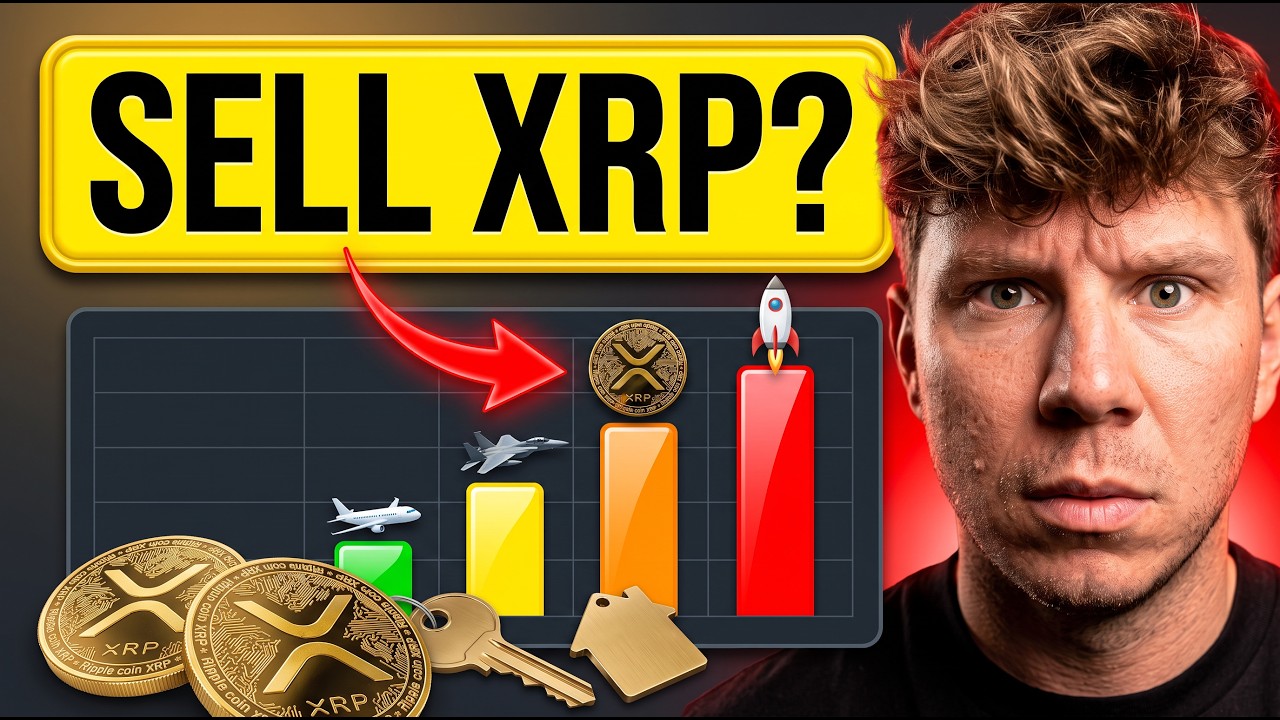
Saylor’s three planes are a rocket (Strategy’s ordinary shares), a fighter jet (Bitcoin) and a passenger jet (STRC). He was asked why someone would buy Strategy’s shares instead of a Bitcoin fund. He said each plane is a different way to reach a destination, depending on risk tolerance, volatility tolerance and time horizon.
Volatility measures how hard a price swings: the higher the number, the bigger the swings. Saylor gave a rough figure for each plane. The video does not say how he calculated them.
| Plane | What Saylor meant | Saylor’s volatility figure |
|---|---|---|
| Rocket | Strategy ordinary shares (MSTR) | About 80 |
| Fighter jet | Bitcoin | About 38 |
| Passenger jet | STRC preferred share | About 8 |
Saylor said those on the rocket will “pull a lot of Gs”. In other words, they should expect a rough ride.
Ripple and XRP did not come up in the interview, so the host ran a similar calculation using daily prices from the data firm Coin Metrics. That data runs from June 2025 to late May 2026, ending about five months before the interview. On that data, Bitcoin’s volatility came out at about 42 and XRP’s at about 68. By the video’s measure, XRP sits between the fighter jet and the rocket.
To show what that looks like, the video says XRP closed around $3.50 in July 2025 and around $1.23 in early February 2026, a fall of roughly 65%. That says nothing about what happens next. It does show the kind of swings XRP holders have lived through. Bullrunners has explained the break-even math after a 50% drop for readers who want to see how recovery percentages work.
How long should money stay put before it goes into a volatile coin?
Saylor said money needed back within about four months belongs somewhere stable. His words were: “If you need your money back, all of your principal back in the next four months, you probably just want to put it in a money market.” A money market fund is a low-risk place for cash that pays a little interest. He ended his plane answer with a similar question: “Do you need the money back next Tuesday?”
The video sums up the rest of his answer as a ladder:
- Under four months: a money market fund or similar stable holding.
- Four months to four years: something mostly steady.
- Four years or more: the fighter jet or the rocket becomes an option.
The video applies this to XRP. If an asset swings as hard as XRP has, it argues, money needed in the next few months probably should not be riding on it. That is not because XRP is bad. The timing of bills and the timing of prices rarely line up, and when they clash, the bill usually wins.
Why did Strategy sell Bitcoin?
Strategy sold Bitcoin because it had dividends to pay. In early July 2026, the company reported selling 3,558 Bitcoin for about $216 million to help fund those payments. The Schwab host said the sale had a big impact on the market over the summer.
Saylor said Strategy will generally be a net buyer of Bitcoin because its capital is growing, but it can sell to fund dividends and support its credit products when needed. The company has kept buying too. On October 19, Saylor posted that Strategy had bought back $193 million of its own STRC and bought 267 more Bitcoin, about $22 million worth, taking its total to 848,517 coins.
The video points to the shape of that spending: most of the money went to supporting the 12% product, and only a small slice went to new Bitcoin. Once a regular income is promised, the income comes first. For individual holders, the video says, the equivalent is rent, mortgages, school fees and repairs. If XRP is the only thing you can sell, you sell it on the day the bill arrives. Bullrunners’ article on a core and working pile approach looks at one way holders keep those pots apart.
What did Saylor say about the Clarity Act?
Saylor said he preferred “a bill of rights, not a bill of restrictions.” He described the Clarity Act as 630 pages, of which he estimated about 620 were restrictions. The Clarity Act is the bill in Congress meant to set out which regulators oversee which tokens and how exchanges are supervised. The Schwab host asked why Saylor seemed happy it had stalled.
In Saylor’s view, the rules the industry got came from regulators instead. He named the SEC for letting firms turn shares into tokens, the CFTC for crypto derivatives and prediction markets, and the Treasury for digital currency. He said this approach would carry on until 2029.
The video’s caution for XRP holders is that regulatory guidance can be changed by the next set of regulators, while a law is much harder to undo. A plan that depends on one bill passing may mean a long wait. Bullrunners has looked at how regulators are writing crypto rules while the Clarity Act is stalled.
The Tuesday test for your XRP
The video turns Saylor’s “next Tuesday” line into a simple exercise:
- Take a piece of paper and draw three boxes.
- In the first box, write any money you might need within four months: bills, the car, a booked holiday.
- In the second, write money you might need in four months to four years.
- In the third, write money you genuinely will not touch for four years or more.
- Check where your XRP sits. The video says any first-box money riding on XRP is the money most likely to be sold at the wrong moment. If XRP sits only in the third box, a 65% fall would hurt, but nothing would force a sale.
- For any income product, ask what is paying for it, whether it pays daily, monthly or yearly.
- Decide in advance what you would sell first, and when.
As the video notes, even the loudest holder in crypto sold some coins when the bills came due. The aim is to make that choice ahead of time, rather than let a bill make it for you.
What to watch next
Strategy shareholders approved daily dividends on October 28, so watch how and when Strategy starts paying them. Watch whether STRC trades near its $100 face value, and whether Strategy keeps buying Bitcoin or sells more to fund payments. On rules, track how far the SEC, CFTC and Treasury go while the Clarity Act is stalled. And check which of Saylor’s planes your own XRP is on, and whether it is the one you meant to board.
Frequently asked questions
What did Michael Saylor mean by 'not if you've got rent'?
According to the video, Saylor used rent and a mortgage to explain who Strategy's 12% income products are for: people who do not want to hold a volatile asset with no cash flow for a decade. He spoke on Schwab Network on October 19, 2026.
What is Saylor's rocket, fighter jet and passenger jet comparison?
Saylor described Strategy's MSTR shares as a rocket, Bitcoin as a fighter jet and the STRC preferred share as a passenger jet. On his figures their volatility is about 80, 38 and 8, and he said the right choice depends on risk tolerance and time horizon.
How volatile is XRP compared with Bitcoin?
Using Coin Metrics daily prices from June 2025 to late May 2026, the video calculated volatility of about 42 for Bitcoin and about 68 for XRP. On Saylor's scale, that puts XRP between the fighter jet and the rocket.
Why did Saylor say Strategy is 'never paying the money back'?
STRC is a perpetual preferred share, so there is no date when holders get their original money back. Holders collect dividends while they are paid, and the only way out is to sell the share to someone else at the market price.
Will Strategy pay dividends every day?
Strategy shareholders voted on October 28, 2026 to approve daily dividends on four preferred shares: STRF, STRC, STRK and STRD. Saylor said in the interview that these would be the first securities in the world to pay dividends every calendar day.
Full video transcript
From the video's captions, lightly formatted. Captions can mishear names and numbers, so check figures against the article above.
There's a pool of investors that want to buy that credit. They do not, you know, do you want to hold a volatile asset for a decade with no cash flow?
Not if you've got rent. Not if you've got a mortgage.
Rent and a mortgage. Now, those are two bills Michael Saylor reached for when he wanted to explain who his 12% income products is for. Saylor co-founded and chairs strategy and the company sitting on more Bitcoin than any other listed company. And he said that on Schwab Network on the 19th of October 2026. So, Michael Saylor says not if you've got rent.
And it's a test your coins must pass as well. Because if you own XRP, the same question applies to you. Could your coin sit through a bad year? Or would a bill land and make the decision for you? Now, in that same interview he set out what I'd call Saylor's rocket fighter jet or passenger jet test.
And it shows who gets forced to sell when things turn. Now, Saylor wants to pay every day, too. He asked his shareholders to let strategy pay dividends on every single day of the year. And then, later in the very same chat, he said, "We're not paying the money back." Now, don't worry. I'll explain exactly what he meant because it's not as scary as it sounds, but it does matter.
Now, the very first link in the description is one that I'll come back to in just a few minutes if you hold crypto but couldn't say, hand on heart, which part you might need back in a hurry, then the link is for you. All right, I'd guess plenty of us are in that spot. Now, we put money into crypto in one pot, the money for the long haul, and the money for a rainy day, maybe even money we'll need for a new car or a big birthday. And we mix it all together, and then the boiler goes, the car fails its test, we sell whatever price it happens to be that exact day that we need it. It doesn't matter if it's good or bad.
And we look at what Saylor's actually selling, his three planes, the time he had to sell, and what he really meant by never paying the money back. Then we'll get to what he thinks of the Clariact, and a quick check to do on your own XRP. So, but let's start with what he's selling, okay? Strategy doesn't just hold Bitcoin, it also sells something called preferred shares. Think of them as a cross between a share and a loan, right?
You hand over your money, and in return you get an income paid out regularly. That's called a dividend, and before the ordinary shareholders get anything. So, the best known one goes to the ticker STRC. That's strategy held its yearly rate at 12% for October 2026, and it'd been paying that out twice a month. Now, Saylor wants to go much further.
Check this out.
We've got a shareholder vote coming up, and if that vote goes as we expect, then all of our credit instruments will go to dividends every calendar day. Those will be the first securities in the world that pay dividends every calendar day. It's never been done before.
Strategy put that to a shareholder vote on the 28th of October 2026, covering four of its preferred shares, and Saylor was refreshingly blunt about part of the reason. Later, he said, and I'm quoting him, "People like the idea of being paid every day." He's right, we do, right? There's something lovely about watching a balance tick up every morning, but that feeling is exactly why we should slow down. How often you get paid tells you nothing about how safe the money is, and 12% paid daily is just 12% with exactly the same risk behind it. As always, guys, nothing I say in this is financial advice, okay?
I like to research, I like to give you the facts. So, like if you're bullish, let's get into the deep of this.
[music]
Let me keep my promise about that first link because it fits Saylor's rent and mortgage line perfectly. Now, I'm not going to tell you to buy any tokens on this video because there might be great opportunities for you that I don't know because I don't know your situation, but whatever you hold, every bit of the money you put into crypto should have a date on it. Now, when might you need it back? Within a few weeks, in a couple of years, or not for a decade? Well, most of us have never actually written that down.
Our Altcoin Pro course helps you put together a plan around exactly that. Which money goes where? How much of it sits in riskier coins and what you'll do if a bill turns up or about day for prices. Here's what to do. Go to the first link in the description and fill in a short form, then book your free 15-minute call, and one of the team will walk you through your own strategy and your own situation.
If you're watching this on your phone, guys, just tap more under the video, and it's the first link you'll see. Do it while the rent and mortgage line are fresh in your head, right? Because the next big bill gets to decide what happens to your coins. Then simply come back because Saylor's free plans are the most useful thing he said all interview. Saylor was asked why someone would buy his company shares instead of just buying a Bitcoin fund.
Well, he answered with a picture. Check this out.
So, the real issue is uh do you want to get on the rocket because that's a digital equity? Do you want to uh get on a fighter jet? That's probably Bitcoin. Yeah. Do you want to get on the passenger jet?
That's probably STRC. And they're all just different ways to get to your destination, depending upon your risk tolerance and your volatility tolerance. And of course, your time horizon makes a big difference. Do you need the money back next Tuesday?
So, the rocket is Strategies own ordinary shares, which trade under the ticker MSTR. The fighter jet is Bitcoin and the passenger jet is that 12% product. Now, he put numbers on it, too. Volatility is just a measure of how hard the price swings around. On his figures, his passenger jet swings about eight, Bitcoin about 38, and his rocket about 80.
And I like the honesty of the next bit. He said, "If you get on the rocket, you're going to pull a lot of Gs. In other words, it's a roller coaster and you'd better have the stomach for it." So, which plane is XRP? And to be clear, Ripple and XRP never came up anywhere in that interview. So, I ran a similar sum myself using daily prices from the data firm CoinMetrics from June 2025 to late May 2026.
Now, on that measure, Bitcoin swung about 42, a touch above his 38 because my data's different. XRP swung about 68. So, on Sailor's own scale, XRP is not the passenger jet. It's not even the fighter jet. It sits somewhere between the fighter jet and the rocket.
So, to give you a feel for what that looks like, XRP closed about $3.50 in July 2025 and by early February 2026, it had actually closed around $1.23. Now, that's a fall of roughly 65%, but none of that tells you what happens next. But, it does tell you what kind of ride you signed up for. And notice how he finished that answer, right? Do you need the money back next Tuesday?
Well, he'd made the same point earlier in plainer words.
If you need your money back, all of your principal back in the next four months, you probably just want to put it in a money market.
Right.
Cuz it's very stable. Now, if it's a safe thing, you know, next Tuesday, you'll get the cash that you put in today back.
That's from one of the biggest Bitcoin bulls there is. Money you might need in the next four months, he said, belongs somewhere boring and safe. And a money market fund is basically a very low-risk place for cash that pays a bit of interest. Then he went up the ladder, right? Four months to four years and you want something mostly steady.
Four years or more and you can think about the fighter a or the rocket. So, think about XRP with that in mind. If something swings as hard as XRP has, then money you'll need in the next few months probably shouldn't be riding on it. Not because XRP is bad, but because the timing of your bills and the timing of the price are never going to agree. And when they don't, it's usually the bill that wins.
A strategy found that out for themselves. For years, Saylor was the face of never selling your Bitcoin. Then in early July 2026, Strategy reported that it had sold about 3 and 1/2 thousand Bitcoin worth roughly 216 million dollars. That's to help pay dividends. In the Schwab interview, the host said the sale had a big impact on the market over the summer, and here's how Saylor explains the company's approach.
So, we will generally be a net buyer of BTC because our capital is expanding, but we also are able to sell it in order to fund our dividends and back our credit when we need to.
To be fair to him, Strategy has kept buying as well. Then on the 19th of October, Saylor posted that Strategy had bought back 193 million dollars of its own STRC and actually bought 267 more Bitcoin, taking it to 848,517 coins. But look at the shape of that. Most of that money went on supporting that 12% product, and only a small slice went on new Bitcoin. Now, once you promise people a regular income, the income comes first, and if the cash isn't there, then something gets sold.
Now, that's the lesson for the rest of us, and it's got nothing to do with being a billionaire, right? Strategy has dividends to pay, we've got rent, mortgages, school fees, and boilers. And if the bills come due, and the only thing you can sell is your XRP, then you'll sell it on the day the bill arrives. That's whatever the price. Now, the people you don't get forced to sell are usually the ones who kept the bill money somewhere else, which brings me to the line in the title.
Saylor was explaining how Strategy makes money from selling these income products, and he said this.
So, we sold a billion dollars of credit, Bitcoin appreciates 10% a year, the company made a billion dollars
Mhm.
of net income equivalent.
Okay.
We're never paying the money back.
That sounds alarming, right? And I know, but here's what he means. STRC is what's called a perpetual preferred share. Perpetual just means it has no end date, and a normal loan or bond has a day when you get your original money back. This doesn't.
You collect the dividend for as long as it's paid, and if you want your money out, then you sell the share to somebody else at whatever price the market gives you. Now, that price moves. Each share has a face value of $100 and Saylor said in the interview that strategy would suspend billions to bring it back to the level whenever it slips. But, over the summer, according to reports at the time, it fell below $80. So, the passenger jet hit some turbulence, too.
The day after the interview, strategy's own account put a very confident post out. It said its dividends can hold up even if Bitcoin went nowhere for 49 years, and that Bitcoin grows just over 2% a year, its dividends are covered forever. That's their claim, and it rests on their own sums about Bitcoin. Now, maybe it's right, but notice what's underneath the steady 12%. It's the fighter jet, right?
The steady income is only as steady as the thing paying for it, and that's worth carrying across to XRP. XRP itself doesn't pay you anything for just holding it. So, when someone offers you a yield on your XRP, the first question isn't how much, it's where the money comes from, and whether you can get your coins back when you want them. Now, there was one more moment XRP holders should hear because it's about the rules, and a lot of people in crypto were counting on the Clarity Act, the big bill in Congress meant to set out which regulators look after which tokens and how the exchanges you use are supervised. The host asked why Saylor seemed happy it had stalled.
If you're a capitalist, if you want to create a great economy or a great nation, what you want is a bill of rights, not a bill of restrictions. The founding fathers said we had rights, and and the Bill of Rights isn't very long, by the way. You can read it. It's on a couple It fits on a couple of pages.
Mhm.
The Clarity Act was 630 pages, and it was a bill of restrictions. It was 630 pages, of which probably 620 pages were restrictions.
So, in Saylor's view, the rules the industry actually got came from the regulators instead. He named the SEC for letting firms turn shares into tokens, the CFTC for crypto derivatives and prediction markets, and the Treasury for digital currency. He actually said that the approach would carry on until 2029. Whether you agree with him or not, right, that's worth knowing as XRP holder. Guidance from a regulatory can be changed by the next set of regulators.
A law is much harder to undo, right? So, if your whole plan for XRP was waiting for one bill to pass, then Saylor's answer is a reminder that you might be waiting a while. And a plan built on a headline is not really a plan. So, what's the takeaway for XRP holders from the man whose company held about 840,000 Bitcoin in the middle of October. Well, I'll boil it down to one test and I'm calling it the Tuesday test after his own line.
Get a piece of paper, draw three boxes. In the first box, write down any money you might need in the four months. Now, bills, the car, the holiday you've booked. In the second, money you might need in four months to four years. In the third, money you genuinely won't touch for four years or more.
Then look at where your XRP sits. If any of that money in the first box is riding XRP, then that's the money most likely to get sold at the wrong moment. lives only in the third box, a 65% would hurt, but you're not forced to do anything about it. Next, remember that regular income isn't the same as a safe one. Daily, monthly, or yearly, ask what's paying for it. And finally, even the loudest holder in the crypto sold some coins when the bills came due and there's no shame in it.
Just make sure you decide in advance what you'd sell first and when. Now, here's my question for you. Which of Sedlar's planes is your XRP on? The passenger jet, the fighter jet, or the rocket? And to be honest, is it the one you meant to board?
Tell me in the comments and if you'd like the calm second opinion every time a billionaire talks about your money, all you got to do is hit subscribe. As always, guys, stay bullish. Oh.
[music]
Education and commentary only, not financial advice. Crypto is volatile and you can lose money. Do your own research and speak to a qualified advisor before making investment decisions. Figures and quotes are as reported in the video on October 30, 2026 and may have changed since.


